



Listen to the article
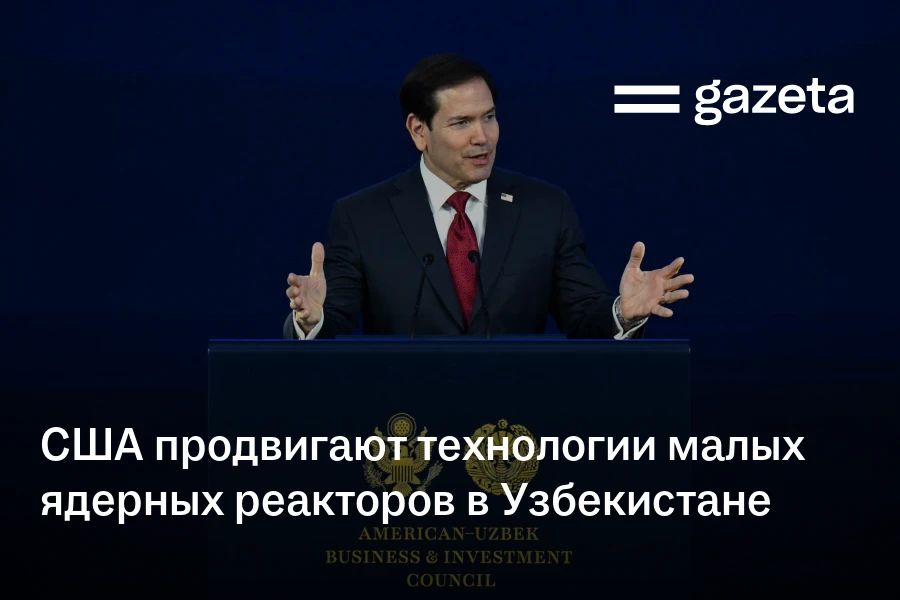
U.S. Secretary of State Marco Rubio told a joint American-Uzbek business and investment council in Samarkand on 19 October that Washington is actively working to deploy American small modular reactors (SMRs) in Uzbekistan and to modernise the country’s electricity grids and gas distribution networks — framing both as direct responses to Uzbekistan’s rapidly growing energy demand.
“We are deploying American small modular reactors and modernising Uzbekistan’s electricity and gas distribution systems, thereby helping the government manage rapidly growing energy demand,” Rubio said at the session, which was attended by President Shavkat Mirziyoyev.
Rubio did not identify which specific SMR projects are under discussion, which American companies are involved, or how far negotiations have advanced. The omission matters: a factual dispute over Uzbekistan’s commitments has already surfaced. When the U.S. State Department published a summary of agreements reached during Mirziyoyev’s November 2025 Washington visit with President Donald Trump, it listed an Uzbek obligation to purchase SMRs from American energy companies. Uzbekistan’s atomic energy agency, Uzatom, publicly denied that any such obligation exists.
Uzbek Interest, Unresolved Commitments
Uzatom director Azim Akhmедkhajayev said in November 2025 that Uzbekistan was prepared to study American SMR technologies, describing them as being “at the cutting edge of global nuclear energy.” He specifically named Holtec, GE Hitachi and NuScale as companies whose certified designs Tashkent had expressed interest in exploring, following Mirziyoyev’s Washington trip. Akhmедkhajayev framed the interest as part of a broader strategy to diversify the country’s nuclear partnerships and technology base — not as a binding procurement commitment.
The gap between the State Department’s characterisation and Uzatom’s denial remains unresolved, and Rubio’s remarks at the Samarkand council did not address it directly.
Minerals, Quantum Technology and a Kentucky Factory
Beyond nuclear energy, Rubio outlined a wider economic agenda. On critical minerals, he said the United States is working to strengthen its own supply-chain security while helping Uzbekistan upgrade its extraction and processing capabilities — citing a partnership with the Colorado School of Mines as one vehicle for that cooperation.
In science and technology, Rubio pointed to a partnership between the University of Texas at Dallas and the Samarkand Quantum Centre as an example of bilateral collaboration in quantum technologies. He also said the U.S. is supporting digital entrepreneurs at Tashkent’s IT Park by providing application developers with access to American chips and AI models — though Rubio noted, with evident amusement, that a Trump executive order now requires the administration to use the term “superintelligence” rather than “artificial intelligence.”
In aviation, Rubio recalled that Boeing sold Uzbekistan Airways 22 wide-body 787 Dreamliner aircraft in the previous year alone, with GE Aerospace supplying engines and components and providing specialist training.
The secretary of state also announced what he described as a historic first: Uzbekistan’s AKFA Group is investing $80 million in Bowling Green, Kentucky, committing to a long-term industrial presence and a contribution to the American aluminium industry. Rubio presented the investment as evidence that the economic relationship now runs in both directions.
Rubio’s Samarkand visit on 19 October also included talks with Mirziyoyev and a C5+1 meeting with the foreign ministers of all five Central Asian states. At those sessions he raised the prospect of multi-billion-dollar agreements across the region, with critical minerals, the Trans-Caspian transport corridor and technology-sector workforce training among the stated priorities. At the business council, both Mirziyoyev and his administration chief Saida Mirziyoyeva pledged transparent and predictable conditions for American investors. Rubio separately said the U.S. administration supports repealing the Jackson-Vanik amendment as it applies to Uzbekistan, though he noted the final decision rests with Congress.