


Listen to the article
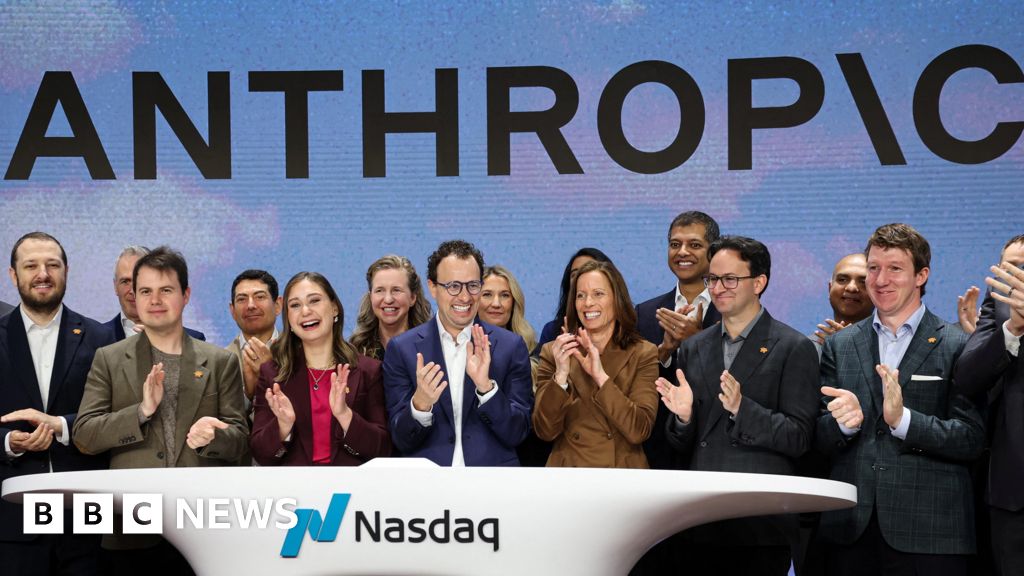
Anthropic, the artificial intelligence company behind the Claude chatbot, made its stock market debut on the Nasdaq on Thursday, closing at $97.17 per share — roughly 17% above its allocation price of $83 — and ending the day with a valuation of approximately $1.76 trillion.
The opening hours were more dramatic. Shares surged immediately to $111.53, briefly pushing the company’s market capitalisation close to $2 trillion, before retreating through the afternoon. The arc of a single trading session captured the broader tension surrounding AI investment: enormous appetite, but genuine uncertainty about what the technology is ultimately worth.
Anthropic’s listing is the first by a company whose entire business is built around artificial intelligence, making it an industry-wide test case. The company was founded five years ago and has risen faster from start-up to public listing than almost any technology firm in history.
A market without a clear peer
Analysts struggled to find a useful benchmark. “There’s no obvious peer to compare it to,” said Neil Wilson, an investor strategist at Saxo UK. Asked whether Anthropic is genuinely worth more than $1.7 trillion, Wilson was candid: “We’ll have a stab at it. I don’t think anyone really knows.”
Ben Barringer, who leads technology research at Quilter Cheviot, predicted that the “initial exuberance” would fade, pointing to what happened with SpaceX earlier this year. That company saw its shares jump roughly 10% on its first day of trading, reaching a record valuation of $2.2 trillion, only to fall below its debut price within a month and continue declining.
The broader market offered little support on Thursday. The Nasdaq Composite Index closed down nearly 2.3%. Alphabet, Google’s parent company, fell 2.9%, while Amazon lost almost 3.9%.
The bubble question
Anthropic’s IPO arrives at a moment of acute scrutiny over AI spending. More than $1 trillion has been invested in AI infrastructure by a handful of major technology companies over the past year alone, fuelling persistent concerns about a financial bubble. Richard Whittle, an economist at the University of Salford, offered a measured note of caution. “Bubbles don’t burst on the day of the largest deal,” he said. “They burst later, if the positive future becomes suspect.”
Most technology companies see their share prices fall after their initial listing, often following the first quarterly earnings report. Yet several that followed that pattern — Meta, Amazon and Google among them — went on to become the most profitable corporations in the world.
Safety claims and regulatory headwinds
Anthropic has consistently positioned itself as an AI developer that takes the risks of its own technology seriously. Daniela Amodei, the company’s president and sister of co-founder and chief executive Dario Amodei, said on Thursday that Anthropic “had an AI safety team before we launched our first product.” Dario Amodei has publicly warned that future AI systems could become capable enough to outsmart humans, with extinction among the possible consequences — a striking posture for a company simultaneously racing to build and commercialise those same systems.
The regulatory environment in the United States remains unsettled. President Donald Trump, speaking at the Asia-Pacific Economic Cooperation summit in China on Thursday alongside Chinese President Xi Jinping and Russian President Vladimir Putin, reiterated his opposition to “any form of robust regulation” around AI, adding, “we won’t allow that to happen, frankly.” On the same day, however, a bipartisan group of US lawmakers announced the formation of the House AI Safety and Innovation Caucus, which will focus specifically on AI regulation and safety. Democrats are expected to hold significantly more positions of power from 2027, and several have already signalled interest in imposing guardrails on AI tools.
How Anthropic navigates that shifting political landscape — while continuing to spend heavily on research and infrastructure — will be among the central questions investors watch in the months ahead.