


Listen to the article
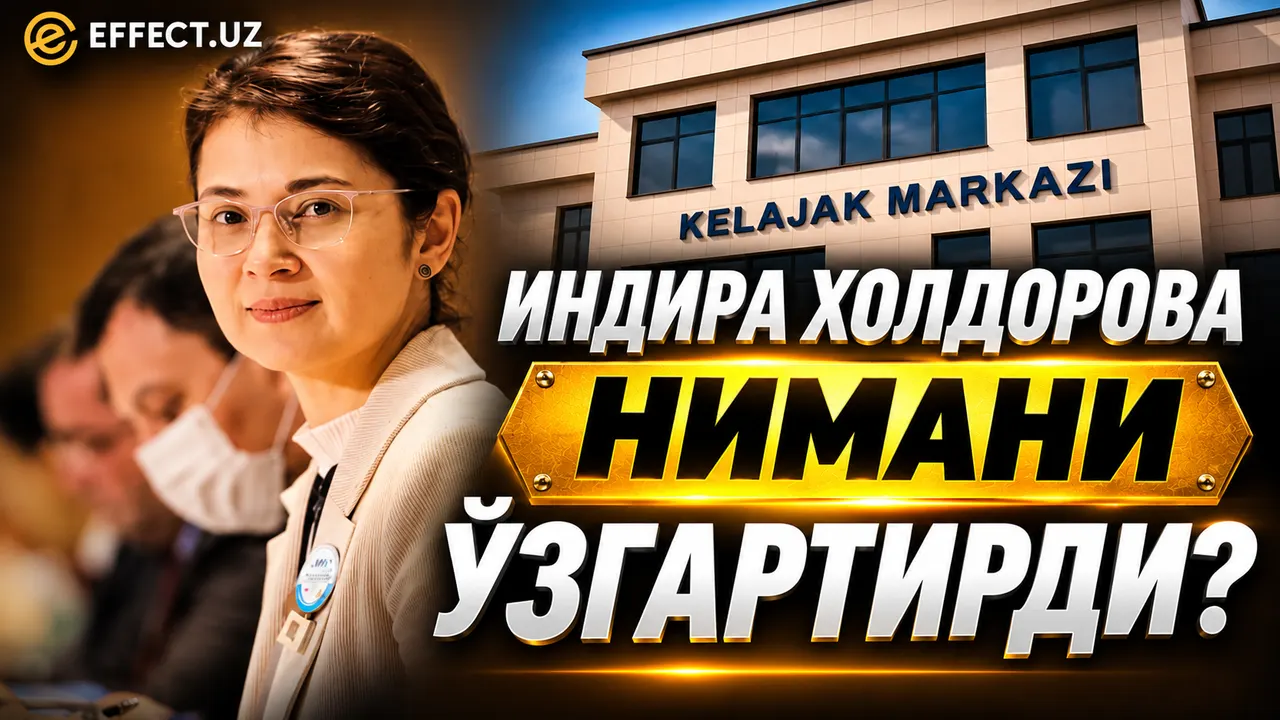
Documents obtained from Samarkand region and published by Effect.uz raise pointed questions about the financial and legal conduct of Uzbekistan’s new network of Kelajak extracurricular education centres — and call on the network’s national director, Indira Xoldorova, to answer them publicly.
The figures at the heart of the inquiry are stark. Enrolment across Samarkand region’s Kelajak centres stood at 48,134 pupils in December 2025. By September 2026 it had fallen to 18,702 — a drop of 29,432 children, or roughly 61 per cent. In January 2026 alone, the regional roll fell by 10,384 in a single month.
The collapse was not evenly spread. In Samarkand city, enrolment fell from 5,170 to 582. Urgut district went from 4,360 to 940; Pastdargom from 4,120 to 1,362; Pastacha from 3,040 to 620; Ishtixon from 2,270 to 600; Kattaqorgon from 3,800 to 1,830; and Narpay from 3,300 to 1,424. In several districts the roll shrank to between one-seventh and one-eighth of its earlier level.
A 10% Levy and a Legal Timeline That Does Not Align
The Kelajak network was established under Presidential Resolution PQ-277, signed on 8 September 2025, which converted the existing Barkamol Avlod children’s schools into regional and district-level Kelajak centres. The same resolution provided that ten per cent of parental fee income collected by the centres would flow into a Republic-level Kelajak support fund, to be spent on equipment, computers, building repairs and infrastructure.
A letter sent to Samarkand region’s Kelajak centres requested data on parental fee income from 1 October 2025 to 1 March 2026. The attached table shows that total parental fees collected across Samarkand region in that period amounted to 21 billion 305 million 36 thousand 322 soums. Ten per cent of that sum — approximately 2.13 billion soums — was recorded as the amount due to the Republic support fund.
The legal difficulty, as Effect.uz sets out, is one of timing. The Cabinet of Ministers resolution that formally detailed how the centres would operate, how the support fund would be constituted, and how parental fees would be used — Resolution No. 776, dated 10 December 2025 — did not take effect until after the period from which the ten-per-cent levy was being calculated. Parental fee rates set under that resolution were introduced from 1 January 2026. Yet the levy calculation runs from 1 October 2025, when the centres were still legally operating as Barkamol Avlod schools.
The question that follows is direct: what was the legal basis for treating fees collected between 1 October and 31 December 2025 — before the governing Cabinet resolution existed — as income subject to the Kelajak fund’s ten-per-cent claim? And into which legal entity’s bank account did those fees actually flow during that quarter?
Staff Costs Add a Further Inconsistency
Available information indicates that staff who had worked at Barkamol Avlod schools began having their salaries calculated under Kelajak centre pay scales from January 2026. If that is confirmed by official orders, staffing tables and payroll records, it creates a further asymmetry: expenditure obligations were treated as beginning in January 2026, while revenue obligations — the ten-per-cent levy — were backdated to October 2025. Effect.uz argues that a consistent legal approach would require both income and expenditure to be attributed to the same starting date.
The fund’s transparency is also questioned. The documents do not show how much money has been transferred to the Republic fund in practice, how much has been redistributed to regional centres, which centres received allocations, or who is monitoring whether the money is being spent on its stated purposes. The publication argues that parents paying fees for their children’s education have a legitimate right to know where every soum goes.
Questions for Xoldorova and the Education Ministry
Effect.uz directs ten specific questions to Indira Xoldorova, director of the Republic Kelajak Centre, and to Education and Science Minister Erkin Turdimov. They include: the legal status of fees collected before Resolution 776 took effect; whether the 2.13 billion soums calculated for Samarkand has actually been transferred; whether the methodology for counting enrolled pupils was the same in 2025 and 2026; and what the national enrolment figures look like across all regions, including Karakalpakstan and Tashkent city.
That last point matters because Samarkand is only one of Uzbekistan’s fourteen regions. If a comparable enrolment decline has occurred nationally, the aggregate fall in children reached by the extracurricular system would be far larger than the Samarkand figures alone suggest — and would sit in direct tension with the presidential decree’s stated goal of broadening children’s access to out-of-school education and maintaining a systematic database of enrolment.
The Kelajak programme was presented as a step forward: more children in organised after-school activities, better facilities, a cleaner financial structure. The Samarkand data, if it reflects a genuine and consistent decline rather than a change in counting method, suggests the transition has so far moved in the opposite direction. Whether that reflects families leaving because fees rose, administrative disruption during the restructuring, a reclassification of what counts as enrolment, or some combination of all three, remains unanswered — and, the publication argues, unanswered by the officials responsible for the system.