



Listen to the article
Javohir Sindarov and Dommaraju Gukesh met the press in Geneva on 25 November after their second game in the World Chess Championship match ended in a draw, leaving the score at 1–1 after two of the scheduled fourteen classical games. Both players addressed questions about opening preparation, decision-making at the board and the mental routines that surround a match of this scale.
Gukesh, the reigning world champion, explained that his choice of the London System had been intended as a modest surprise at an early stage of the match. “I thought the London System would be a small surprise at the start of the match,” he said. “But credit to my opponent — he was prepared, he knew what to do, even despite the unexpectedness.” He added that the opening carries a degree of nostalgia for him, having used it frequently several years ago, including during the coronavirus pandemic.
Sindarov confirmed he had not anticipated the London System from Gukesh but said he had studied it during preparation. “It was not a big surprise for me, since it is a perfectly playable option,” the Uzbek grandmaster said. He also confirmed that his seventh-move queen manoeuvre to b6 — which drew attention from commentators — had been part of his home preparation. Gukesh acknowledged familiarity with the line but said he could not fully recall his own analysis of that position during the game.
Why Gukesh agreed to a draw with pieces still on the board
A journalist asked Gukesh why he had accepted a draw when material remained on the board and his opponent might still have erred. The champion was direct: “In this specific position it was very hard for me to see a way to create any serious problems for my opponent. And if I try something, I also take on some risk.” He noted that continuing would have required accounting for his own potential mistakes, not only his opponent’s. “Maybe if I could have made the c4 move work I would have continued playing, but I just didn’t see how to do it,” he said.
Sindarov observed that Gukesh had roughly 45 minutes remaining for the next 20 moves at the point the draw was agreed, which might have created difficulties had play continued. He assessed the position as solid for both sides with limited scope for either player to alter the character of the game.
Asked by a journalist from The Indian Express whether he would have preferred at least one win from the first two games, Gukesh replied: “I would prefer both games to end in my favour.” He was quick to add that it was too early to draw conclusions. “This is a 14-game match and only two games have been completed. So it is still too early to think about the score or where I would like to be,” he said.
‘I am not just resting there’
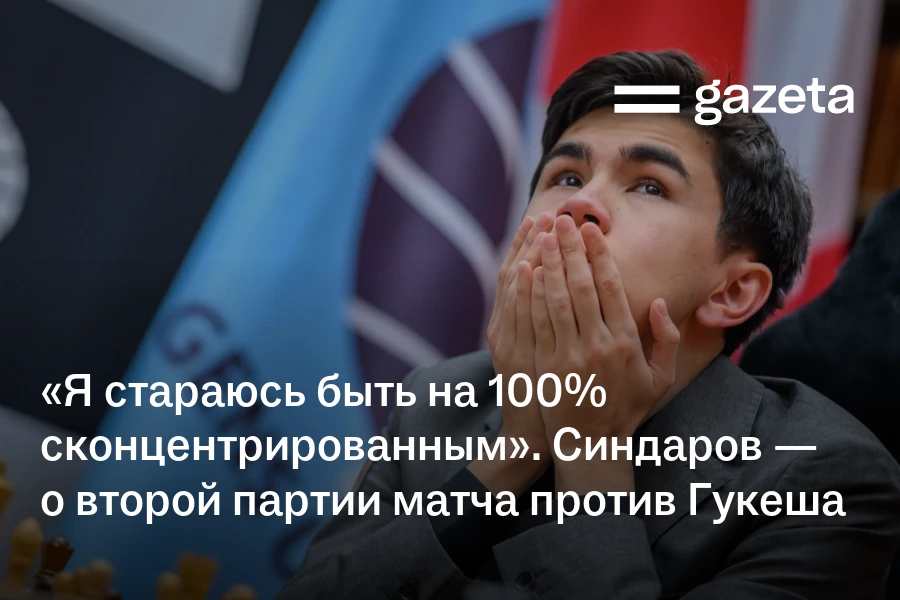
Television footage of the second game showed Sindarov yawning at the board, prompting a fan to submit a question through the organisers asking whether he was sleeping enough and whether late-night preparation sessions were taking a toll. Sindarov was relaxed in his response. “When my opponent is thinking, I just try to relax a little. I am not just sleeping there — I am thinking about moves, but at the same time I try to relax a little. I slept very well,” he said.
Pressed on whether he had been bored, he rejected the suggestion. “I try to be 100% concentrated. But when he thinks for a long time, especially in such positions, it is impossible to calculate long variations. So I just try to understand what possible ideas and moves he has. I always stay concentrated. The fact that I am sitting there does not mean I am just resting,” Sindarov said.
Card games at midnight and conversations about life
A ChessBase India journalist noted that before the second game, unlike the first, Sindarov had paused briefly at the entrance to the playing hall to speak with his second, Nikita Vityugov. Asked whether the exchange covered opening variations, Sindarov said the conversations before games tend to focus elsewhere. “In general we talk not about variations but about some psychological moments. Sometimes not even about chess, about other things. Just to relax before the game and not to be nervous,” he explained.
Sindarov also described his relationship with coach Roman Vidonyak, who has said his primary role during the match is psychological support. “We are just trying to adapt, to understand the level of this match and everything else, because we have never felt such energy before. Usually we just talk about how things are going, discuss psychological moments,” Sindarov said. He added that the conversations frequently move away from chess entirely. “Sometimes we don’t talk about chess at all, we just talk about life. At the end of the day, maybe at midnight, we can play cards or some small games. In general we just spend time together and talk a lot.”
Commentators: ‘The opening battle will now start to sharpen’
FIDE commentators Peter Svidler and Peter Leko offered analysis of the cautious opening to the match. Svidler suggested Gukesh’s choice of the London System may have served as a reconnaissance exercise. “They are still exploring the territory, trying to understand what and where the opponent is planning. I think the choice of the London System today was one of those scouting steps by Gukesh’s team. It gave him nothing on the board, but he definitely got some information in return,” the Russian grandmaster said.
Leko argued that the London System rewards experience above all, citing American grandmaster Gata Kamsky as an example of a player who has built deep intuition in the line. He suggested Gukesh felt uncomfortable precisely because he lacked that accumulated feel for the resulting positions. Leko also speculated that Gukesh had not wanted the draw. “You don’t get the feeling that Gukesh feels a little guilty? He is not happy at all. It’s not that he went for a draw because he wanted a draw. He didn’t want it, he wanted to fight,” the Hungarian grandmaster said.
Svidler noted that the early repetition was unusual for players of this generation. “Chess players of this generation usually don’t finish games in draws in positions where the possibilities for play have not been fully exhausted. But a world championship match obviously makes them adjust not only their opening preparation but their playing style,” he said.
Looking ahead, Leko argued that both teams had gathered useful intelligence from the first two games. Gukesh’s team now knows Sindarov is prepared to enter endgames via the Spanish — something Leko described as unexpected given Sindarov’s more frequent use of the Italian. Sindarov’s team, meanwhile, knows Gukesh is ready to play the Berlin Defence. “I think the opening battle in the match will now start to sharpen,” Leko said. Svidler added that Sindarov had significantly expanded his use of 1.d4 during 2026, pointing to a key win over Fabiano Caruana at the Candidates Tournament as evidence of his growing range.
The third game is scheduled for 26 November at 19:00 Tashkent time, with Sindarov playing the white pieces. A rest day follows on 27 November. A player needs 7.5 points to claim the world title; if the fourteen classical games end level at 7–7, a tiebreak will decide the champion.