



Listen to the article
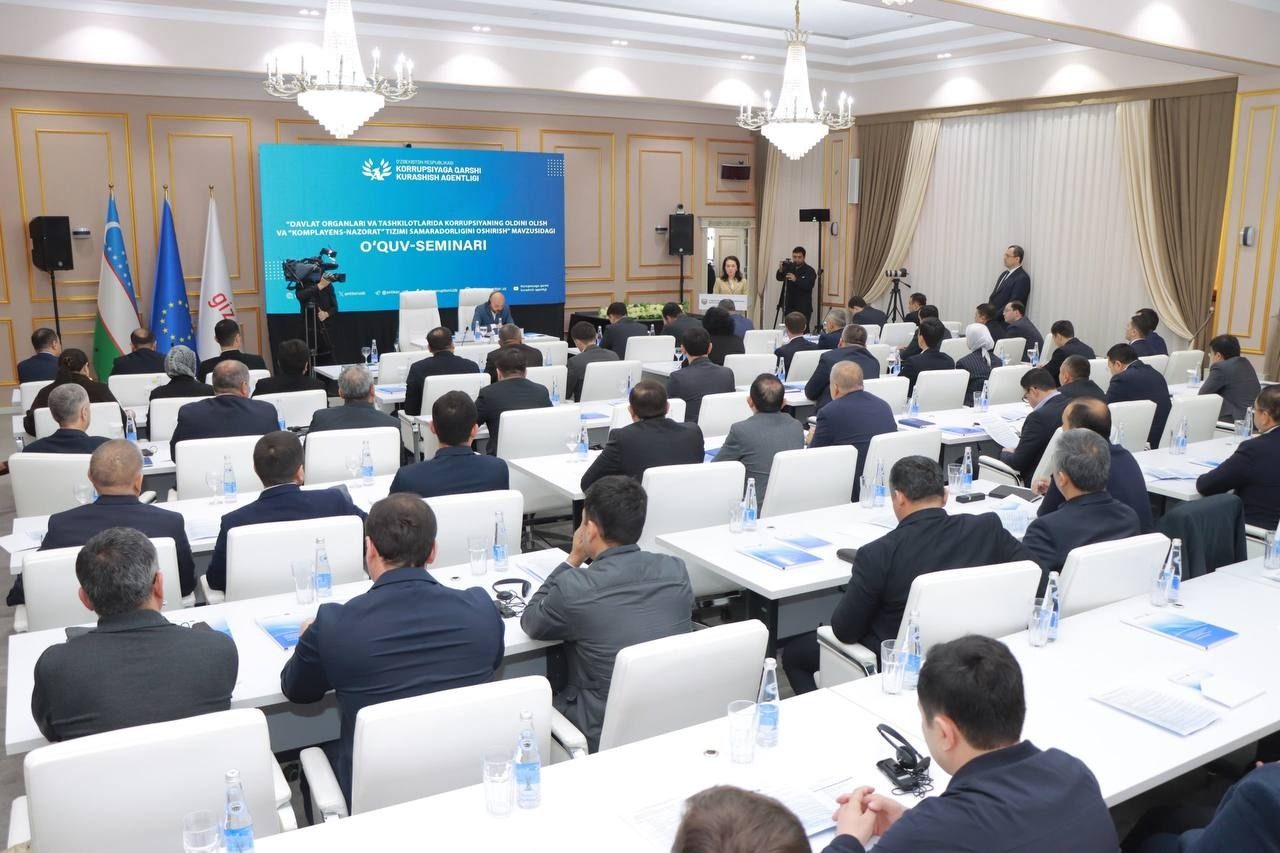
Uzbekistan’s Anti-Corruption Agency has convened a training seminar for staff of internal compliance and oversight units across state bodies, co-organised with the European Union Delegation in Uzbekistan and the German development agency GIZ. The session focused on raising the professional capacity of compliance officers and on the latest institutional reforms shaping the country’s anti-corruption architecture through 2030.
The seminar is part of a series the Agency runs with international partners to strengthen the knowledge and practical skills of internal control staff. Participants exchanged views with domestic and foreign experts on rating anti-corruption effectiveness, identifying and reducing corruption risks, managing conflicts of interest, preventing corruption in public procurement, and conducting anti-corruption reviews of regulatory documents.
A System That Has Grown Sharply Since 2021
The internal compliance network has expanded considerably in recent years. In 2021, such units operated in 91 organisations; they now cover more than 230 state bodies and organisations, staffed by more than 1,700 specialists. To reinforce their independence, the units have been placed under the direct authority of the head of each organisation and made accountable to the Anti-Corruption Agency rather than to line management below the top.
A new deputy-head post responsible for compliance and internal oversight has been introduced at the governance level within organisations. Holders of that post have been granted significant powers, including the authority to temporarily relieve an organisation’s head of duties — a notable shift in the balance of internal accountability.
A system of professional development, internships and attestation for internal control staff has been put in place; attestation processes began in September of the current year. Professional standards for compliance specialists are also being developed and introduced into practice.
Digital Platform and New Institutional Structures
A Risk Analysis Centre has been established to identify corruption risks before decisions are taken. Its principal digital instrument is the Digital Compliance information software complex, currently operating in pilot mode. The platform is designed to integrate the information systems of state bodies, digitalise internal anti-corruption control processes, and automatically detect affiliation relationships in public procurement.
An Anti-Corruption Prevention Cluster has also been introduced, bringing together state bodies, law-enforcement and supervisory agencies, academic institutions, internal control units and civil-society organisations. A phased rollout of a National Anti-Corruption Management Certification System across state bodies and organisations is planned by 2030.
This year’s legal and organisational measures have included a revised Model Statute governing how internal control units are organised, their tasks and functions, rights and obligations, and the procedure for agreeing on the appointment and dismissal of their staff. Guidelines on anti-corruption expert review of major investment projects and assessment of their effect on the competitive environment now explicitly provide for the participation of compliance units in those processes. A presidential decree has also assigned to internal anti-corruption units the authority to assess whether contacts between civil servants and business entities are justified or unjustified.
The seminar did not confine itself to achievements. Problems and shortcomings in the work of internal control units in certain state bodies were discussed critically, and tasks were set for eliminating those gaps, raising the accountability of internal control structures, and strengthening preventive work.