


Listen to the article
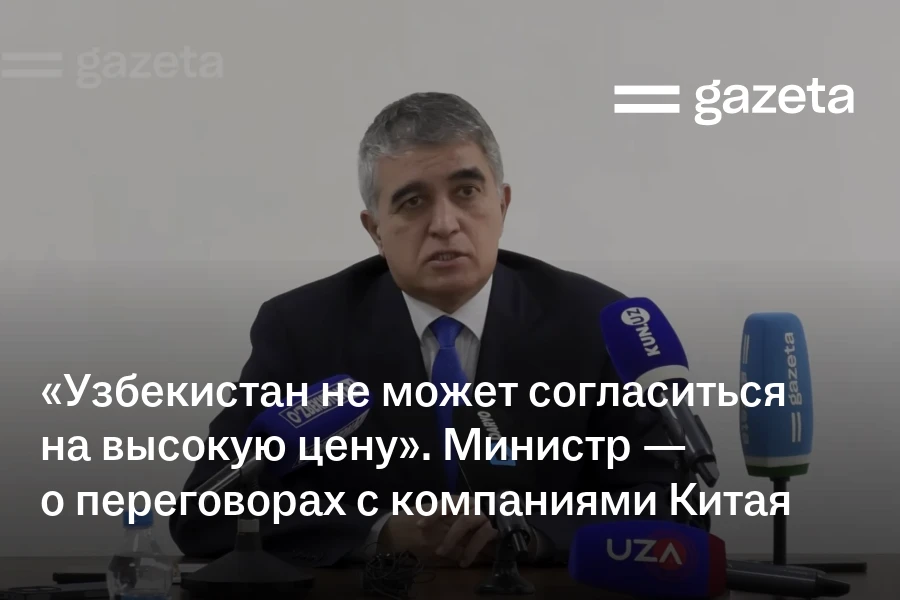
Uzbekistan’s Water Resources Minister Shavkat Khamrayev used a press conference on 19 November to draw a firm line under more than a year of stalled contract talks with Chinese construction firms: the government will not accept inflated prices simply because the financing comes from China. The statement came days after his appearance before parliament, where a deputy had pressed him on why $130 million earmarked for 2026 irrigation projects remained unspent.
“We cannot agree to a high price just because China is providing the money from its own investment funds,” Khamrayev said. “We are thinking about the interests of Uzbekistan.”
A Tied Credit, a Short List of Bidders
The minister explained the structural reason prices have been hard to bring down. China’s financing takes the form of a tied credit — a concessional loan from the Export-Import Bank of China that restricts the pool of eligible contractors to a handful of state-designated Chinese companies. “They say: here are four or five companies, choose among them,” Khamrayev said. Bidders then submit their own technical specifications, including unit costs for concrete and other materials, and those figures have come in well above Uzbekistan’s own feasibility estimates.
The projects in question cover irrigation infrastructure reconstruction across Surkhandarya, Qashqadarya, Bukhara and Namangan regions, authorised under Presidential Decree PP-409 of 29 November 2024. That decree set a preliminary combined value of $220 million: $160 million for the three-region package and $60 million for Qashqadarya alone, with CITIC Construction named as the intended lead contractor and China CAMC Engineering as a co-contractor for the Qashqadarya component.
CITIC Construction won the subsequent tender but quoted a price roughly 20 percent above the approved ceiling. Negotiations broke down, and talks shifted to Sinohydro, which had placed second. Those discussions are still live: Khamrayev confirmed that a session with Sinohydro took place on 19 November itself, and that the company has asked for time until 1 December to respond. He declined to disclose the figure Uzbekistan is willing to pay, saying the number would be published after the tender closes.
Diplomatic Noise, Clarified
Earlier in the press conference Khamrayev said he had received calls from the Chinese embassy and another organisation following media coverage of the failed negotiations. He then walked the claim back when a journalist pressed for detail. “The Chinese embassy did not call me. They did not call me personally. They are conducting dialogue with our relevant organisations,” he said. The clarification matters because initial reports had suggested direct diplomatic pressure on the minister.
Khamrayev was also at pains to separate the current pricing dispute from Uzbekistan’s broader record with Chinese contractors. Over 22 years in the sector, he said, he had overseen more than 15 major projects with Chinese partners worth a combined sum he estimated at over $1 billion, and described the results as consistently strong. As a benchmark he cited a land-reclamation project in southern Karakalpakstan completed before 2010: the tender estimate was $48 million, a Chinese company won at $33 million and delivered the work for $31 million, while Russian and Turkish competitors had quoted $48–54 million. That project covered roughly 100,000 hectares across the Turtkul, Ellikqala and Beruniy districts and replaced two pumping stations — Qizilqum and Beruniy — that had been discharging contaminated groundwater into the Amu Darya.
p>The minister also pointed to a practical reason for the current cost gap: foreign contractors must import equipment and locate their own sources of sand and gravel because they are unfamiliar with local quarries. Uzbekistan, he suggested, could help reduce costs by identifying nearby extraction sites and preparing construction sites — a form of in-kind contribution that could bring both sides closer to an agreed price. “If we jointly create conditions to do the work at this price, both we and they will win,” he said.
Khamrayev told parliament on 11 November that canal-lining work would be completed in 2027–2028 within the approved budget. He gave no revised start date at the press conference, and the gap between the $220 million authorised under the presidential decree and the $130 million in unspent 2026 allocations cited by the deputy who raised the issue in parliament was not formally reconciled in his remarks.