



Listen to the article
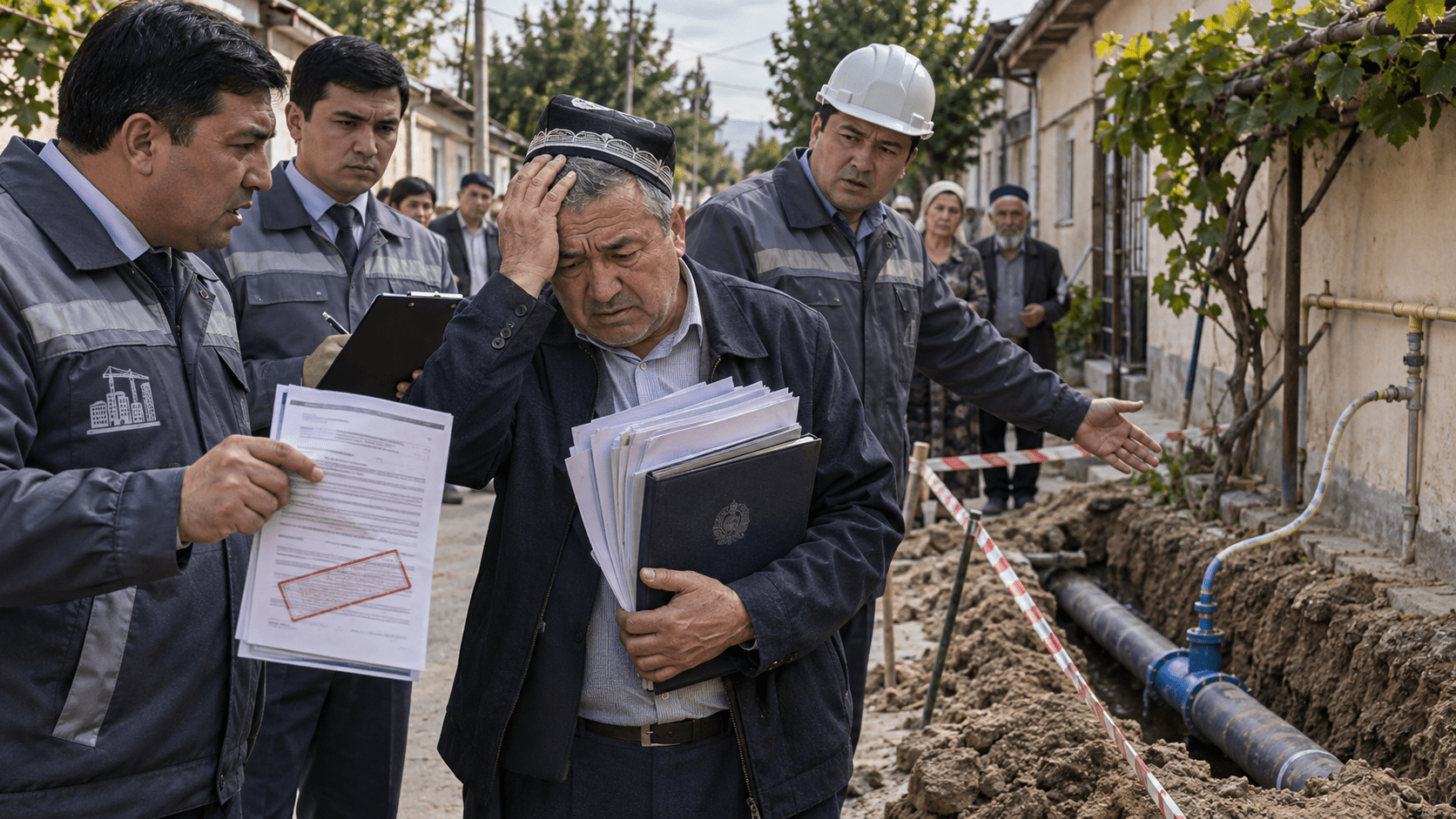
Officials from the Tashkent regional directorate of the Construction and Housing-Communal Services Inspectorate have been drawing up administrative citations against neighbourhood council (mahalla) chiefs across the region, charging each of them with unauthorised connection to water-supply networks under Article 163 of the Code of Administrative Offences and imposing fines of 6.6 million soums per case. In every instance brought before the courts that Kun.uz examined, judges annulled the fines and closed the proceedings.
The pattern came to light after the editorial office received a complaint from a mahalla chief contesting a decision issued by the inspectorate’s Tashkent regional directorate. Reporters then reviewed a series of similar cases heard at the Sredne-Chirchiq district court for administrative matters.
What the Mahalla Chiefs Said in Court
The chief of the Burgalik neighbourhood council in Sredne-Chirchiq district told the court in a written complaint that in November 2025 employees of a water-supply company had come to the mahalla building, shut a tap and sealed it. The tap was located in a garden outside the building. He noted that inspectors had visited during his predecessor’s tenure as well, but had left without taking action after the former chief refused to cooperate. About a year later, inspectorate staff returned, drew up a report and imposed the 6.6-million-soum fine despite his insistence that he had no connection to the alleged violation. He asked the court to annul what he described as an unlawful citation and decision.
Judge Norqobilov, examining the case, found that the inspectorate’s penalty decision had been formalised on the basis of suspicion and conjecture rather than established fact. The decision was annulled and the administrative case against the chief was closed.
The chief of the Uyghur neighbourhood council faced an identical situation. In his court complaint he stated that neither the mahalla building nor the water pipe connected to it had been formally commissioned for use, that the water network running to the mahalla remained unfinished, that he did not use the water from it, and that the accusation had no bearing on him whatsoever. The court concluded that there was not a single piece of evidence in the case file confirming that anyone had independently installed or used a water connection, and annulled that fine as well, closing the administrative proceedings.
A Pattern Across the District
Kun.uz found that several other mahalla chiefs in Sredne-Chirchiq district had been subjected to the same treatment. In each of those cases, too, the court overturned the inspectorate’s administrative fine decisions.
The cumulative picture, as described in the complaints and court rulings, is of a regional inspectorate directorate that had developed what the outlet characterises as a peculiar practice: visiting any mahalla, regardless of whether a violation existed, drawing up a citation for unauthorised water-network connection against the chief, and levying the 6.6-million-soum penalty. Neighbourhood chiefs — already occupied with the full range of community administrative duties — were left with the choice of paying a fine for something they denied doing or pursuing the matter through successive court hearings. In the cases reviewed, those who went to court prevailed.
The inspectorate’s Tashkent regional directorate had not publicly responded to the findings at the time of publication.