



Listen to the article
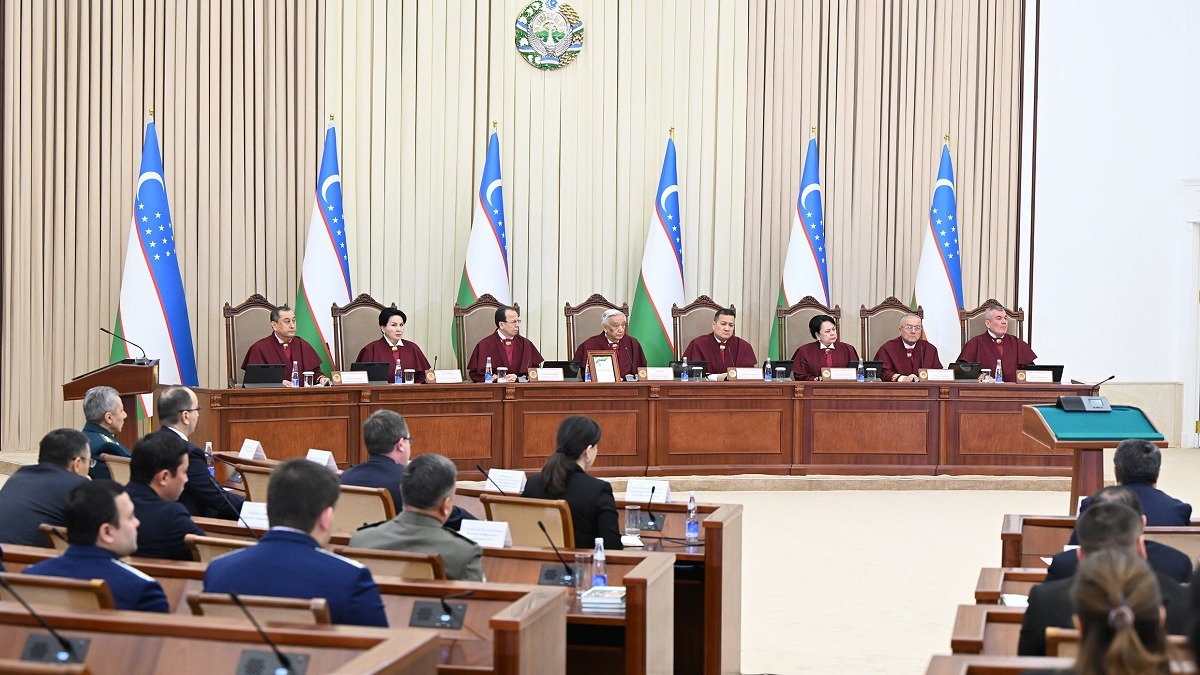
Uzbekistan’s Constitutional Court will be required to broadcast its hearings live on the internet and to build a fully digital case-management system, under a revised law on the court signed by President Shavkat Mirziyoyev on 14 October. The online-streaming obligation and the supporting information infrastructure must be operational by 1 January 2028, giving the court just over a year to complete the transition. All other provisions of the amended law took effect on the date of its signing.
The legislation allows citizens and companies to file applications electronically and to participate in proceedings by video link or mobile application — changes that place Uzbekistan’s highest constitutional arbiter on a formal digital footing for the first time. Electronic case documents will carry the same legal force as paper ones, ending a hierarchy that had long made physical filings the authoritative record.
Tighter procedural deadlines
The new law codifies a sequence of strict time limits designed to prevent cases from stalling at each stage. Once an application is received, the court has no more than 15 days to conduct a preliminary review of petitions from individuals and organisations. Preparation for a full hearing — identifying participants and engaging specialists or expert witnesses — must be completed within 20 days of receipt. The court then has 10 days to schedule a hearing and must notify all interested parties at least five days before it opens; the date, time and venue must be published on the court’s official website. Once a ruling is issued, it must be dispatched to the parties within five days.
Where a case concerns a referral from the Supreme Court seeking clarification on whether a normative legal act being applied in separate proceedings conforms to the Constitution, all related proceedings are suspended until the Constitutional Court delivers its decision. The court is given one month to rule in such circumstances.
If a petition falls outside the court’s jurisdiction, the law explicitly authorises the court either to redirect it to the appropriate body or to decline to consider it — a provision that should reduce the volume of misdirected filings that previously had no clear procedural exit.
Annual accountability report
The amended law also imposes a new transparency obligation: the Constitutional Court must compile an annual report on the state of constitutional legality, drawing on the cases it examined during the year. That report must be submitted to the President of the Republic and to both chambers of the Oliy Majlis, the national parliament — creating a formal channel through which the court’s work is made visible to the executive and legislative branches simultaneously.
Taken together, the reforms represent a significant procedural overhaul of an institution that has historically operated with limited public visibility. The live-streaming requirement in particular will expose constitutional hearings to scrutiny by any citizen with an internet connection, a change whose practical effect will depend on how consistently the court applies the obligation once the 2028 deadline arrives.