



Listen to the article
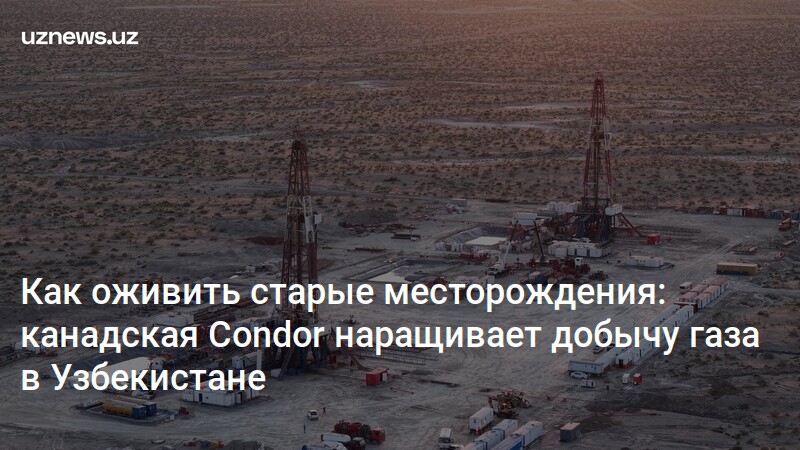
Daily gas production at eight mature fields in Uzbekistan’s Bukhara region has risen more than 60 percent since the start of 2026 — from roughly 1.8 million to 3 million cubic metres a day — after Canada’s Condor Energy Development deployed plunger-lift technology and began drilling horizontal wells across assets that had been losing output at 10 to 20 percent a year before the project began.
Condor operates the fields under a production-enhancement contract with Uzbekneftegaz’s Gazliysky oil and gas production division in the Karakul district of Bukhara region. The company started work in March 2024, spending the first eighteen months assessing well conditions and arresting the production decline before new drilling commenced in September 2025. Chief executive Trent Mercier said the turnaround required persuading both the government and Uzbekneftegaz to accept unfamiliar methods. “In 2024–2025 we managed to stop the decline, after which we started drilling new wells and production began to rise,” he said. The company carries the investment risk itself, funding the project from its own capital.
Plunger Lifts Revive Wells Choked by Liquid
A central problem on ageing gas fields is liquid loading: over time, a mixture of formation water and gas condensate accumulates in the wellbore and blocks the upward flow of gas even when recoverable reserves remain in the reservoir. Condor’s answer has been the plunger lift, a technology explained on site at the Kumli field by chief operating officer Matt Pachell. “The plunger works like a piston,” he said. “We lower it through the lubricator at the wellhead into the tubing and set it at a depth of 2,000 to 2,200 metres. The reservoir’s own energy then drives the plunger upward, carrying the liquid to the surface.”
The system runs without external power: the plunger moves on reservoir pressure alone, and the control unit is solar-powered, reducing maintenance costs. Because the system is sealed, gas does not need to be vented during the process, cutting methane emissions and losses of raw gas. Condor has installed 31 plunger-lift sets across the project fields and helped Uzbekneftegaz fit the technology to two additional wells. Canadian specialists brought the equipment and trained local staff, who now install, configure and service the systems independently.
Horizontal Wells Multiply Contact With the Reservoir
Alongside the plunger programme, Condor has introduced horizontal drilling. A conventional vertical well intersects a productive formation over only a short interval; a horizontal well is steered along the gas-bearing layer for roughly a kilometre, multiplying the contact area and the flow rate. Pachell described the directional control used underground: “With sensors we determine the location of the gas-bearing rocks and can change the drilling trajectory to stay in the layers where there is more natural gas.”
Before drilling began, Condor’s geologists reprocessed and reinterpreted existing seismic data and records from previously drilled wells to map the reservoir geometry and select well paths. The drilling itself used imported services including mud engineering, drill-bit services, directional drilling and real-time downhole data transmission.
The results from the first horizontal well, K-46, illustrate the technology’s potential. Flow tests showed a daily rate of more than 500,000 cubic metres — against a typical range of 20,000 to 70,000 cubic metres a day for conventional vertical wells on the same fields. The company notes that individual well performance will vary with geological conditions. Condor expects to end 2026 with daily output roughly double the level at the start of the year.
After reaching the surface, gas passes through separators to remove water and condensate before entering a shared pipeline for final processing. High-pressure operations are monitored by emergency shut-off valves and sensors that detect gas concentrations and hydrogen sulphide levels at key points on the site.
Workforce Conditions and Community Commitments
The project employs a rotating shift workforce housed in a camp built for approximately 100 people in the Bukhara desert. Facilities include residential and office space, a canteen, a medical post where workers undergo daily health checks, and a gymnasium under construction. Staff describe a marked improvement in conditions from the era when the fields were regarded as remote outposts with minimal infrastructure.
Condor has also directed funds toward social projects in the region. The company built a mini-football pitch, installed a drinking-water purification system and renovated the assembly hall at Boarding School No. 27 in Bukhara city, a specialist institution for children with disabilities. The school’s director, H. M. Husenov, presented Condor representatives with a letter of thanks stating that the work had been completed “in the shortest possible time” to create better conditions for pupils. The company has separately contributed to a disability support fund in a Tashkent district, an animal shelter, and a social feeding initiative called FOOD AND LIFE that serves people in hardship, including those with disabilities and without permanent housing. Condor has also sponsored the Uzbekistan Judo Federation for two consecutive years.
The company’s Tashkent office, staffed by around 40 people, coordinates production and management processes and maintains contact with the Calgary headquarters. Mercier said Uzbekistan holds a strategic position in Condor’s portfolio and that international shareholders and the board support expanding investment in the country. Additional funds for production growth have already been allocated, he said, with drilling planned through 2027, 2028 and 2029. “Our goal is to gradually increase gas supplies to the domestic market and to be a reliable partner for Uzbekistan,” he said, adding that all gas produced under the contract goes to the local market in support of the government’s energy-security objectives.
Looking further ahead, Condor is examining the extraction of critical minerals from deep industrial brines using oilfield technology — a prospect that, if pursued, would extend the company’s footprint well beyond conventional gas production. The more immediate legacy, however, may be the transfer of skills: the plunger-lift systems that Canadian engineers introduced in 2024 are now installed and maintained entirely by Uzbek staff, embedding the technical knowledge in the local workforce rather than exporting it with the gas.