


Listen to the article
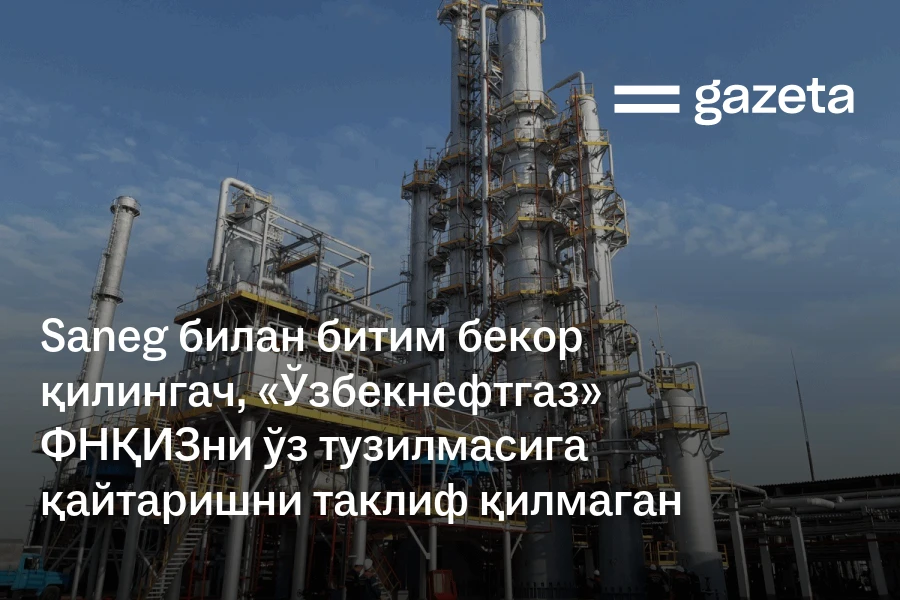
Uzbekneftegaz has made no formal proposal to reabsorb the Fergana Oil Refinery into its corporate structure following the collapse of the privatisation deal with investor Sanoat Energetika Guruhi (Saneg), the company’s first deputy chairman said at a press conference on 27 October.
Sukhrob Hamrayev, responding directly to a journalist’s question on whether Uzbekneftegaz had put forward such a request, answered simply: no. He noted that the refinery had already left Uzbekneftegaz’s perimeter in 2018, when it was transferred to the State Assets Management Agency (Davaktiv), and had since been placed on the privatisation track. “Fergana refinery has not been part of Uzbekneftegaz for eight years,” Hamrayev said, adding that the company was not privy to the details of the obligations that had arisen between the agency and the investor.
A Privatisation That Unravelled
The refinery’s journey through private hands was brief and troubled. In 2020 it was handed to Jizzakh Petroleum under a trust management arrangement; that company was later renamed Saneg. In May 2022 Davaktiv announced the sale of the state’s stake to Saneg for $100 million, with the investor also committing to inject a further $380 million in modernisation capital — funds earmarked to deepen refining capacity, launch production of modern grades of petrol and diesel, and expand overall throughput.
Those commitments were never fulfilled. By early June 2026 the refinery had reverted entirely to state ownership. Registry data show Davaktiv as the sole founder of the enterprise, holding 100 percent of a statutory fund valued at 124.54 billion soums. As recently as May 2026, Saneg still held a 41.5 percent stake alongside the agency’s 58.5 percent.
Davaktiv director Sohibjon Murodov explained the reversal at a separate press conference on 8 October, attributing it to Saneg’s financial difficulties on other investment projects, which prevented the company from meeting its payment obligations on schedule. The sale contract, he said, contained a clause allowing the seller to terminate unilaterally if payments were delayed by three months. The agency engaged international legal advisers before acting and sent Saneg a formal warning letter before cancelling the deal. How much Saneg had paid in total before the termination, the size of the remaining liability, and the mechanics of any financial settlement between the parties have not been disclosed.
Options Open, No Decision Taken
Hamrayev confirmed that Davaktiv is examining several scenarios for the refinery’s future: restructuring its management arrangements, returning it to Uzbekneftegaz, attracting new investors, or re-privatising it. No final decision has been taken on any of these paths, he stressed.
Murodov had said on 8 October that re-privatisation was not on the immediate agenda. A short-term stabilisation strategy has been drawn up, a financial rehabilitation process has begun, and an international audit is under way to establish the true scale of the refinery’s liabilities — the results of which will determine whether debts are repaid or restructured. The plant recorded a loss of 538.1 billion soums in 2025.
In January 2026 the government tasked a working group — involving Enter Engineering, Eriell Group and Saneg — with preparing proposals for new investors capable of completing the modernisation of the Fergana refinery, among other strategic projects.
The refinery is one of Central Asia’s largest producers of fuels and lubricants, manufacturing petrol, diesel, aviation kerosene, motor and industrial oils, and bitumen. Its uncertain ownership status carries wider significance: deals involving Saneg-linked assets have become the subject of a criminal case against Bakhodirjon Sidiqov, the former chairman of Uzbekneftegaz’s management board, and other individuals.