



Listen to the article
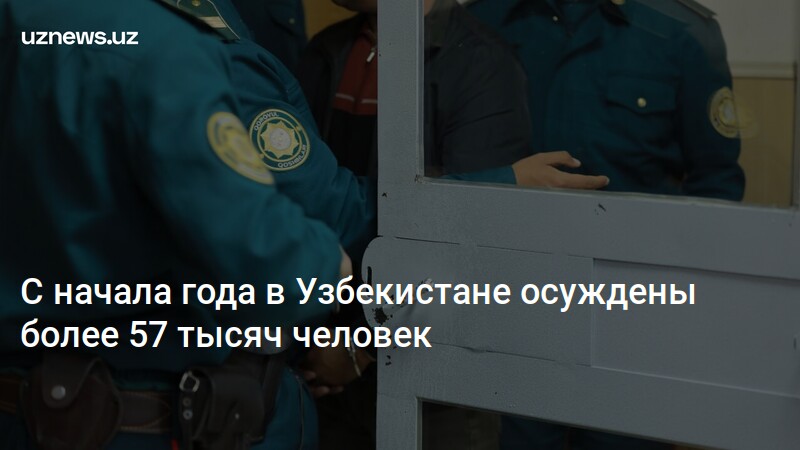
Uzbekistan’s criminal courts convicted 57,376 people in the first nine months of this year, according to statistics published by the Supreme Court. Of those convicted, 18,026 received custodial sentences, 38,737 were given non-custodial punishments, and 613 received suspended sentences.
The figures cover 64,902 criminal cases brought against 78,739 people in total. Courts acquitted and rehabilitated 385 defendants, among them 161 victims of political repression.
The convicted population skewed heavily male — 50,435 men against 6,941 women. Young people accounted for 21,670 of those convicted, including 2,097 minors. A further 2,052 convicted persons were aged over 60.
Fraud and drugs lead the caseload
The most frequently prosecuted offences were fraud, theft, road-traffic violations, and possession of narcotics or psychotropic substances without intent to distribute. Courts also handled significant numbers of cases involving intentional minor bodily harm, embezzlement, hooliganism, intentional moderate bodily harm, document forgery, and drug trafficking with intent to sell.
The highest volumes of criminal cases were heard in Tashkent city and in the Fergana, Tashkent, Samarkand and Andijan regions.
Charges dropped, sentences softened
In 13,938 cases, charges brought by preliminary investigators were either dropped entirely or reclassified to a lesser offence — a figure the Supreme Court presented as evidence of judicial correction of investigative overreach. A further 6,377 defendants were released from custody in the courtroom itself after receiving non-custodial sentences.
The reconciliation mechanism, which allows criminal liability to be extinguished when parties reach agreement, was applied to 18,844 people, freeing them from prosecution. Courts also granted early release to 26,794 convicted persons and commuted the sentences of 8,761 others to lighter punishments. Forty-seven individuals — including young people and women — received non-custodial sentences on the basis of guarantee letters.
To address the underlying conditions that enabled offences, courts issued 34,325 special rulings directed at state bodies, organisations and officials.
Appeals and cassation
The appellate tier reviewed 6,509 cases involving 8,659 people. First-instance rulings were overturned for 314 defendants and modified for 1,830. Cassation proceedings covered 4,504 cases and 5,060 people, with 354 decisions annulled and 1,188 amended.
Supervisory review at the regional level encompassed 3,931 cases involving 4,576 people; 114 decisions were overturned and 492 modified. The Supreme Court’s own criminal chamber, sitting in supervisory review, examined 567 cases involving 646 people, annulling lower-court decisions for 95 defendants and amending them for 188.