



Listen to the article
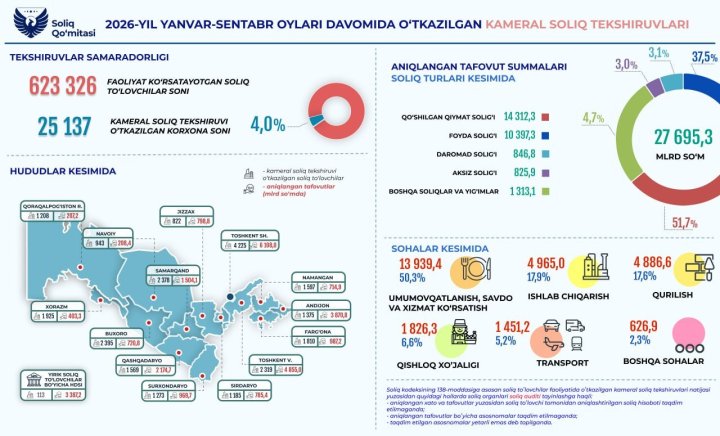
Uzbekistan’s Tax Committee has disclosed that desk audits conducted on roughly 25,100 businesses between January and September this year uncovered tax discrepancies totalling 27.7 trillion soums — a figure that spans value-added tax, corporate profit tax, personal income tax and excise duties. Demand notices have been issued to the taxpayers concerned.
The audited businesses represent just four percent of the country’s registered taxpayer base, which now exceeds 623,300 entities, the committee’s press service said. The scale of the discrepancies found in that narrow sample raises questions about the potential exposure across the remaining 96 percent.
Where the Gaps Are Largest
Value-added tax accounted for the single biggest category of discrepancy, at 14.3 trillion soums. Corporate profit tax followed at 10.4 trillion soums. Personal income tax discrepancies reached 846.8 billion soums, with excise tax adding a further 825.9 billion soums.
Broken down by sector, the food-service, retail trade and services industries produced the largest combined shortfall at 13.8 trillion soums. Manufacturing came second at 4.9 trillion soums, followed closely by construction at 4.8 trillion soums. Agriculture accounted for 1.8 trillion soums in discrepancies, while transport contributed 1.4 billion soums.
A Narrow Audit, a Large Number
The concentration of discrepancies in trade, services and construction reflects sectors where cash transactions and informal arrangements have historically complicated tax collection. The committee did not specify in its disclosure how much of the 27.7 trillion soums has been recovered or is under dispute, nor did it detail the penalties applied. Demand notices, under Uzbek tax procedure, require taxpayers to explain or correct the identified gaps; they do not in themselves constitute a finding of fraud or evasion.
The figures nonetheless underscore the fiscal stakes of expanding desk-audit coverage beyond the current four-percent threshold. With more than 600,000 registered taxpayers on the books and a programme that reached only one in twenty-five of them in nine months, the Tax Committee’s own data implies that the full picture of compliance gaps across the economy remains largely unmeasured.