



Listen to the article
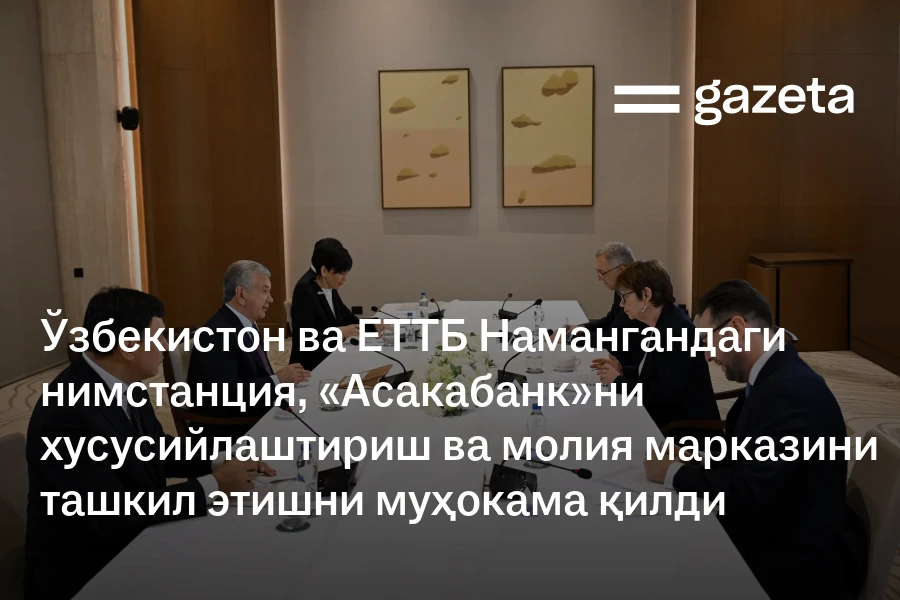
On the sidelines of the COP31 climate summit in Antalya on 10 November, President Shavkat Mirziyoyev and EBRD President Odile Renaud-Basso reviewed a broad pipeline of new investment projects earmarked for 2027, spanning energy infrastructure, state-bank privatisation, agriculture and the creation of a Tashkent international financial centre.
The meeting underscored the depth of a relationship that has made Uzbekistan the EBRD’s largest borrower in the region for six consecutive years. The bank’s cumulative project portfolio in the country has passed $7 billion, and in 2025 annual operations exceeded $1 billion for the first time. Renaud-Basso said the partnership had entered “an entirely new phase” over the past decade, noting that in the current year alone the bank had committed more than €800 million across 40 projects in Uzbekistan, with the bulk directed at green-economy initiatives. The bank’s own figures put the green share of its Uzbekistan portfolio at close to 60 percent.
A New Substation for Namangan — If the Board Approves
The most concrete infrastructure item discussed was a proposed 500/220/110/10 kV electricity substation in the Kosonsoy district of Namangan region, to be built and operated by Uzbekistan National Electric Networks JSC. The EBRD is considering a sovereign loan of up to $57.69 million for the project. The substation is designed to improve supply reliability in the region, cut transmission losses and provide connection capacity for new generation, including renewables.
As of mid-November the project had not yet received final EBRD board approval; a review date of 2 December 2026 is listed in the bank’s project database. The two sides discussed the possibility of signing the relevant agreement before the end of 2026, but no loan contract has been concluded.
Asakabank: Privatisation Preparations Under Way, Sale Not Yet Closed
The privatisation of state-owned Asakabank featured prominently in the talks. A presidential decree issued on 20 April 2026 approved additional preparatory measures, including a framework under which the EBRD would acquire a 15 percent stake in the bank. The decree tasked the Ministry of Economy and Finance, the EBRD and Asakabank with jointly improving the bank’s operational efficiency, asset quality and readiness for a partial share sale.
Under that decree, the Ministry of Economy and Finance and Asakabank were required to submit proposals on the sale price for the state’s 15 percent stake and the principal terms of an investment agreement by 1 September 2026. The decree also envisaged an additional $95 million equivalent injection into the bank’s statutory capital from the state budget in 2026, alongside measures to address non-performing assets and transfer non-core property.
The materials published following the Antalya meeting did not confirm that the 15 percent stake sale had been completed. The discussions appear to reflect ongoing preparation rather than a concluded transaction.
Agriculture, a Financial Centre and a Fergana Hospital
The two sides also reviewed the ANORA platform — Agrifood Investment Opportunities for Resilient Agriculture — launched in June 2026 at the Tashkent International Investment Forum with the participation of the Ministry of Agriculture, the EBRD and international partners. The platform aims to mobilise up to $1.5 billion in investment in Uzbekistan’s agri-food sector by 2030, bringing together government bodies, international financial institutions, climate funds and private investors. Priority areas include water-saving technologies, irrigation modernisation, storage and processing capacity, agricultural digitalisation and climate resilience. The $1.5 billion figure represents a stated target, not funds already committed or allocated to specific projects.
Establishing a Tashkent International Financial Centre was identified as one of the priorities for EBRD-Uzbekistan cooperation in 2027, though no structural or legislative details were disclosed in the published materials.
Mirziyoyev also invited the EBRD to consider financing New Tashkent infrastructure projects and an 800-bed multi-profile hospital in Fergana region on a public-private partnership basis. EBRD project records show the bank is examining a bridge loan of up to $38 million for the construction, equipping and subsequent servicing of the Fergana facility under a 23-year PPP agreement with the Ministry of Health. The hospital is intended to provide high-technology care including cardiac surgery, neurosurgery and organ transplantation. As of 16 November, that financing had also not received final board approval.
The meeting additionally touched on preparations for the next session of the Foreign Investors’ Council under the President of Uzbekistan, scheduled for 2027. The EBRD has operated in Uzbekistan since 1992 and significantly expanded its activity after resuming full engagement in 2017; its current country strategy runs to 2029 and centres on low-carbon development, private-sector support and transport and energy infrastructure.