



Listen to the article
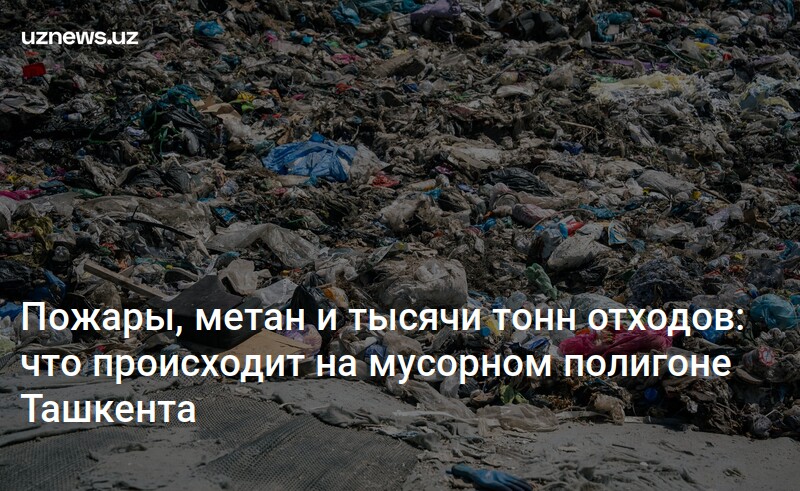
Up to 3,000 tonnes of Tashkent’s rubbish arrive every day at the Akhangaran landfill in the Akhangaran district — a site that has been receiving the capital’s waste for more than half a century, that caught fire during last summer’s heatwave, and that the national ecology regulator says is still not legally open for business.
A New Site Operating Without Official Clearance
The original Akhangaran landfill was created in 1970 on a ravine roughly 18 metres deep, eventually covering 59 hectares. By 2019 it was 98–99 percent full. Waste continued to arrive — more than 2,300 tonnes a day by 2023 — compacted by bulldozers and compactors and layered with 30–40 centimetres of soil between each two-metre band of refuse, a technique intended to contain combustible methane and reduce ignition risk.
When the old site neared capacity, a new landfill was commissioned alongside it. A contract between Chinese firm Stecol-Power China Guiyang and the Uzbek municipal operator Makhsustrans-ISHB was signed in December 2022. The new facility covers 31.2 hectares, with three purpose-built lined pits occupying 24.4 hectares and a combined capacity of 7.66 million cubic metres — enough, by design, for roughly 12 years of operation. Its base is sealed with a four-layer barrier of bentonite and geosynthetic materials to prevent leachate reaching groundwater. Two 60-tonne electronic weighbridges, eight 360-degree cameras and 1.8 kilometres of access road were also installed.
Makhsustrans says construction finished in September 2024 and the site was commissioned on the basis of a state commission certificate. The National Committee on Ecology and Climate Change told a different story in July 2026: construction at the Yangi Hayot mahalla site began in 2021, it said, remains unfinished, and the facility has never been formally commissioned. Yet Makhsustrans-ISHB has been depositing Tashkent’s household waste there since May 2025.
Landfill director Alisher Muradov, who oversees day-to-day operations, said he did not have information about the site’s official status. His practical argument was blunt: “If the landfill were operating illegally, we would not have been allowed to run it for a whole year. Three thousand tonnes of rubbish arrive here every day. Calculate how much that is over a year and ask where it would all go. The old landfill was already completely full.”
A Summer Fire and What the Air Showed
One major fire broke out during an abnormal heatwave over the past year, burning across the new site for three to four days. Muradov described simultaneous ignitions in multiple locations: “We start extinguishing in one place and it catches fire somewhere else. I thought the fire was spreading from a single point. But no — it was starting in different places at once. It was physically impossible to be everywhere.” Staff did not evacuate; they fought the blaze themselves using the site’s own machinery and additional vehicles supplied by Makhsustrans to spread soil. Emergency services were not called. After the fire, all 24 hectares of the active pit were covered with an additional layer of earth, and round-the-clock watch shifts were introduced.
An anonymous worker with 15 years at the site offered a starker account. He attributed fires partly to gas accumulating beneath the waste layers: “First there was a small fire, then the wind spread it. When gas comes out of the ground, it explodes and catches fire.” He said he feared that in a future fire the flames could jump the protective strip around the perimeter. He works 24-hour shifts every three days and said that after 12 hours his head begins to ache. “If I had to work here every day, I couldn’t do it,” he said. He also contradicted Muradov’s claim that workers receive daily health checks: “No, nobody checks. Once a year we have a medical examination — that’s all.”
Air-quality measurements taken in July recorded exceedances of permitted limits across multiple pollutants: carbon monoxide at 10.7 times the allowable level, formaldehyde at 12.2 times, nitrogen dioxide at 12.8 times, and sulphur dioxide at nine times. Ecologist Nina Pikul, who assessed the landfill’s environmental impact, said that when winds blow from the east or south-east, combustion products and odour can reach residential districts of the capital. She noted that the ecology police and the Ecology Committee had brought administrative proceedings against the landfill’s management, and that the operator Makhsustrans had been assessed compensatory payments of 683.87 million soums for atmospheric pollution, with materials referred to court.
Methane, Groundwater and the Limits of Burying the Problem
The old landfill, now covered with soil and formally classified as reclaimed, presents its own hazards. Journalists who visited the site reported a strong smell of gas in the air. Black pipes for venting landfill gas run across the surface; the upper ends of some were stoppered with ordinary plastic bottles. Staff said the pipes belong to a foreign company’s gas project, but no functioning collection or processing system was visible. Some plastic components had deformed in the heat.
The gas infrastructure dates to a 2018 government-approved investment project under which South Korean company Sejin G&E was to invest around $55 million and install equipment with a minimum capacity of 16 MW to generate electricity from landfill gas at Akhangaran and the Maydontal site. The project was later continued by a successor entity, Sejin UZ. By early 2026, official figures showed 253 boreholes drilled and pipelines laid — but the electricity-generation phase had not materialised.
Pikul warned that risks extend beyond air quality. Rainwater percolating through waste layers becomes contaminated leachate that can reach underground aquifers — a serious concern in an arid country with limited water resources. Decomposing organic waste also generates biogas composed mainly of methane and carbon dioxide, compounding both fire risk and greenhouse-gas emissions. She called for coloured segregation bins in every Tashkent mahalla for plastic, glass, paper and metal, separate collection of food waste, and automated sorting lines at transfer stations. A waste-to-energy plant financed by direct Chinese investment is under construction and is expected to reduce the volume reaching the landfill, though both Muradov and the anonymous worker doubted a single facility could handle the current daily intake of 2,500–3,000 tonnes.
Muradov, who manages a staff of 53 working around the clock, was candid about the absence of alternatives: “You cannot say: we are not ready yet, deal with the land yourselves, keep your rubbish at home. We accept it and we work.” The anonymous worker’s conclusion was more personal. He has spent 15 years on the site not because the conditions suit him, but because he has a family to feed. “The pay is a little less,” he said, “but we have no other choice.”