



Listen to the article
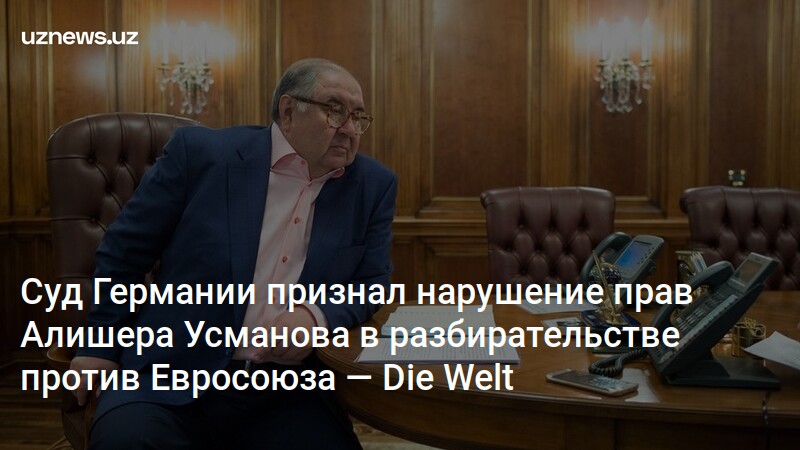
Germany’s Federal Court of Justice ruled on 21 October 2026 that blocking Alisher Usmanov’s lawsuit against the Council of the European Union was unlawful and violated his right to judicial protection — a decision that could open the door for thousands of individuals on EU sanctions lists to challenge damaging claims about them in national courts.
The ruling, reported on 2 November by the German newspaper Die Welt, centres on a Hamburg court action Usmanov filed in December 2023. The Russian-Uzbek businessman sought an order compelling the EU Council to stop circulating what he contends are false and reputation-damaging statements. A Hamburg judge had ordered the claim documents served in Brussels, but their delivery was blocked.
Three Years of Obstruction, Coordinated With Ministries
According to Die Welt, the presiding judge in Hamburg spent nearly three years preventing service of the lawsuit, acting in coordination with German state authorities including the Federal Ministry of Justice and the Federal Foreign Office. Officials were concerned that allowing national courts to hear such cases could cut across EU sanctions policy. The Federal Court of Justice found that obstruction to be illegal.
The EU Council placed Usmanov on its sanctions list in 2022, describing him as an oligarch close to the Kremlin and alleging he had acted as a trusted intermediary for Russian President Vladimir Putin. One source cited in the EU’s materials was a Forbes article. Hamburg’s Regional Court subsequently banned Forbes from republishing the relevant claims after the magazine was unable to produce specific evidence or identify the expert it had cited. Despite that ruling, the EU Council made only partial amendments to its official documents, leaving the contested allegations in place.
Usmanov was removed from the EU sanctions list on 22 September 2026, yet certain allegations against him remain visible on official EU websites, according to Die Welt. His case before the Hamburg court therefore continues to concern the lawfulness of those residual published statements.
Implications Beyond One Businessman
The Federal Court of Justice’s ruling does not address the legality of the sanctions themselves or the accuracy of all the allegations made against Usmanov. Its scope is narrower: it establishes that denying him the procedural right to have his claim heard was itself unlawful.
That narrowness does not limit its potential reach. Die Welt’s correspondent Andreas Rosenfelder, writing under the headline “Now the European Union Will Have to Answer Before a German Court,” argues the decision could have far-reaching consequences. More than 3,000 individuals appear on EU sanctions lists; the ruling suggests they may now be able to pursue similar actions in German — and potentially other national — courts to contest the publication of information they regard as inaccurate.
Usmanov’s lawyer, Joachim Steinhöfel, framed the outcome in constitutional terms. “Access to justice is a fundamental right, and it does not depend on the foreign policy of the government in power,” he said, as quoted by Die Welt.