



Listen to the article
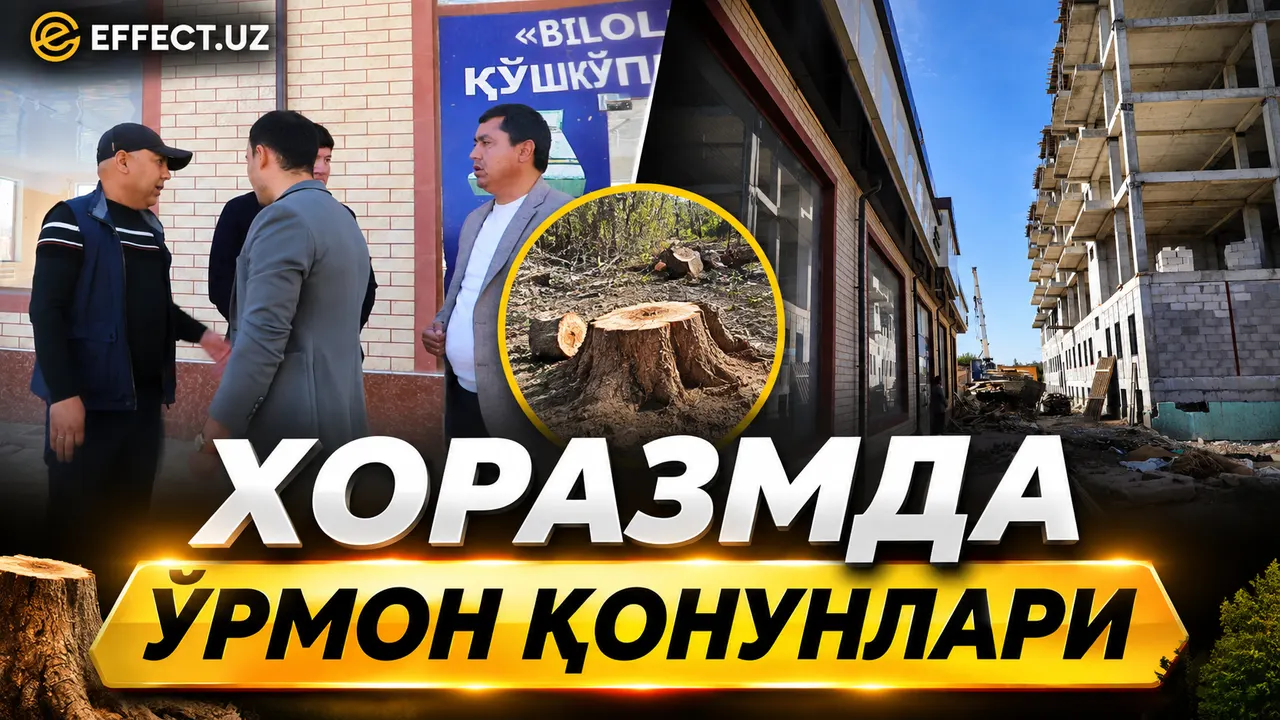
A businessman in Uzbekistan’s Khorezm region has filed a formal complaint with the regional prosecutor alleging that a multi-storey residential building under construction in the Qo’shko’pir district directly contradicts a presidential decree and encroaches on land tied to his own commercial property.
Dilshod Rahimov, who operates non-residential commercial facilities on Al-Beruniy Street in the Chamanzor neighbourhood of Qo’shko’pir, says the construction by a private company called Brother Gold Hous began in front of his properties, blocking access routes and sitting uncomfortably close to existing structures. He states that repeated approaches to the construction organisation’s management produced no result and work continued regardless.
Rahimov acquired the properties — previously owned by a limited liability company called Xadra Xasan — through an electronic online auction on 27 April 2026, after the company’s assets were put up for sale because of credit debts. He registered them in the name of his wife, Matluba Otaniyozova, and planned to redevelop them as trade complexes.
A Decree That Specified an Eco-Market, Not Apartments
At the centre of the dispute is Presidential Decree PQ-410, signed on 29 November 2024. Clause 11 of that decree granted approval for the sale of a 51-percent state stake in Qo’shko’pir Dehqon Bozori LLC — a farmers’ market company — on the explicit condition that the buyer preserve the entity’s line of business and develop the site as a modern eco-market, a trade and household-services complex with a car park, and an entertainment facility. The decree did not provide for multi-storey residential construction.
A state order, numbered 2025-Y-13/005, was subsequently issued to Brother Gold Hous confirming its ownership of the 51-percent state stake. That order, Rahimov says, also recorded the same conditions: preserve the market function, build an eco-market, trade and services complex, car park and entertainment venue.
Yet a meeting chaired by Shuhrat Ahmedov — who served as Qo’shko’pir district governor from November 2023 until October 2026, when he was appointed deputy director of the Agency for the Development of Livestock and Pasture Management — produced District Administration Minute No. 67. That document approved a building-rights limit, or BRL, for addresses at 25 and 25A Al-Beruniy Street in Chamanzor neighbourhood that envisaged nine-storey multi-apartment residential buildings. Rahimov’s complaint argues that this minute is incompatible with the conditions set out in PQ-410, and that the legal basis on which a district administration meeting could override or modify a presidential decree has not been established.
Disputed Conclusion, Cadastral Data and a Court Ruling
On 1 November 2025, the working body of the Architecture and Urban Planning Council under the Khorezm regional construction and housing-communal services authority issued conclusion No. 225858524, which Rahimov says gave Brother Gold Hous the green light to build a multi-apartment residential block. He applied to the Urgench inter-district administrative court to have that conclusion declared invalid, but the court rejected his claim.
The court cited, among its grounds, the expiry of the six-month statutory period for filing such a challenge. Rahimov contests that finding, stating that he only learned of conclusion No. 225858524 in August 2026, when he reviewed case materials — after receiving a response in July 2026 from the Khorezm regional territorial directorate of the Construction and Housing-Communal Services Inspectorate. Because he was unaware of the conclusion’s existence before that point, he argues, the limitation period should not have been counted from an earlier date. He is asking the prosecutor to seek appellate review of the court’s ruling of 25 September 2026, case No. 5-2201-2601/882.
A separate dispute concerns cadastral records. The Khorezm regional directorate of the State Cadastre Agency submitted a reference document, No. 02-10790, dated 24 September 2026, to the court. That document stated that the boundaries attributed to Brother Gold Hous do not overlap with the non-residential building registered to Otaniyozova or its surrounding land. Rahimov flatly disputes the accuracy of those figures and is asking the prosecutor to investigate whether false information was submitted to the court and, if culpable individuals are identified, to pursue their liability.
In his complaint to the Khorezm regional prosecutor’s office, Rahimov requests an examination of all construction permits issued to Brother Gold Hous, an assessment of the cadastral data’s reliability, a legal evaluation of whether the district administration’s Minute No. 67 is consistent with PQ-410, and criminal-law scrutiny if evidence of an offence is found.
The claims set out above reflect the complainant’s own account. Brother Gold Hous, the Khorezm regional State Cadastre directorate and the court have not yet provided responses to the specific objections raised. Effect.uz, which published the complaint, said it would report official positions from the relevant organisations when received.