


Listen to the article
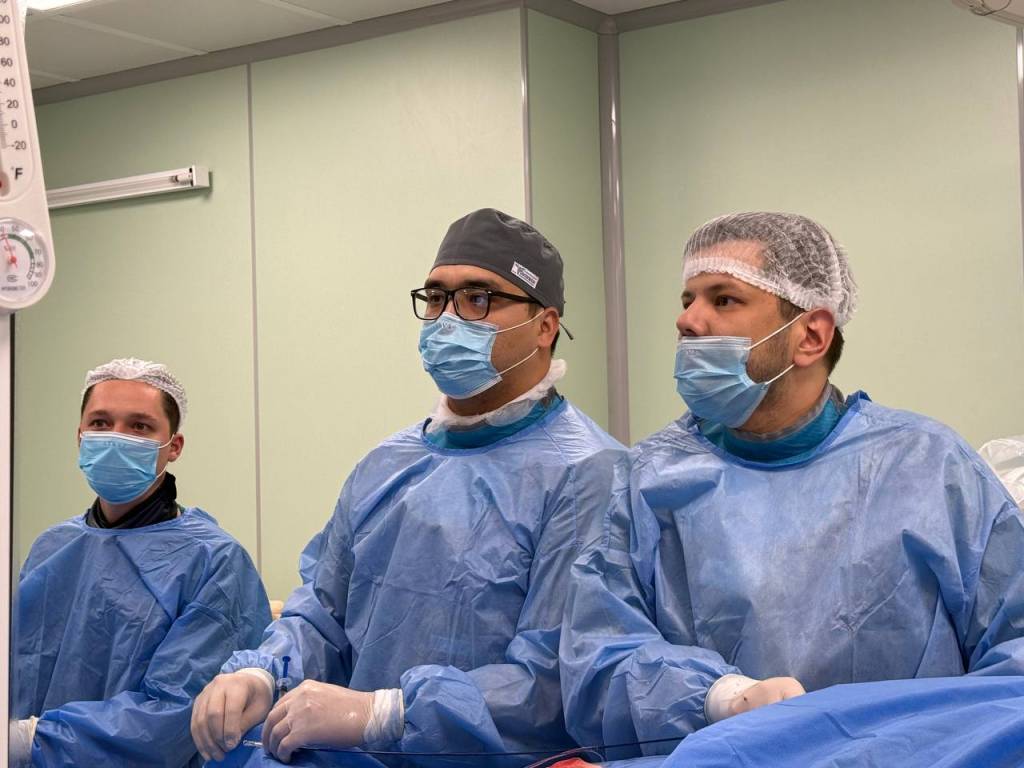
Surgeons at Uzbekistan’s National Medical Centre have for the first time performed a cerebral aneurysm stenting procedure independently, without the involvement of foreign specialists — a step that officials say signals a significant shift in the country’s capacity for high-technology neurovascular care.
The patient was a 55-year-old resident of Surkhandarya region who had sought treatment after prolonged episodes of dizziness and deteriorating vision. Following a thorough diagnostic workup, physicians confirmed a brain aneurysm — a condition in which a weakened section of an arterial wall balloons outward, posing a serious risk of rupture and potentially fatal or disabling complications if left untreated.
The medical team opted for stenting, a minimally invasive technique in which a small mesh device is inserted into the affected vessel via a thin catheter threaded through the bloodstream. The approach does not require opening the skull, which doctors say reduces tissue trauma, shortens post-operative recovery and allows patients to return to normal life more quickly than conventional open surgery.
From foreign-assisted to fully independent
Until recently, procedures of this complexity at the centre were carried out with the direct participation of foreign experts. According to the centre, qualified local interventional radiologists and endovascular surgeons have now mastered the technique sufficiently to perform it on their own. The institution described the development as evidence of a broader transformation in Uzbekistan’s medical sector, where advanced technologies are increasingly being applied by domestically trained specialists.
The centre did not specify how many such procedures have now been completed independently, describing the milestone in terms of the technique having been successfully adopted rather than citing a cumulative caseload.
Cerebral aneurysms are considered among the most demanding conditions in neurovascular medicine. The stenting method used in this case is regarded as a high-precision intervention requiring specialised training in endovascular techniques, making the local acquisition of the skill a notable development for a healthcare system that has historically relied on visiting specialists for its most complex cases.