


Listen to the article
On the sidelines of the World Climate Summit in Antalya, Uzbekistan’s President Shavkat Mirziyoyev met separately with Slovenian President Nataša Pirc Mušar and Finnish President Alexander Stubb, using the COP31 gathering to advance bilateral economic agendas with two European Union member states.
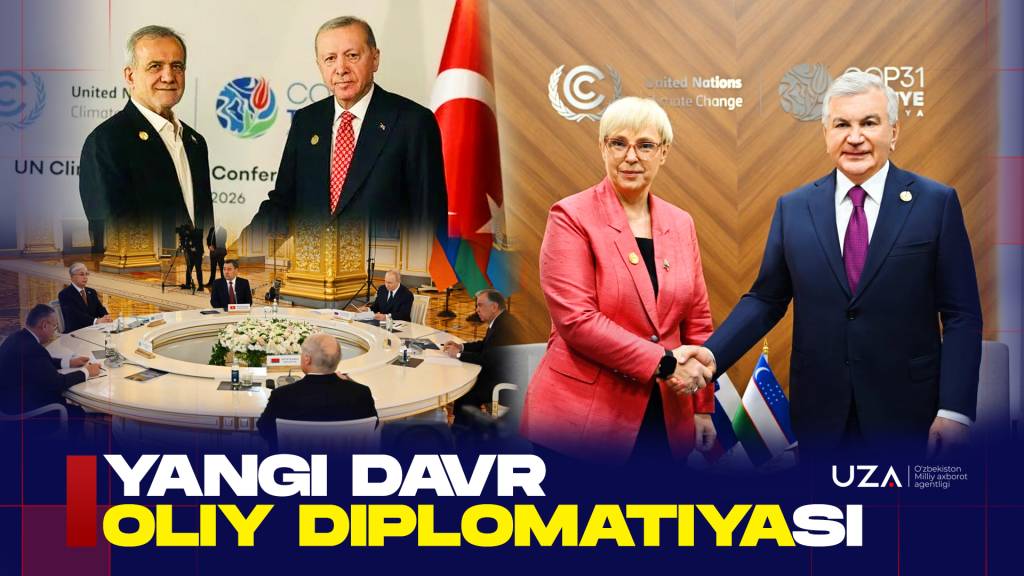
In his meeting with Pirc Mušar, the two sides discussed expanding trade, economic and investment cooperation, with particular attention to transport, pharmaceuticals, urban development and critical mineral resources. The parties also agreed to broaden cultural and tourist exchanges and to deepen cooperation within the framework of the European Union.
The session with Stubb covered the implementation of agreements reached during the Finnish president’s official visit to Uzbekistan last year. The two leaders discussed accelerating joint projects in metallurgy, energy and geology, as well as expanding trade and economic ties. They agreed to hold the next session of the Intergovernmental Commission in early 2027, alongside a business forum. Environmental protection and the rational use of water resources were also on the agenda, and the two sides exchanged views on pressing regional and international issues.
Elsewhere at the Antalya summit, Turkish President Recep Tayyip Erdoğan met with Iranian President Masoud Pezeshkian. The two discussed bilateral relations alongside regional and international matters. Erdoğan stressed the need to immediately halt the war between Iran and the United States and to create space for diplomatic efforts to achieve stability. He said Turkey would continue to support efforts to secure peace together with fraternal states in the region.
Separately, a regular session of the Collective Security Treaty Organisation council took place in Moscow, bringing together the leaders of Kazakhstan, Russia, Belarus, Kyrgyzstan and Tajikistan, along with CSTO Secretary-General Talатbek Masodiqov. Participants reviewed the results of cooperation within the organisation, assessed work carried out in 2026 and discussed priority tasks ahead. The session also addressed international and regional security, counter-terrorism, combating the illicit circulation of narcotics and ensuring information security.