


Listen to the article
Uzbekistan used the second day of the 31st UN Climate Conference in Antalya to advance a cluster of concrete proposals spanning climate finance architecture, industrial decarbonisation, water technology and population displacement — going well beyond the headline agreements announced at the conference’s opening.
A ‘5+5’ forum to channel climate money into Central Asia
The centrepiece institutional proposal was a dialogue format Uzbekistan is calling “5+5”: five Central Asian countries sitting alongside five international climate funds to align investment priorities, build a shared project portfolio and improve the efficiency with which multilateral money reaches the region. Uzbekistan said it is prepared to host the inaugural meeting of the forum in Tashkent in 2027.
Silk Road declaration on climate migration
A regional declaration titled “Silk Road” was signed at the conference, bringing together countries from Central Asia and the South Caucasus around a shared framework for managing population displacement driven by climate change. The document commits signatories to developing joint approaches that protect vulnerable communities, preserve livelihoods and ensure migration is safe and orderly — an acknowledgement that environmental stress is already reshaping where people can live across the two sub-regions.
Cement industry gets a decarbonisation roadmap
A dedicated session at Uzbekistan’s national pavilion focused on industrial emissions, presenting a roadmap for cutting carbon output from the cement sector. The plan envisages the adoption of energy-efficient technologies, more rational use of raw materials and fresh investment in production modernisation. The urgency of the exercise is underlined by official data showing that industry accounted for 26.8 percent of Uzbekistan’s GDP in 2025.
Population growth meets a warming climate
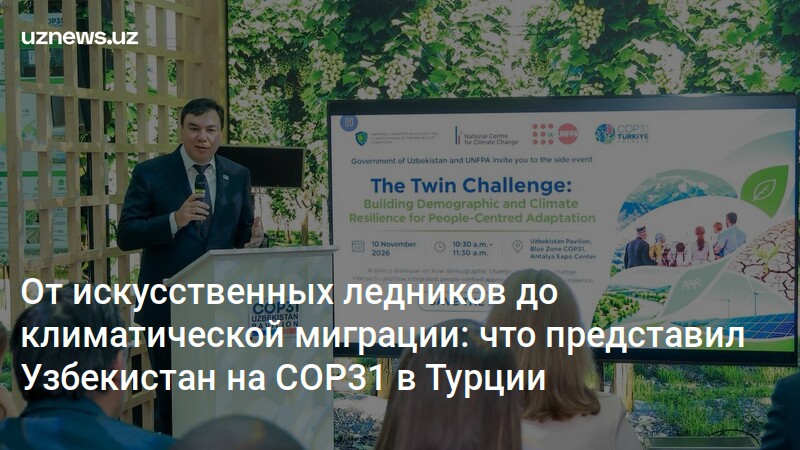
A study prepared with the involvement of the UN Population Fund was presented at the conference, projecting that Uzbekistan’s population could exceed 52 million by 2050. The research set that demographic trajectory against a recorded rise in average annual temperature of approximately 1.6 degrees Celsius over the past six decades, and examined the combined pressure both trends place on water supply, food security, infrastructure and public health.
Ice Stupa technology and rainwater harvesting for agriculture
A session organised by the Food and Agriculture Organisation under the FOLUR-Uzbekistan project showcased practical water-conservation methods, including rainwater harvesting systems, the Ice Stupa technique for creating artificial glaciers, and the rehabilitation of degraded landscapes. The approaches are aimed at making Uzbekistan’s farming sector and natural ecosystems more resilient to drought and chronic water scarcity.
Aral Sea fund raises $16.2 million, Uzbekistan pledges $5 million more
Discussions on the Aral Sea region produced a set of figures that illustrated both what has been achieved and what remains to be done. The first phase of the UN Multi-Partner Human Security Trust Fund for the Aral Sea Region mobilised $16.2 million and reached more than 293,000 direct beneficiaries across eight districts of Karakalpakstan. For the fund’s second phase, which runs to 2030, Uzbekistan committed to contributing $5 million.
Mountain resilience and the road to Bishkek+25
Central Asian representatives also held joint discussions on protecting mountain territories, covering glacier retreat, shifting water regimes, early-warning systems and access to international climate finance. Those talks were framed partly as preparation for the global mountain summit known as Bishkek+25, scheduled for 2027.
Turkey’s Vice President Cevdet Yılmaz visited Uzbekistan’s national pavilion during the day’s proceedings. After reviewing the initiatives on display, he remarked that Uzbekistan was moving dynamically along the path of sustainable development.