


Listen to the article
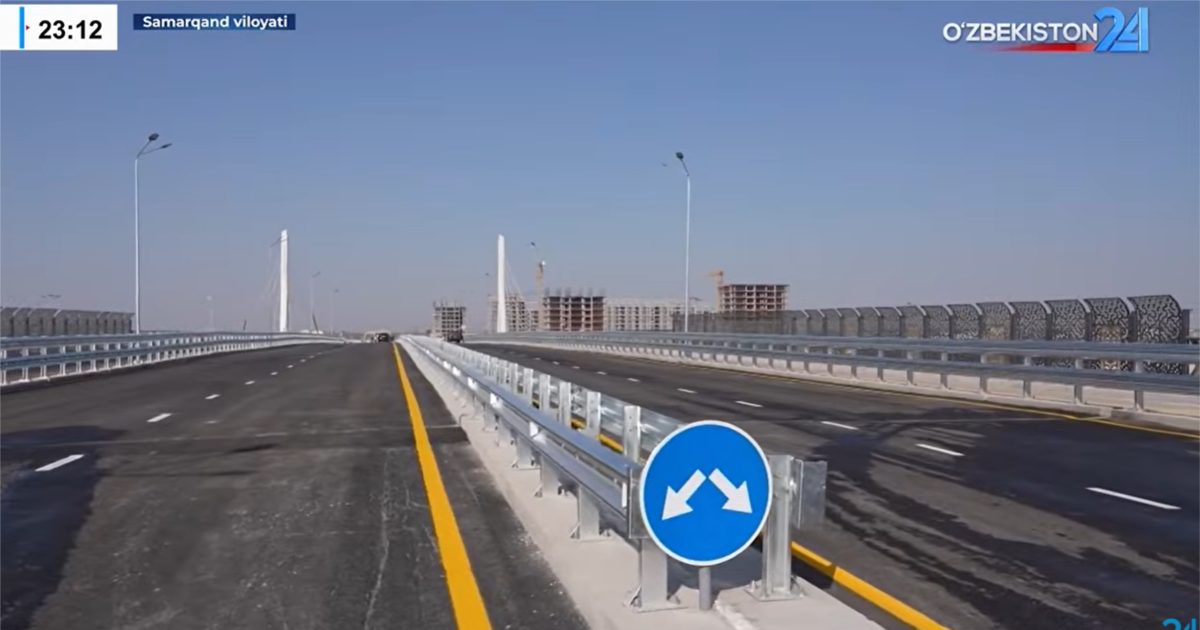
On 18 October, President Shavkat Mirziyoyev toured a new bridge under construction over the Qoradaryo river in Samarkand region, praising the project on state television. The same day, workers building that bridge contacted Radio Ozodlik to say they had not been paid in full for months.
The bridge — 780 metres long, 29.8 metres wide and 12 metres high, with four traffic lanes and a projected daily capacity of 25,000 vehicles — is designed to link the Shirin residential district to central Samarkand and its international airport, cutting the journey from 23 kilometres to four and travel time by 30 minutes. Its project cost is stated at 310 billion soums. The presidential website described it as a long-held ambition of the head of state.
380 Workers, Months Without Full Pay
The bridge is being built by the 67th Bridge Construction Detachment, a unit within Köprikqurilish AJ, a subsidiary of the state-owned Uzbekistan Railways joint-stock company. Workers who identified themselves as members of that detachment told Ozodlik that the unit employs 380 people and that wage delays have become routine since construction began.
“Our president was happy to see the bridge, but does he know how many workers behind that labour are going without pay?” one worker said, declining to give his name for safety reasons. According to the workers, holiday pay, sick-leave payments and final settlement payments have gone unpaid since December 2025. August wages have not been paid to anyone; July wages were received by only some workers, and those on the second shift rotation have yet to receive even those.
The workers said the delays force them to borrow money for daily expenses and utility bills. They described approaching management repeatedly and being told each time that funds were unavailable.
A March to the Hokimiyat — and a Partial Response
Frustration boiled over on 13 October, five days before the presidential visit, when 180 workers set out on foot toward the Samarkand regional administration building — the hokimiyat — to demand their wages. Halfway there, the director of their unit, identified as Zafar Makhamatov, met them and persuaded them to turn back, promising to release the outstanding payments. July wages were subsequently transferred, but workers said those on the second rotation shift still had not received them, and August wages remained unpaid for everyone.
It was the second time workers had stopped work over the issue. An earlier complaint submitted to Ozodlik’s Sizdan Telegram channel in early 2026 had prompted the release of December 2025 wages, but the underlying problem persisted throughout the year.
Ozodlik sent written questions about the workers’ claims to Zafar Makhamatov, identified as chairman of Köprikqurilish AJ, and also messaged the detachment head, Ravshan Akhmedov, via Telegram. Akhmedov read the message but did not reply. No response had been received from Makhamatov at the time of publication; Ozodlik said it would publish any reply when it arrives.
A Contractor With a Troubled Record
The wage complaints are not isolated. In March 2021, workers from the same company’s 13th Bridge Construction Detachment staged a work stoppage over unpaid wages that had been delayed since the start of that year, a case Ozodlik reported at the time.
Köprikqurilish’s parent company, Uzbekistan Railways, has faced repeated public criticism over infrastructure quality. A tunnel built at the intersection of Rudaki and Bostonsaroy streets in Samarkand — opened ceremonially on 31 December 2021 — flooded during the first rainfall. Its project budget had been set at 67.7 billion soums, but the final cost to local taxpayers came to 143 billion soums, more than double the original estimate. The railways company has also been criticised in connection with the Sardoba reservoir disaster of May 2020, a fatal accident on the under-construction Yunusobod metro line in December 2019, and multiple technical failures on Tashkent’s overground metro.
For the workers on the Qoradaryo bridge, the arithmetic is straightforward. “If the opening of the bridge shown to the president is the result of our work,” one told Ozodlik, “then settling accounts with the workers who built it on time should be an inseparable part of that work.”