


Listen to the article
South Korea’s Education Minister Choi Kyo-jin resigned on Sunday after the government’s hastily assembled response to AI-assisted cheating fears turned the country’s most consequential annual exam into a day of widespread confusion and anxiety.
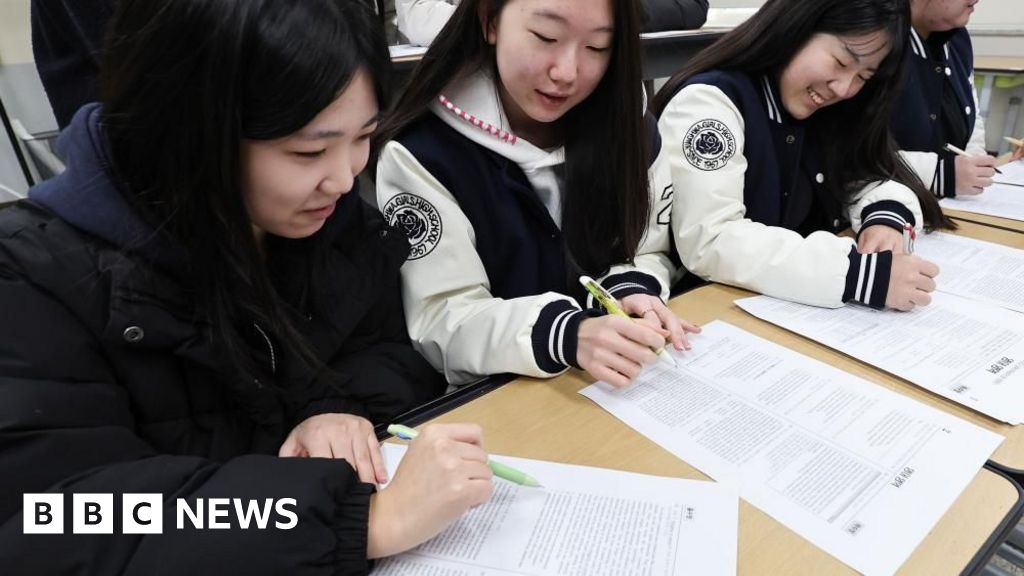
Choi said he could not escape responsibility for the disorder that accompanied Thursday’s Suneung, the college entrance examination that can take up to nine hours to complete and carries enormous weight in the career trajectories of millions of South Koreans. About 500,000 students sat the exam this year. President Lee Jae Myung, who has publicly called for an overhaul of the current exam system, accepted the resignation.
“As the minister in charge, I believe I cannot escape criticism that we failed to prepare in advance,” Choi was quoted as saying by South Korea’s Yonhap news agency. “Now that the exam has concluded, I feel a deep sense of responsibility and am offering my resignation.”
A confession that set off a chain reaction
The crisis was triggered the previous weekend when Han Won-seok, the top scorer in April’s national tax accountancy examination, admitted publicly that he had cheated. His unusually high result — just one of 160 questions wrong — had already attracted suspicion. In a video message, the 34-year-old said he had used a microcamera to photograph test questions, sent the images to an artificial intelligence system, and then checked his answers on a smartphone.
With the Suneung only days away, education authorities moved urgently. The measures they introduced were sweeping and, critics would argue, poorly thought through. On exam day, three nationwide emergency alerts were sent between 08:00 and 15:00 local time in an attempt to detect hidden devices. The alerts caused phones across the country to blare simultaneously — including those set to silent mode and those belonging to tourists using data roaming. Only phones that were switched off or set to airplane mode were unaffected. It was the first time South Korea had deployed its national disaster alert system to combat exam cheating.
Candidates were also required to cover the buttons on their shirts and jackets to block potential hidden cameras, and authorities inspected eyewear for signs of smart-glass technology.
Honest students caught in the crossfire
The measures rattled students who had done nothing wrong. One high school senior told the Korea Times he was worried his horn-rimmed spectacles would be mistaken for smart glasses. Another told Yonhap that he normally wore glasses but switched to contact lenses specifically to avoid raising suspicion during the exam.
The education ministry said 111 candidates were found in possession of unauthorised smart devices during this year’s Suneung — a figure that, while not trivial, affected a small fraction of the half-million students who sat the test. The broader disruption, however, fell on everyone.
Concerns about AI-assisted cheating had been building for weeks before Han’s confession, driven by reports of candidates using connected devices during competitive examinations. The tax accountancy case crystallised those fears and forced officials into reactive mode at the worst possible moment in the academic calendar.
Choi’s resignation leaves the education ministry without a permanent head as South Korea grapples with how to modernise its examination infrastructure against a rapidly evolving landscape of miniaturised AI tools — a challenge that Thursday’s events showed it was not yet equipped to handle.