


Listen to the article
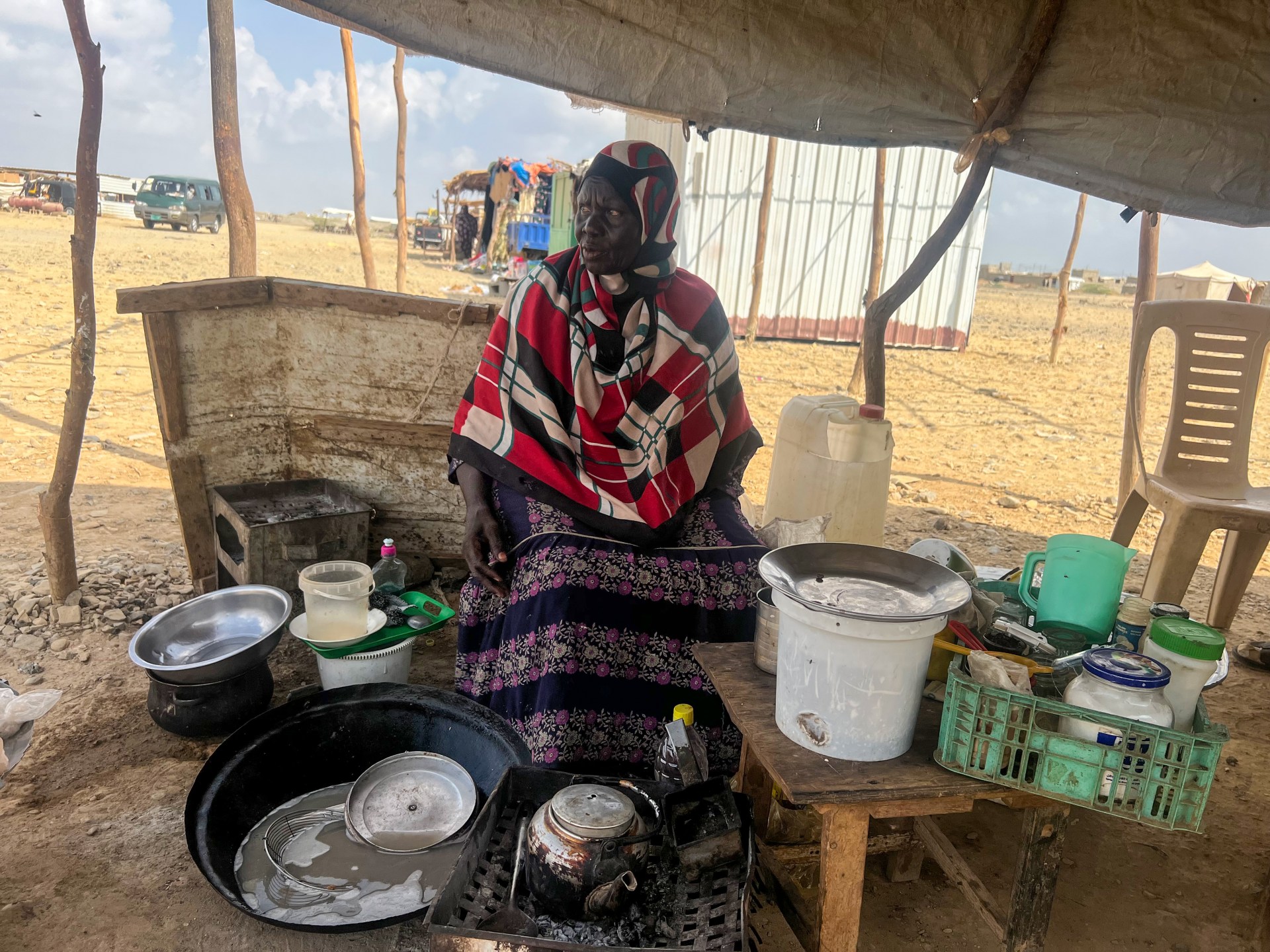
Aisha Adam, 50, did not choose Port Sudan. When fighting between Sudan’s Armed Forces and the paramilitary Rapid Support Forces erupted on 15 April 2023, she fled her home in Khartoum’s al-Kalakla neighbourhood for nearby Omdurman, only to be driven out again weeks later. She boarded the first available bus heading somewhere safe. It took her to the Red Sea coast city she had never visited before.
More than three years on, Adam lives in a displacement camp on the outskirts of Port Sudan with her orphaned grandson and nephew. Each morning she walks to a nearby market, where she fries zalabia — a traditional Sudanese pastry — and sells tea and coffee. The income is unpredictable. On good days she turns a small profit; on bad ones she loses money she cannot afford to lose.
“The important thing is that we eat, even if it is only lentils and water, with nothing else,” she told Al Jazeera. “But my greatest fear is that we will fall ill, because we have no money for treatment.”
Her daily arithmetic is unforgiving. Three kilograms of flour cost 21,000 Sudanese pounds (about $2.25); two litres of cooking oil, 22,000 pounds ($2.36); three bags of charcoal, 9,000 pounds ($0.97). After restocking for the next day’s trading, what remains is often too little to cover a meal. A kilogram of lentils — among the cheapest food available — costs 16,000 pounds ($1.72). Meat has disappeared from her diet entirely.
Over the past six months, Adam says she has received humanitarian assistance on only three occasions: a cash transfer of 550,000 pounds ($59.13), a 12-kilogram bag of flour, and a package of women’s hygiene supplies. Water, she notes with relief, has been provided free by aid organisations for the past five days. Before that, she was buying 18 litres for 1,500 pounds ($0.16) — and sometimes borrowing the money to do so.
A crisis measured in millions
Adam’s situation is not exceptional. The war between the Sudanese Armed Forces and the Rapid Support Forces has killed as many as 200,000 people, according to aid workers, and displaced 13 million. On 22 October 2026, the World Food Programme announced that funding shortfalls had forced it to cut monthly food assistance to displaced people, a reduction affecting approximately 900,000 individuals. Across Sudan, some 19.5 million people face acute hunger, including five million at emergency levels. The WFP identifies Greater Darfur and Greater Kordofan as the areas at greatest risk of famine.
A joint statement issued by the United States Department of State on 27 October warned of “an alarming deterioration” in food security and cited the Integrated Food Security Phase Classification’s warnings of famine risk in the coming months, calling for urgent action.
Inside a camp in al-Obeid
Esraa Mohammed supervises the al-Suraiha 8 IDP camp in al-Obeid, the capital of North Kordofan state. She says 450 people are officially registered there, with a further 40 recent arrivals not yet on the records. Most newcomers arrive in torn clothing, without shelter from sun or rain, and without food.
“There are 100 children in the camp, 30 of whom are suffering from severe acute malnutrition,” she told Al Jazeera. Some organisations provide roughly 400 millilitres of cooking oil and 250 grams of peas per person; another distributes lentils, flour, oil and salt. Mohammed says these quantities fall well short of what families need to last a month, forcing displaced people to seek casual labour — which is not always available.
She also reported accounts from people who had fled South Kordofan, who said they were forced to eat tree leaves during their flight because they feared being killed by RSF fighters. Reports of civilians being murdered, detained or raped by RSF personnel have been widely documented.
Aid shrinkage and the risk of catastrophe
Ahmed Ismail, described as an expert on the United Nations and NGOs, told Al Jazeera that Sudan is confronting a compound crisis: famine, mass displacement, the collapse of health services, the destruction of livelihoods and serious violations against civilians. Humanitarian monitoring, he said, has recorded rising civilian deaths linked not only to violence but to the inability to access food, medicine and shelter.
“When assistance declines, the most vulnerable families are deprived of food and medicine, increasing the risk of death among children, women and older people, particularly in conflict and displacement areas,” Ismail said. He warned that continued reductions in aid, combined with escalating restrictions on humanitarian access, could transform the current crisis into a far wider catastrophe.
For Adam, the abstraction of policy and statistics resolves into a daily calculation of flour, oil and charcoal — and the unresolved fate of two sons who went missing when the war began. A third son died before the fighting started. “I have no choice but to work,” she said. “There is no one I can rely on.”