


Listen to the article
More than a thousand businesses have now signed Uzbekistan’s Anti-Corruption Charter, and the annual Biznesda Halollik — or Integrity in Business — international forum used its fifth edition to map out what comes next: a shift from voluntary pledges to structured rewards, compliance certification and automated detection of conflicts of interest in state procurement.
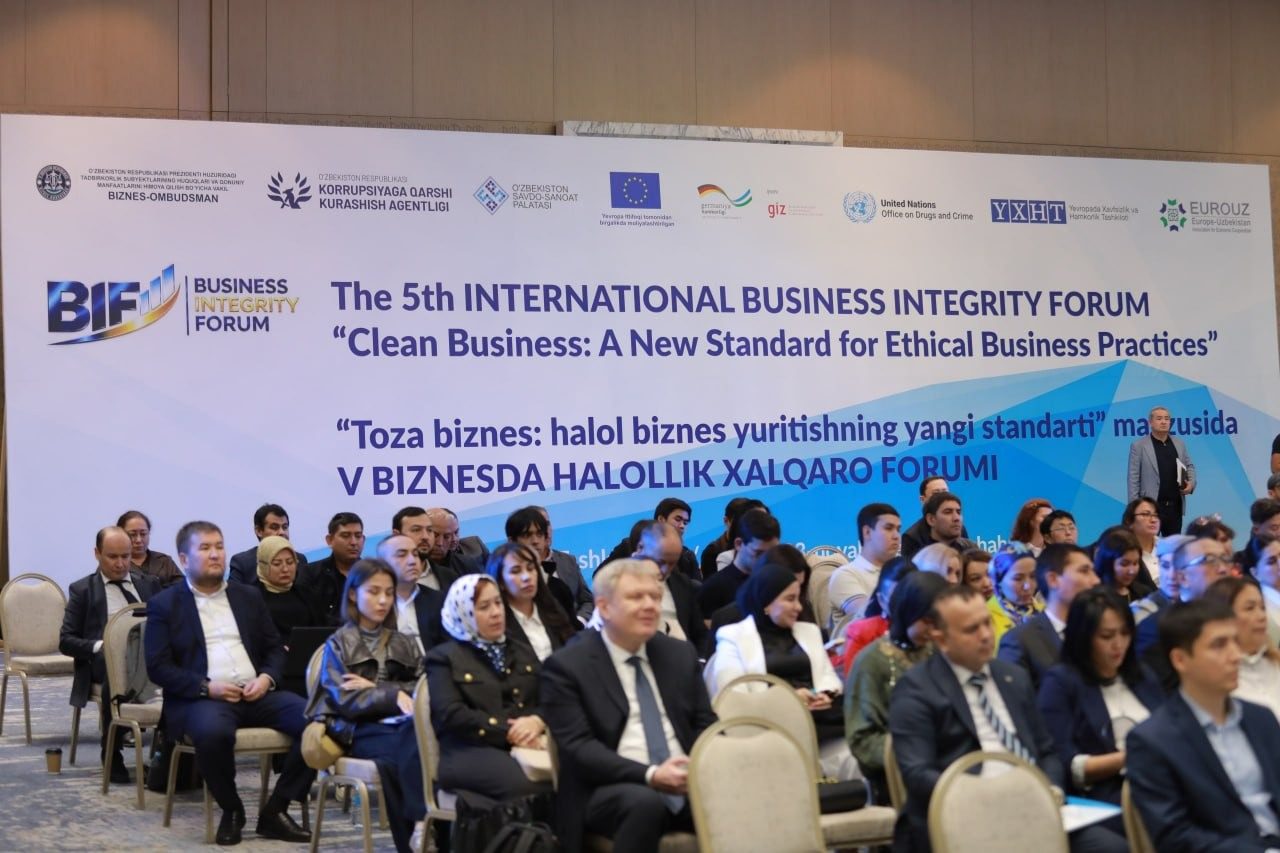
The forum, organised by the Anti-Corruption Agency, the Business Ombudsman’s Office under the President, and the Chamber of Commerce and Industry, brought together government officials, international organisations and private-sector representatives to discuss reducing corruption risks, improving corporate governance and strengthening Uzbekistan’s appeal to foreign investors. It was supported by the UN Office on Drugs and Crime, the European Union Delegation, Germany’s GIZ development agency and the OSCE.
From Pledge to Privilege
The forum’s central theme was translating the five-year-old charter — developed jointly by the Anti-Corruption Agency, the Chamber of Commerce and the Business Ombudsman — into tangible benefits for compliant firms. Under plans discussed at the event, companies that join the charter through its electronic platform will be eligible for a dedicated incentives and privileges scheme. Businesses that demonstrably implement effective internal anti-corruption systems will be eligible for a special compliance mark, and a new annual award — Best Company in the Fight Against Corruption — is planned to recognise top performers.
International participants acknowledged two recent government steps as significant for the business environment: President Shavkat Mirziyoyev’s launch of the Toza Biznes, or Clean Business, national programme — formally titled Corruption-Free, Honest and Transparent Business — and a three-year moratorium on inspections of small business entities introduced in August of this year.
Three Sessions, Three Pressure Points
The forum ran three thematic sessions. The first, framed around what global capital will demand of Uzbek business by 2030, examined international investor requirements, corporate governance standards, compliance frameworks and the prospects for Uzbek companies entering world markets. The second focused on practical responses to corruption risks, systemic obstacles facing businesses and ways to rebuild investor confidence. The third brought together customs and transport sector representatives to address corruption risks in cross-border trade, the digitalisation of customs procedures and transparency across logistics chains.
Work is also under way on several structural measures: certifying anti-corruption management systems inside state bodies and organisations; using artificial intelligence to automatically detect affiliation and conflicts of interest in public procurement; and introducing a whistleblower protection order mechanism for those who report corruption.
The forum concluded with a signing ceremony admitting new companies to the charter, and participants — local and foreign business representatives and experts alike — agreed on a set of recommendations to tackle bureaucratic barriers and prevent corruption in entrepreneurial activity, with forward-looking tasks defined alongside international and domestic partners.