


Listen to the article
Uzbekistan’s state oil and gas company Uzbekneftegaz has declined to reveal how much it is paying China’s CCDC to plug a runaway gas well in Surkhandarya that has been leaking toxic hydrogen sulphide since September 2024, telling journalists at a 27 October press conference that a non-disclosure agreement with the Chinese contractor prevents it from publishing any figures.
The blowout at well No. 604 on the M-25 field — formally named the “25 Years of Independence” deposit in Baysun district — killed four workers in September 2024 and has since triggered repeated flare-ups, including a second high-pressure hydrogen sulphide release just two days after the well was initially declared sealed. A further blowout at a separate well on the same field occurred in March 2025. The field sits atop reservoir pressures of up to 65 MPa and temperatures of 150 degrees Celsius, with gas streams carrying heavy concentrations of both hydrogen sulphide and carbon dioxide — conditions that defeated earlier attempts at containment by Russian and American specialists brought in by drilling contractor Eriell.
Why CCDC, and Why Not Say How Much
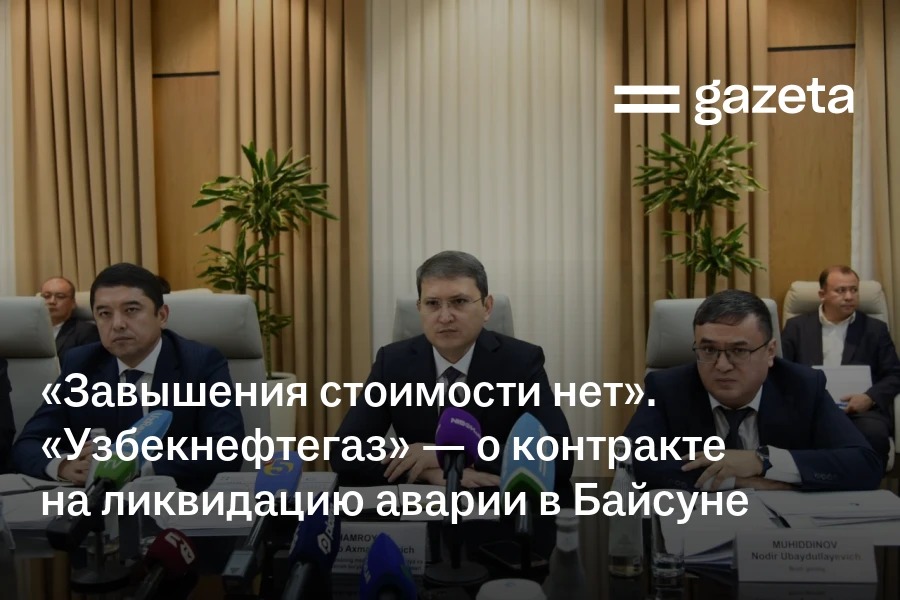
Chief geologist Nodir Mukhiddinov told the press conference that Uzbekneftegaz and its consultants evaluated proposals from companies in the United States, China and Russia before settling on CCDC, a subsidiary of China’s state-owned CNPC. The selection criteria, he said, covered the technical soundness of each proposed solution, projected timelines, associated risks, price, and — critically — the contractor’s track record on comparable blowouts in geologically similar fields in the region.
Deputy chairman for processing Aborjon Khudoybергanov acknowledged the contract value question directly but refused to answer it. “The cost is confidential information. An NDA has been signed between the two companies. Before disclosing any figures we must obtain the consent of the other party,” he said. He nonetheless insisted there had been no artificial inflation of the price, stating that the decision was reached only after all required expert reviews and sign-offs from relevant state bodies. Company spokesman Mumin Ibodov added that Uzbekneftegaz chairman Abdugani Sanginov had on multiple occasions sent contractor proposals back for revision because of cost or other non-compliance issues.
Sanginov had previously stated publicly that payment to the Chinese partners would be made in cash and would not involve any transfer of natural resources — a clarification apparently intended to address concerns about the terms of engagement on a field whose reserves have been estimated at more than 150 billion cubic metres of natural gas.
Timeline and Scale of the Remediation
Practical work on closing well No. 604, near the village of Kofrун, was formally launched on 15 August 2026 in a ceremony attended by Sanginov, Baysun district governor Bakhodir Shuкurov and CNPC representatives, at which a month-by-month remediation schedule was presented to local residents. More than 40 units of specialised drilling equipment are to be shipped from China by the end of 2026, supplemented by high-pressure, corrosion-resistant equipment from other countries. Drilling of the relief wells is scheduled to begin in January 2027, with full resolution of the emergency targeted for July 2027 — a deadline Sanginov had earlier summarised as the first half of 2027. Four additional wells must be drilled to achieve that outcome.
Sanginov discussed progress with CNPC leadership on 20 October, days before the press conference, with both sides confirming that the relief-well approach remained the chosen method for stopping the uncontrolled gas flow.
The M-25 field is considered one of the country’s largest undeveloped gas deposits. A production-sharing agreement covering exploration, development and the construction of a 5-billion-cubic-metre-per-year gas processing complex in Surkhandarya was signed with an investor consortium in 2017, with the total project value put at $5.8 billion, of which $2.9 billion was earmarked for the processing plant alone. By November 2023, roughly $1.45 billion had been invested and 20 wells drilled, 11 of them tested. The operating company is Surhan Gas Chemical Operating Company; Eriell handled drilling and Enter Engineering was assigned the processing complex and infrastructure.
President Shavkat Mirziyoyev, visiting Surkhandarya in February 2026, declared that a technical solution to the emergency had been found and pledged that the project would deliver a major economic boost to the region once resolved. What that resolution will cost the state company — and by extension Uzbekistan’s public finances — remains undisclosed, as do the cumulative emergency expenditures since September 2024 and any official estimate of the volume of gas lost during more than two years of uncontrolled releases.