


Listen to the article
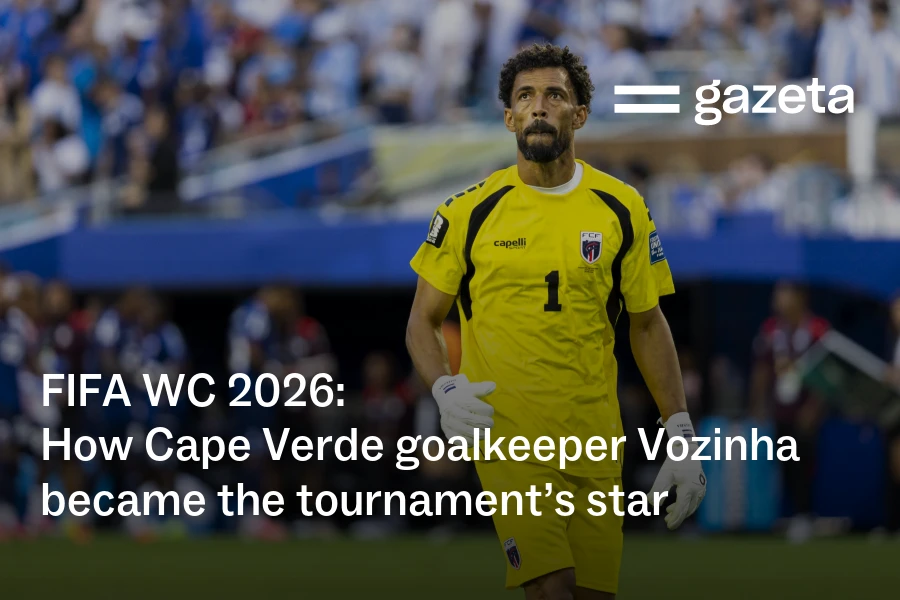
One day Josimar José Évora Dias was a 40-year-old goalkeeper playing second-division football in Portugal. A few weeks later, Lionel Messi was embracing him on a World Cup pitch and telling him his people should be proud. The journey in between — through Atlanta, through tears, through seven saves against Argentina — is the story of the 2026 FIFA World Cup’s most improbable breakout figure.
Known universally as Vozinha, the Cape Verde shot-stopper was born on June 3, 1986, in Mindelo, one of the largest cities in the Atlantic island nation of under one million people. For most of his career he played for little-known clubs in Cape Verde, Angola, Moldova, Portugal, Cyprus and Slovakia. He came to professional football relatively late, joining Angolan side Progresso do Sambizanga only in 2012, after the age of 25. The World Cup, he has said, was the dream that kept him going.
A name with a story
Even Vozinha’s name carries an unlikely connection to Argentina. His father, José Pedro, intended to name his son after Jorge Valdano, the Argentine forward who scored one of Argentina’s three goals in the 1986 World Cup final against West Germany. When registering the birth, however, he was told that foreign names could not be given to children in Cape Verde. He settled on Josimar instead, after Brazilian defender Josimar Pereira, whose name fitted the country’s Portuguese-language naming tradition.
Forty years on, FIFA tracked down Valdano and told him the story before Cape Verde’s World Cup debut. The former forward had known nothing of it. “Forty years after playing at the 1986 World Cup, I’m playing vicariously at World Cup 2026, through Vozinha. It came as a huge surprise to me. Initially, I was a bit confused. Why did his father think of me? He had Maradona right there!” Valdano said.
The nickname Vozinha also dates to childhood. While his mother worked and his father served in the military, the boy was raised by his grandparents. He spent his time playing football with older children who would tease him when he came home upset after a rough game. “They would tease me, saying I was going to complain to my grandparents,” he recalled in a 2014 interview. In Portuguese, vozinha is a diminutive of avó, meaning grandmother — effectively, grandmother’s boy.
The draw that shook Atlanta
Cape Verde arrived at the 2026 World Cup as debutants. Their opening group match, against Spain — one of the tournament favourites — ended goalless. When the final whistle sounded in Atlanta, thousands of supporters embraced and danced in the stands. Neutral spectators joined them. Vozinha, named player of the match, could not hold back his tears.
“I cried because I grew up with my grandparents and unfortunately they were not here; they died a few years ago,” he said after the game. “I also cried because my mum didn’t manage to be here because of the visa. Because of the money we had to pay for the visa, we didn’t manage to get it done on time. I would like her to be here.”
He was equally direct about what Cape Verde had come to do. “Everyone thought that we came here just to enjoy the World Cup… but we are here to compete, and we are here to fight for our country,” he said.
The group stage confirmed the Spain result was no fluke. Cape Verde drew with Uruguay and Saudi Arabia as well, finishing with three points but unbeaten. In the expanded 48-team format, the top two sides from each group advanced to the round of 32, along with the eight best third-placed teams. Across all 12 groups, only Senegal and Cape Verde reached the knockout stage with just three points — a passage made possible precisely because Cape Verde had not lost a single match.
Seven saves against Messi
On July 4, Cape Verde faced Argentina in the round of 32. Before the match, Vozinha made no attempt to hide his feelings about the opponent. “He is the greatest footballer of all time. Sharing the pitch with Messi is a dream, and one day I will proudly tell my children that I played against him. I know it is almost impossible to stop him, but I will give everything I have to make sure he does not score against me,” he said.
Over more than 120 minutes, Vozinha made seven saves. He stopped four of Messi’s attempts, including a curling effort in the second half directed to the far corner. Cape Verde lost 2–3, but they had pushed the eventual finalists and tournament champions to the limit on their World Cup debut.
After the final whistle, Vozinha approached Messi. “He hugged me and said: ‘You are magnificent. Your people should be proud of you.’ For me that was incredible. To hear those words from Leo Messi means a great deal. I thanked him and said: ‘Thank you, Leo. You are the best,'” the goalkeeper recounted.
From 50,000 to 29 million
The social media numbers that followed the Spain match were extraordinary. Within 24 hours of the final whistle in Atlanta, Vozinha’s Instagram following rose from roughly 50,000 to nearly 10 million. By the end of the tournament it had reached 29.4 million.
The career that preceded that explosion was built on patience and persistence. After his early years at clubs in Mindelo — Batuque until 2011, then Mindelense — Vozinha moved to Angola, then back to Mindelense, then to Moldovan club Zimbru in Chișinău in 2015. A year later he joined Portuguese second-division side Gil Vicente, then spent five years at Cypriot top-flight club AEL Limassol from 2017. In 2022 he moved to Slovak club AS Trenčín, and two years later returned to Portugal with second-division side Chaves.
He is the second most capped player in Cape Verde’s national team history, having represented the side at the Africa Cup of Nations in 2013, 2015, 2021 and 2023 before the 2026 World Cup. His international debut came in September 2012 in a playoff against Cameroon. Cape Verde lost the second leg 1–2 in Yaoundé, but CAF later awarded Cameroon a technical defeat for fielding a suspended player. On their first-ever appearance at the Africa Cup of Nations finals, Cape Verde reached the quarter-finals before losing to Ghana.
“I was named man of the match but this is for all of my teammates because without them nothing would be possible,” Vozinha said after the Spain game. “I will continue to work for Cape Verde and for the people.”