



Listen to the article
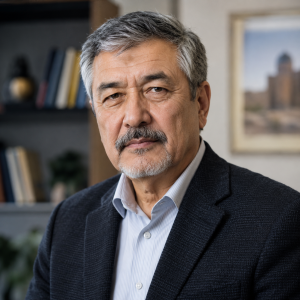
Waldo Arriagada did not set out to become a mathematician. Born in Santiago, he enrolled in a medical technology programme at the University of Chile’s School of Medicine, endured a year and a half of it, and was on the verge of no clear direction when a calculus lecturer introduced the concept of a limit. “Something just clicked in my head and I knew mathematics was exactly what I wanted to do,” he recalls. He dropped the medical programme and transferred to the Civil Mathematical Engineering programme at the University of Chile’s School of Physical and Mathematical Sciences, completing both a bachelor’s and a master’s degree there.
His master’s thesis explored the topological properties of solenoids — structures built by nesting circles inside one another according to a Cantor-set logic, the same recursive process of removing middle thirds that, repeated infinitely, reduces a line segment to a cloud of dust-like points. “It may sound boring, but to be honest, it is a beautiful topic in the eyes of the connoisseur,” Arriagada says. That aesthetic sensibility is central to how he understands his discipline. “Pure mathematics is an art; therefore, a mathematician is less a scientist and more an artist.”
After his master’s, he moved to Canada, where part of his family already lived, and began a PhD at the University of Toronto under topologist Boris Khesin. The city did not suit him — he describes it as huge, restless and extremely humid, and recalls having to sleep in his office for the first few days. He transferred to the University of Montreal, where he completed his doctorate in Complex Dynamics and Differential Equations, followed by a postdoctorate at the University of Calgary.
In 2013 he took a three-year visiting professorship at the University of The Bahamas. From there, Khalifa University in Abu Dhabi recruited him as an assistant professor; he stayed seven to eight years before moving to a university in China. Life there brought its own difficulties: relentlessly humid weather, unfamiliar food — he describes ordering noodles and finding unexpected anatomical surprises in the bowl — and, on one mountain run, a face-to-face encounter with a bobcat outside an abandoned Buddhist temple. He turned around and left.
A newsletter and a friend’s recommendation
The move to Tashkent came through an unlikely combination of a job posting and a travel anecdote. While still in China, Arriagada received a newsletter advertising a position at New Uzbekistan University. Around the same time, a well-travelled friend who had visited Central Asia told him Tashkent had impressed him most because of the contrast between tradition and modernity, with ski-accessible mountains nearby as an added draw. Arriagada watched travel vlogs on YouTube to get a sense of the place and accepted the offer. He arrived in late summer 2025.
His first impressions were formed largely on foot, walking from his apartment in Akay City along Kary Niyazov Street to Taras Shevchenko Square on weekends. What struck him was the architectural collision: modern buildings standing directly beside Soviet-era ones. “The city seemed to be deeply attached to its traditions, yet surprisingly secular at the same time,” he says. His sharper criticism is reserved for traffic. Drivers park on pavements and in school zones, he notes, and do not consistently yield to pedestrians at marked crosswalks. He draws a comparison to Abu Dhabi around 2015, when driving was similarly dangerous, and argues that the solution is cultural rather than infrastructural. “Building bridges and underpasses so that pedestrians can avoid cars is not the answer. The right solution is to change the driving culture.”
Beyond those frustrations, he describes Uzbekistan as an excellent place to live — safe by global standards, low in humidity, warm, and family-oriented. He has visited Samarkand and noticed that when shopkeepers lack English, younger bystanders step in to translate. He is also struck by the ease with which people move between Uzbek and Russian mid-conversation, a code-switching he finds unusual compared with the more rigid linguistic boundaries he observed in Belgium and Canada. “I find that strange, yet very fascinating,” he says.
Teaching, funding and the right people to talk to
At New Uzbekistan University, Arriagada currently teaches differential equations to second-year students. He is direct about where he places responsibility: “The onus of learning mathematics falls mostly on the student. I can help someone understand basic calculus, but if they do not want to learn, no amount of extra help will work.” He finds it easier to work with students beyond the first year, who have already decided what they want and are, in his words, serious about their studies.
He values the faculty’s international composition — colleagues from the United States, Europe and Asia — partly because mathematical pedagogy varies significantly across traditions. The American approach, he says, is pragmatic and direct; French and Italian traditions demand exhaustive proof, filling pages with microscopic detail. Both have merit, and their coexistence at one institution is, in his view, an asset.
Over the past decade he has published approximately 30 research papers. Pure mathematics, he notes, demands little infrastructure: paper, a pen, and the right interlocutors. His closest collaborator is Jorge Huentutripay, a faculty member at Universidad Austral de Chile working in Chilean Patagonia; despite the distance, they exchange research constantly. Funding has come from Chile’s CONICYT and Canada’s NSERC at different stages of his career; in Tashkent, his students have been applying for research funding through local programmes.
Watches, rock music and the relativity of time
Outside the classroom, Arriagada’s hobbies converge on a single preoccupation. “I have always been obsessed with the idea of time,” he says. “Is it linear? Does it only move in one direction? It feels like a universal variable, a coordinate we assume to be the same on Earth as it is on the surface of the Moon, yet modern physics proves it is entirely relative.” That obsession found a practical outlet in watch collecting, which began with Swatch models bought for around $30 during his student years; at its peak, his collection numbered around a thousand pieces. He sold many but kept the interest, and when conversations around him turned to a particular Seiko model he already owned several of, he launched a YouTube channel called Plastic Indices, posting reviews covering case dimensions, colour, complications and movement type.
Music runs alongside the watches. His father taught him guitar as a child, and he plays both electric and acoustic, preferring the softer sound of the acoustic. He could not bring his guitar to Tashkent but has used the music room on campus. He also regularly encounters a Georgian street musician under the bridge at the intersection of Abdulla Qodiriy Street and Mustaqillik Avenue, a man he describes as knowing 1970s rock inside out — Iron Butterfly, Deep Purple and others — who lets him play. His deepest loyalty, though, is to Creedence Clearwater Revival, a band that performed for only four years, from 1968 to 1972. “I was not even born yet, but I feel a special connection to them,” he says.
He attended the International Jazz Festival near the Palace of International Forums three days running last spring, and has been to the State Conservatory of Uzbekistan for a Christmas carol concert. For mathematical work, his preferred venue is less glamorous: a Turkish café on the ground floor of the Park in Mall, where he drinks tea and thinks. “A few papers have been conceived while sitting over a cup of Turkish tea,” he says. He has no fixed long-term plans — for Tashkent or anywhere else.