



Listen to the article
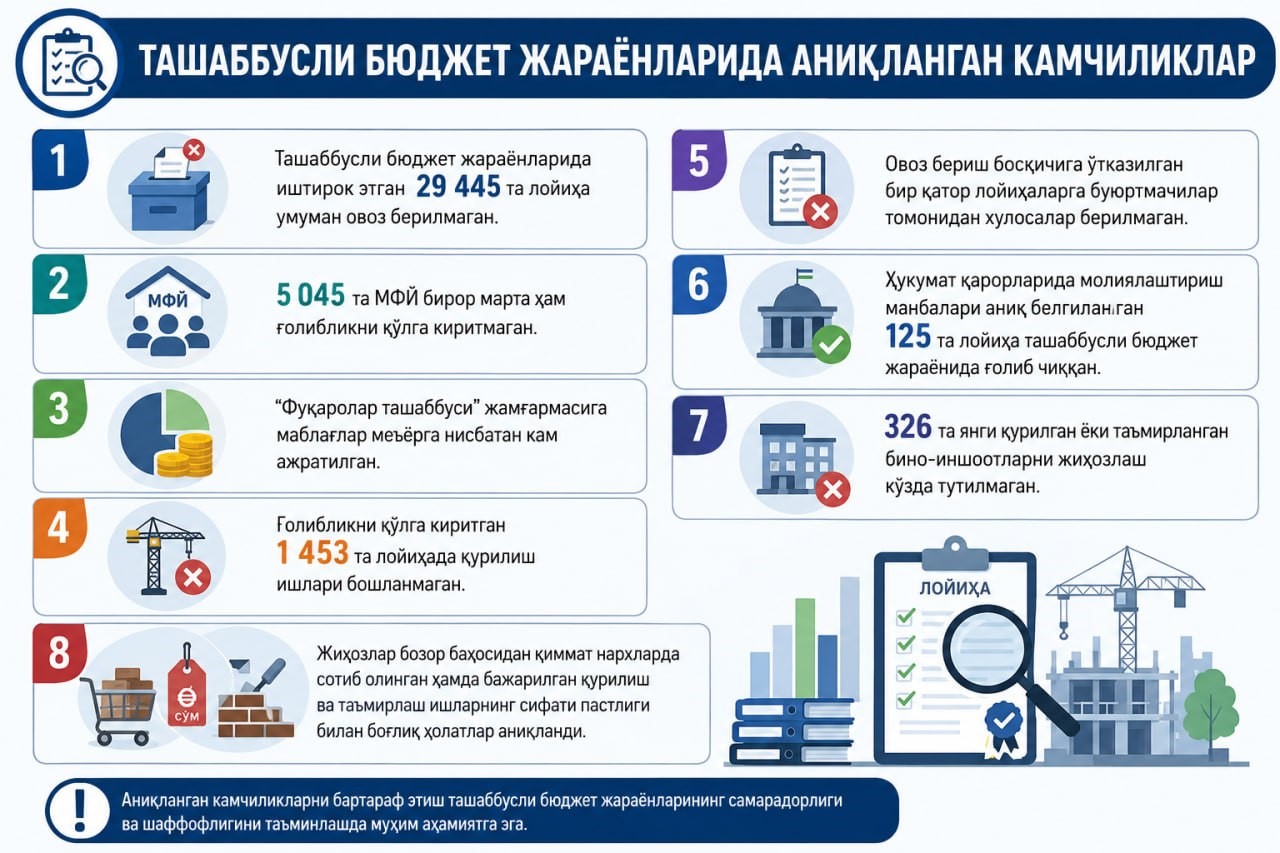
Nearly 1,500 projects that won public votes under Uzbekistan’s participatory budgeting programme have not seen a single shovel of construction work begin, the Chamber of Accounts has found after a review of the scheme covering 2025 and the first season of 2026.
The audit, conducted in May and June of this year, examined the Citizens’ Initiative fund, which received a total of 9.7 trillion soums. Of that sum, 7.9 trillion soums came from local budgets, 1.3 trillion soums from supplementary local budget sources, and 0.5 trillion soums from the national budget. Initiators submitted 71,711 project proposals with a combined declared value of 80.8 trillion soums; 6,978 projects, which together accumulated 21.6 million votes, were declared winners and allocated 9.3 trillion soums for implementation.
A Programme Undermined From Multiple Directions
The Chamber’s working group identified a series of structural failures running through the programme. Some 29,445 projects that entered the participatory budgeting process received not a single vote, while 5,045 mahalla citizen assemblies — the neighbourhood bodies that form the grassroots tier of the scheme — have never once produced a winning project. Local district and city administrations, known as hokimiyats, transferred funds to the Citizens’ Initiative fund at levels below the legally required minimum.
Procedural controls also broke down at the selection stage: for a number of projects that were admitted to the voting round, the contracting authorities had not submitted the required expert conclusions. More strikingly, 125 projects that already had their financing secured by separate government decisions were nonetheless put through the participatory budgeting competition and declared winners — effectively double-counting public resources.
Physical delivery problems compounded the administrative ones. Construction or renovation work was completed on 326 buildings and structures without any provision for equipping them — meaning facilities were built but left non-functional. In Surkhandarya region, which the Chamber examined as a case study, auditors found equipment purchased at prices above market rates alongside instances of poor-quality construction and repair work.
Nine-Point Remediation Plan Issued
The Chamber has drawn up a nine-point action plan in response. Its measures include full digitalisation of participatory budgeting processes, the use of artificial intelligence at the project-selection stage, strengthened quality-control mechanisms for completed works, the creation of a registry of organisations’ equipment needs, and a requirement that newly constructed or renovated buildings be equipped using dedicated budget allocations.
Formal instructions arising from the audit have been sent to the Ministry of Economy and Finance and to the hokimiyat of Surkhandarya region. The Chamber said the measures, if implemented, would improve transparency, ensure that the projects most meaningful to residents are actually delivered, and secure more rational use of public funds.