


Listen to the article
Brazil’s Supreme Court issued an emergency two-hour extension to voting hours in the country’s presidential run-off on Sunday, pushing the nationwide closing time from 17:00 to 19:00 local time (22:00 GMT) in what the BBC’s correspondent in Brasília described as a highly unusual step that could delay results by several hours.
The ruling was granted by Supreme Court Justice Cristiano Zanin, who said his office became aware of the situation at 16:32 local time and acted given what he called the seriousness of the allegations and the urgency of the situation. He instructed the Superior Electoral Court to take the necessary steps to comply with the order.
The extension was triggered by a motion filed by President Luiz Inácio Lula da Silva’s Workers’ Party (PT) in three cities in the state of Bahia, alleging that disruption to public transport had prevented voters from reaching polling stations. Speaking to reporters before the ruling, Lula called on the Supreme Court and the National Electoral Court to investigate the reports. “What we want is an election done honestly and with everyone having their right to vote,” he said, urging voters to “not give up” and to “wait, and vote, because democracy must win.”
Local officials in Salvador, the capital of Bahia state, said the transport disruption there was temporary and stemmed from buses carrying stickers bearing the candidates’ faces and electoral numbers — a violation of electoral rules. Nearly two million people are eligible to vote in Salvador, and more than nine million in São Paulo, making both cities strategically significant. BBC correspondent Ione Wells, reporting from Brasília, noted that São Paulo is a key swing state and the most populous city in South America, while Salvador has traditionally been a stronghold for Lula in Brazil’s northeast.
The campaign of right-wing senator Flávio Bolsonaro separately requested an extension, citing heavy rainfall in a large number of cities across São Paulo, Paraná and Santa Catarina states. The cities named in that request included São Paulo, Curitiba, Tijucas and Joaçaba, among others. Bolsonaro’s campaign argued the weather could have hindered voters in areas where he also commands strong support.
Confusion at polling stations
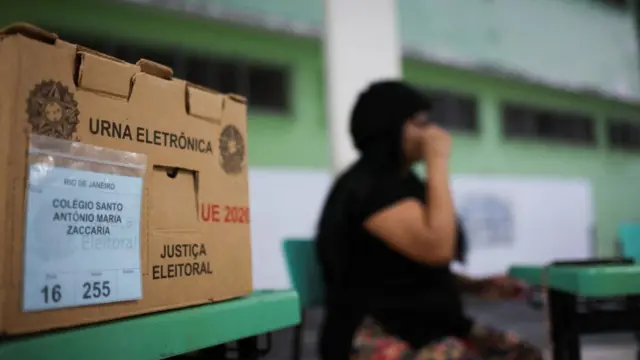
Zanin subsequently clarified that the extension applied only to polling stations where voting had not yet been finalised at 17:00. Because Brazil uses electronic voting machines that cannot be reopened once closed — Zanin’s note compared the process to turning off a computer that cannot be restarted — stations that had already shut their machines at the original closing time would have their results counted as declared at 17:00.
The clarification did little to resolve confusion on the ground. Several poll workers told BBC Brasil they had already been dismissed before the extension was announced. The principal of a state school in Pirituba, in western São Paulo, said his station had already closed and issued ballot box reports when the local electoral office announced the extension, adding there were no technical guidelines on how to reopen the machines despite an order from the Regional Electoral Court to remain open. A poll worker at another location said she witnessed a woman being turned away from a school used as a polling station after 17:00, despite the minister’s ruling.
Stakes and context
Sunday’s vote is the second round of the 2026 presidential election. Flávio Bolsonaro won the first round earlier this month, beating incumbent President Lula but falling short of the outright majority needed to avoid a run-off. The margin between the two candidates in the first round was just over 2.2 million votes.
Abstention among voters aged 70 and above reached 49.1 percent in the first round, according to data from the Superior Electoral Court — the highest of any age group and representing more than eight million Brazilians, or nearly four times the first-round gap between the candidates. Political scientist Mayra Goulart of the Federal University of Rio de Janeiro described this cohort as possibly the most strategically decisive group in the second round, given the narrow margin and the fact that voting is not mandatory for those aged 70 and older.
Early ballot box reports from overseas polling stations, released by the Superior Electoral Court, showed Bolsonaro ahead in Japan, the United Arab Emirates and Hong Kong, while Lula led in China, Australia and New Zealand. Almost one million Brazilians are eligible to vote abroad, spread across 186 cities, representing just over 0.5 percent of the total electorate.
US President Donald Trump, asked by journalists who he was supporting, said he was watching the Brazilian elections. Flávio Bolsonaro met Trump at the White House in May and has positioned himself as a close ally of the administration.