



Listen to the article
When marine biologist Kim Hyun-woo received a coastguard call in mid-September asking him to rescue a large shark from a concrete canal in Busan, he was on his way home from tracking mackerel shoals. Despite being one of South Korea’s leading shark experts, he had never expected to be summoned to save one.
The shark — a female dusky shark, a species linked to only two recorded deadly attacks — had appeared in a shallow canal beside the world’s seventh busiest port. Nothing like it had been seen there before. Within hours, Busan’s city council had sent an emergency text alert to every resident urging caution, and the crowds began to gather.
Fans named her Bukangi, derived from “buk hang,” the Korean name for the nearby harbour. Within days a business had trademarked the name, and Bukangi pins, plushies and T-shirts were selling online. City authorities livestreamed her movements and declared her an official mascot. A banner at the canal entrance invited the public to sign a petition — nominally on Bukangi’s behalf — demanding national government support for a new 30,000-seat baseball stadium nearby. More than 1.6 million visitors ultimately came to the canal. The local mayor said the shark had brought “the kind of publicity even billions of dollars cannot buy.”
The unspoken etiquette among visitors held that children got the front row, and anyone who spotted Bukangi was expected to point her out to newcomers. Self-appointed night patrols kept watch to ensure no one shone torches or lasers at her.
A rescue that kept failing
Kim’s team from the National Institute of Fisheries Science first tried an electrical deterrence device — a weak current sharks typically avoid, normally deployed near beaches after sightings. After five hours, officials concluded Bukangi was too large and fast for it to work. Kim then decided to wait for her to leave on her own. She did not.
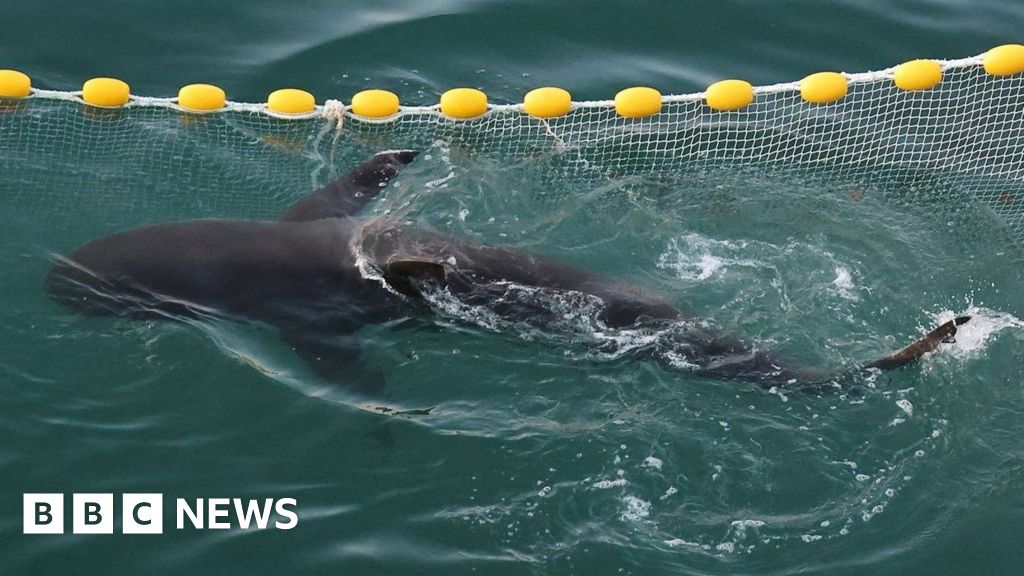
A second attempt at the end of September drew on a 2004 Massachusetts incident in which water jets had driven a great white shark from a shallow pond. Bukangi kept circling back. On 2 October, a net was stretched across the width of the canal; she swam around it and returned within hours.
By then her condition was deteriorating. She had not been seen feeding for days, and bloody abrasions had appeared on her snout from contact with the concrete walls. Marine biology professor Choi Yoon told local media that experts were particularly concerned about a “critical” injury near the shark’s eye.
Kim began to suspect Bukangi’s electromagnetic navigation sensors, located in her snout, might have been impaired — or that she had become disoriented by noise from harbour shipping. The oceans ministry suggested a broader cause: warming seas. It noted that some 50 large sharks had been recorded off South Korea’s east coast in the first half of the year, four times the previous year’s figure, and suggested Bukangi may have followed fish into warmer, shallower waters.
A city divided
As each rescue attempt failed, a vocal faction of Bukangi’s admirers began demanding she be left alone. On one Thursday, several arrived at the canal with placards reading “leave Bukangi alone” and “remove the net.” When a security guard intervened, one man shouted: “I love you, Bukangi!”
“I am obsessed with her,” said Jeong Yo-won, a woman in her forties, calling the shark a “source of hope and joy” and arguing against what she called a merciless eviction. Others took a different view. “I would stare at her for hours because I was so enamoured by her,” said one woman who had made three visits to the canal. “I hope Bukangi would stay, but I prefer that she lives a long and healthy life.”
Some joked the council should issue Bukangi an official identity card and a pension. “She brought so much fun with her,” said one visitor named Shin Seungmin. “But she should go and live her normal shark life.”
Kim was unambiguous about the stakes. Falling autumn temperatures would normally prompt sharks to migrate south, he explained, and the canal — concrete, shallow, loud with port traffic — was “far from something we can call a habitat.”
The final push
With public scrutiny intensifying, the oceans ministry took over from the fisheries institute. Around 40 personnel were mobilised, including divers from Busan’s aquarium. A veterinarian stood by, and an ambulance was on standby in case divers were injured.
On a Wednesday, divers installed two layers of nets. Bukangi was herded out of the narrow canal into open water — but overnight she swam back, diving beneath the outer net and becoming trapped between the two layers. The following day rescuers removed the outer net, and Bukangi was observed swimming progressively further toward open sea. Though she occasionally circled back, the operation was declared over.
There have been no confirmed sightings in the days since. Professor Choi said the absence was a positive sign, suggesting she may be adjusting to wider, deeper water, though he cautioned she was unlikely to have travelled far and could reappear within the coming week. He also expressed concern about the injuries she sustained in the canal, noting that repeated contact with the walls had stripped skin from her snout and pectoral fins.
South Korea is waiting to see whether Bukangi completes the journey home.