



Listen to the article
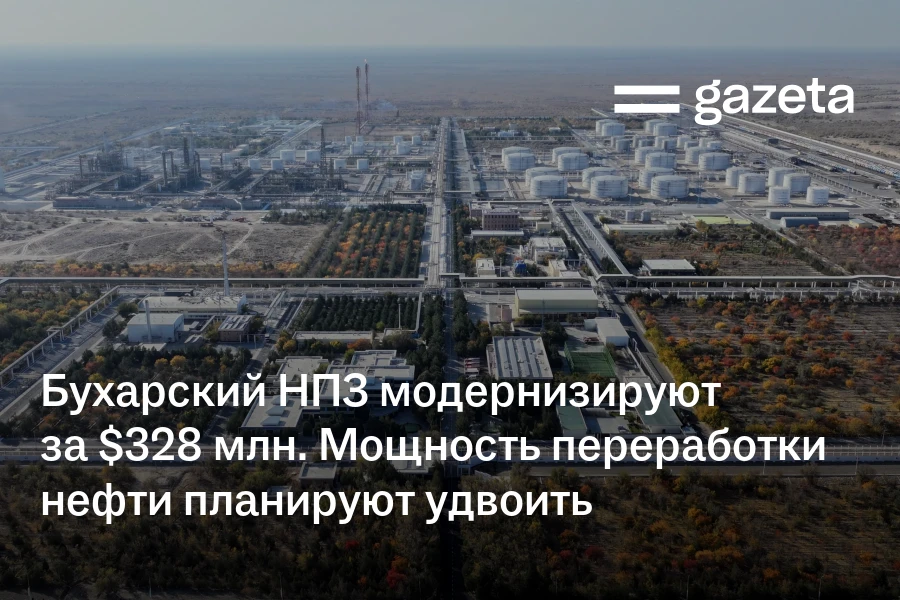
President Shavkat Mirziyoyev visited the Bukhara oil refinery in the Karaulbazar district of Bukhara region on 3 November, inspecting a $328 million modernisation project intended to double the plant’s annual processing capacity from 2.5 million to 5 million tonnes of crude oil and gas condensate.
Of the total cost, $49 million will come from the refinery’s own funds, with the remaining $279 million drawn from foreign loans. The presidential press service did not name the foreign lenders, the contractors engaged, or a completion date for the works.
What the Upgrade Involves
The project centres on installing new naphtha hydrotreating and isomerisation units. Hydrotreating removes sulphur and other impurities from light petroleum fractions, while isomerisation raises the octane rating of the resulting fuel — together enabling the plant to produce AI-92 and AI-95 petrol grades meeting the Euro-5 environmental standard without relying on imported octane-boosting additives. Equipment for primary crude distillation and deeper processing of heavy residues is also to be upgraded.
Mirziyoyev instructed managers to keep to schedule, maintain quality standards, ensure new equipment is compatible with existing production lines, and keep the plant running throughout the construction period. During the visit he met representatives of the foreign companies involved in the project; their identities were not disclosed by the press service.
The Bukhara refinery employs more than 3,200 people and is one of Uzbekistan’s largest downstream facilities. In the first nine months of this year it produced 1.36 million tonnes of petroleum products worth 12.1 trillion soums. Export revenues over the same period reached $99.5 million, with a target of $116 million set for the full year.
A Long History of Delayed Plans
The announcement arrives against a backdrop of repeated, and repeatedly revised, modernisation promises. In April 2019 Uzbekneftegaz presented a $553 million reconstruction scheme — the plant’s first major technological overhaul since it opened in 1997 — designed in three phases between 2019 and 2025 with South Korea’s SK Engineering & Construction. That project envisaged processing 2.5 million tonnes annually and producing 1.2 million tonnes of Euro-5 petrol, along with aviation fuel, diesel and fuel oil, while lifting the refinery’s processing depth from 79 percent to 95 percent. A front-end engineering and design agreement with SK E&C followed in 2020.
By 2024 France’s Axens and China’s CNPC had been drawn into the project. Axens was to design a 360,000-tonne-per-year naphtha hydrotreater and a 380,000-tonne isomerisation unit — the same technologies now described in the current $328 million plan. In May 2024 a deputy chairman of Uzbekneftegaz said the refinery intended to stop making low-grade AI-80 petrol — which at that point accounted for roughly 85 percent of output — from the start of 2025, shifting to AI-91 and AI-92.
What has actually been completed from those earlier programmes, and how the current $328 million scheme relates to or supersedes them, remains unclear. Uzbekneftegaz first signalled the new project at a press conference on 27 October 2026, when First Deputy Chairman Suhrob Hamraev said a feasibility study had been completed, presidential approval obtained and a conclusion issued by the Centre for Comprehensive Expertise. He indicated work could begin in the fourth quarter of 2026 or in 2027, with contractors to be selected through an open tender. Deputy Chairman for Refining Aborjon Hudoyberganov added that current capacity was already being used to its maximum and that stocks of motor petrol available for consumers exceeded 125,000 tonnes.
Hamraev also argued that the shift away from additive-dependent blending would reduce production costs and, ultimately, pump prices — a claim that will be tested once the project reaches completion, whenever that proves to be.