


Listen to the article
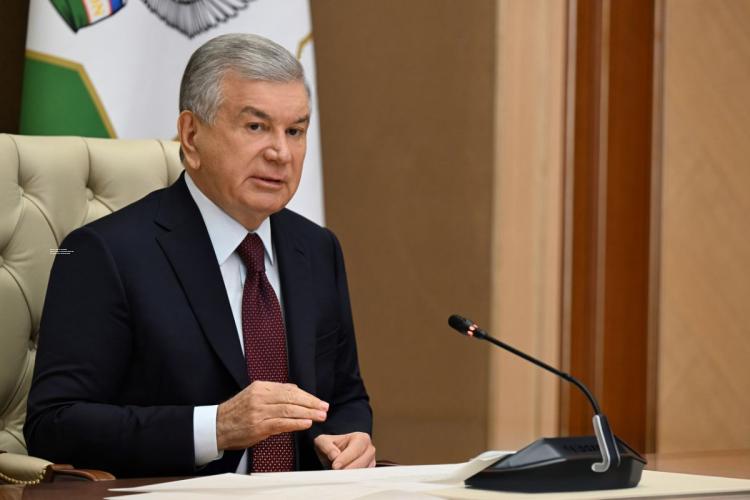
President Shavkat Mirziyoyev has chaired a planning meeting on the 2027 state budget, fixing projected revenues at 416 trillion soums and expenditures at 464 trillion soums while ordering that core tax rates remain unchanged for the year. The decisions, announced by the presidential press service, set the framework for a budget that will be submitted to local Kengashes before going to the Legislative Chamber of the Oliy Majlis.
The draft budget is built on a 7% GDP growth assumption. Authorities forecast nominal output of $232 billion in 2027, up from a projected $200 billion by the end of the current year. Per-capita income is expected to reach $5,200 this year, with a longer-range target of $10,000 within a decade and total GDP of $300 billion by 2030.
Inflation is to be held at no more than 6% in 2027, falling to 5% in 2028–2029. The overall fiscal deficit is to be kept within 3% of GDP. With tax rates frozen, officials said revenue growth must come from stimulating economic activity, broadening the tax base, reducing the shadow economy, and deploying digital tools and artificial intelligence in tax and customs administration.
Social spending rises across education and health
The budget preserves what officials described as the social orientation of public finances. Combined spending on education and healthcare is set at roughly 176 trillion soums. Education receives 114.3 trillion soums, an increase of 14 trillion soums over the previous year, while healthcare is allocated 61.4 trillion soums, up 12 trillion soums. A further 70 trillion soums is earmarked for regional and mahalla infrastructure, employment, human capital development and social protection.
Mirziyoyev stressed that every soum of budget funds must produce a concrete result. Officials were instructed to pilot a digital monitoring system capable of tracking expenditure in full across construction projects under the state investment programme, with the aim of tightening budget discipline and cutting inefficient spending.
New industrial model targets high-value sectors
The meeting identified a shift to a new economic growth model as the central task from 2027 onward. The approach centres on modern industrial policy: moving toward high-value-added output, attracting advanced technology, integrating domestic enterprises into international supply chains and diversifying exports.
Accelerated development strategies are being drawn up for chemicals and petrochemicals, mechanical engineering, electrical engineering, textiles and pharmaceuticals. Emerging areas singled out for priority attention include semiconductor technology, robotics, biotechnology, high-technology components and electric-vehicle batteries.
Each priority sector is to attract at least two or three major international investors in 2027. New mechanisms will be created to draw in global brands, support research and development, and build competitive domestic producers. Modern industrial zones are to be established and localisation deepened.
Responsible officials were instructed to develop sector-by-sector and region-by-region plans to bring in $65 billion in foreign investment during 2027. Non-gold exports are targeted to reach nearly $40 billion the same year.
State assets, energy and WTO accession
The meeting also addressed the transformation of state enterprises and banks, the acceleration of privatisation, improvements to energy and transport infrastructure, and the completion of Uzbekistan’s accession to the World Trade Organisation. Officials were told to direct state investment toward creating conditions for private capital rather than substituting for it, and to develop modern financing mechanisms that raise the economic efficiency of public investment and subsidies.
On financial sector development, the meeting noted the need to expand private participation in banking, increase the volume of credit, use public-private partnerships for investment projects and deepen cooperation with international financial institutions.
To sustain the social commitments embedded in the budget, the meeting set a minimum annual growth requirement of 7%, to be achieved through existing reserves and new technological drivers — a threshold officials described as necessary for the long-term fiscal framework to remain viable.