


Listen to the article
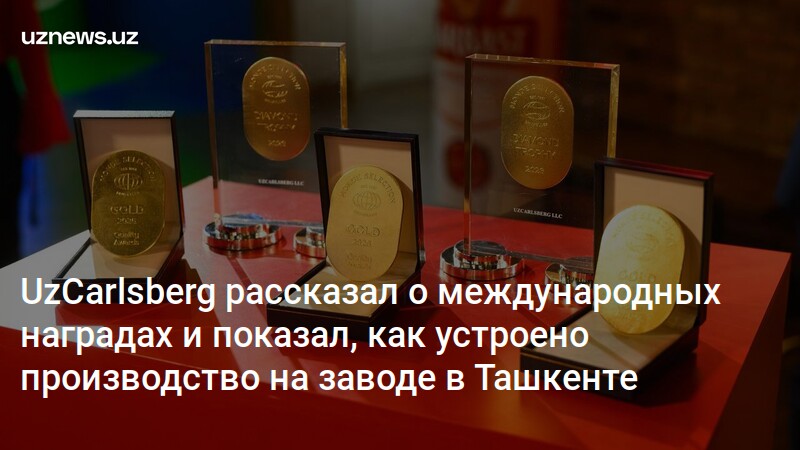
UzCarlsberg’s locally developed beer brand has won a gold medal and the Uzbekistan Country Winner title at the World Beer Awards, and separately claimed the Grand Gold — the highest distinction — at Belgium’s Monde Selection competition, the company announced at its Tashkent brewery on 26 September.
The World Beer Awards is part of the British World Drinks Awards programme, which spans more than 35 beverage categories and uses blind judging. A Country Winner designation goes to the top-scoring entry from a given country in its style, after which it competes against winners from other nations. Monde Selection, founded in 1961, evaluates products on taste, aroma, appearance and laboratory results; Grand Gold is its highest award tier.
Chief executive Nadav Geller said the recognitions reflected adherence to strict international standards on flavour and raw-material quality. “For us a gold medal is undoubtedly a source of pride, but the consumer is the judge. We need them to choose us again and again,” he said.
The awards come in a year when the European Bank for Reconstruction and Development became a shareholder in the company. Geller described the EBRD’s entry as recognition both for UzCarlsberg and for Uzbekistan, noting that a major institutional investor had chosen to acquire a stake in another local business in the country.
UzCarlsberg employs more than 400 people and carries a portfolio of over 30 product lines. In addition to its own national brands, the brewery produces international licensed brands for the domestic market under the same specifications used abroad, a right it obtained after external audits and maintains through periodic reviews.
Marketing director Irina Inyutina said the company had launched three or four new brands over the past two to three years and described the Uzbekistan market as young and fast-moving. “Each season we try something new, each season we give the consumer a choice and work on innovation,” she said, adding that the current portfolio looked very different from what it was seven years ago.
The brewery draws its water exclusively from on-site artesian wells, with pumps set at 200 metres depth. The water passes through multiple purification stages and is tested for alkalinity, hardness and pH. Quality manager Evelina Pogosova, who has worked at the plant for 18 years, said the laboratory conducts more than 200 analyses daily, covering all incoming raw materials, intermediate stages and finished batches. Samples from every raw-material lot are retained for re-testing, and all results are stored on company servers. “If you ask me right now for a result from 2008, I can pull it up immediately and tell you what the quality was,” she said.
Laboratory equipment includes a Japanese spectrophotometer and density analysers from Austrian manufacturer Anton Paar; each analyser delivers eight product parameters within four minutes, allowing continuous in-line monitoring rather than end-of-batch checks. Microbiologists working in sterile booths test raw materials, water, semi-finished product and production lines, including swabs taken from operators’ hands.
A tasting panel of trained in-house experts meets twice a week to evaluate all batches produced over the preceding three weeks. Candidates undergo a selection and training process from which, according to the company, as few as five of 20 applicants may qualify. Panellists must reconfirm their certification every two months against international reference samples. This year the panel moved to a digital format, with results entered on tablets and fed to production technologists.
Production follows a sequence from a brewing vessel — where water and grain are combined — through cylindroconical fermentation tanks, a candle-type kieselguhr filtration stage that removes residual haze, and then to filling lines for glass bottles, cans, PET bottles and kegs. All main-hall lines are automated.
Personnel director Yekaterina Rastrigina said virtually all staff are Uzbekistan nationals. Technical specialists, including electronics engineers who maintain the European-supplied equipment, are recruited directly from universities under agreements that define selection criteria and development pathways. “Literally the entire electronics team was developed and grown here, and they are with us today,” she said.