


Listen to the article
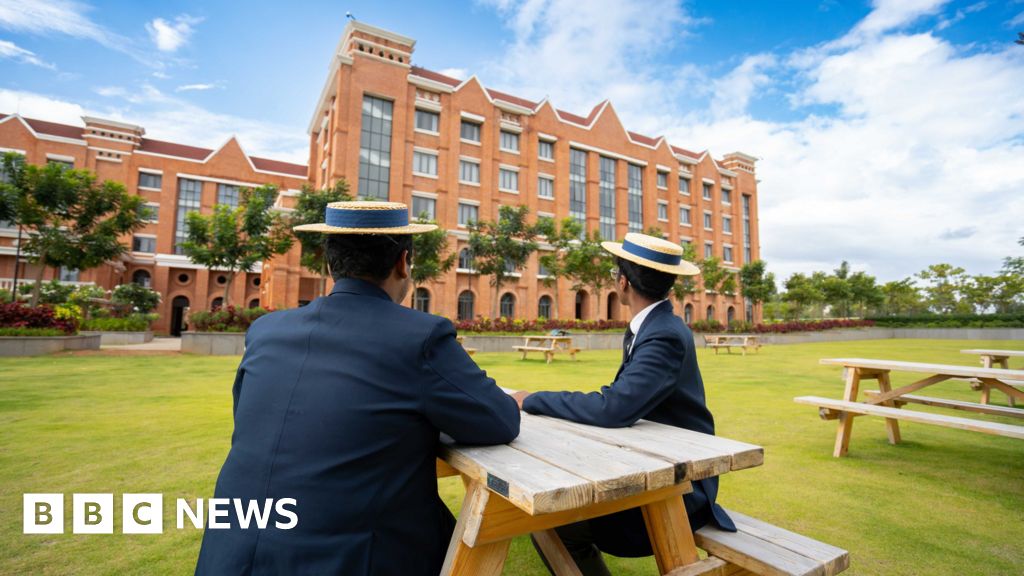
On the outskirts of Chandigarh, in India’s north-western Punjab state, a 473-year-old English boarding school opened its first all-girls international campus earlier this year. The Bedford School’s Mohali premises are modern — purpose-built academic blocks rather than the Gothic stonework of its Bedfordshire original — but a red-brick clock tower signals where the institution comes from.
Bedford Mohali is the newest in at least half a dozen British public schools, including three of England’s oldest, that have established campuses across India. The expansion reflects a convergence of pressures: a rapidly growing population of wealthy Indian families, a slowdown in China and, since 1 January 2025, a 20 percent VAT on private school fees in Britain.
Who has arrived, and where
Harrow School — alma mater of India’s first prime minister, Jawaharlal Nehru — opened in Bengaluru in 2023. Shrewsbury School has a campus in Bhopal. Wellington College has chosen Pune, a western city that markets itself as the “Oxford of the East.” Millfield, Queen Elizabeth’s School and several others are reportedly preparing satellite campuses in the coming years.
Harrow and Bedford are among the few schools in India offering an all-through Cambridge curriculum — a framework recognised at 10,000 schools worldwide — from primary level through to A-levels. Harrow has transplanted its traditions wholesale: teachers are called Beaks, students wear the traditional Harrow hat and uniform, and the school holds The Long Ducker cross-country race that runs across its global network. A house system is in place. These customs sit alongside the Indian national anthem each morning and celebrations of Ganesh Chaturthi.
Sixty percent of Harrow Bengaluru’s staff are international, according to Caroline Pascoe, the school’s head, who told the BBC that the international curriculum is “quite a driver for many” families. Non-resident Indians — those who have returned after stints abroad, or who remain in the UK or the Middle East and want their children connected to their roots — represent a significant secondary market, she said.
Harsimran Singh Kocchar, whose family runs a chain of schools across India, enrolled his five-year-old daughter at Bedford Mohali because of what he described as its “holistic focus on character development, confidence and not merely academics.” He also cited the absence of a “VIP culture”: “Children of ministers and bureaucrats don’t get greater privileges,” he said.
China slowdown and the VAT effect
Much of British public schools’ international expansion over the past decade was concentrated in China and Hong Kong, which together account for half of the 151 satellite campuses operated by 50 UK schools, according to a 2025 study by the UK-based Private Education Policy Forum (PEPF). That growth has since slowed under tighter regulation and, from 2024, a Chinese law requiring schools to integrate patriotic education into all subjects — a requirement that led to some planned campuses being cancelled outright.
The domestic VAT change has added further urgency. Naomi Atkins, founding principal at Bedford School Mohali, said the levy has forced many private schools to look abroad. “They are in a desperate situation. Even those that hadn’t previously looked for international expansion are now suddenly active in India,” she told the BBC.
A harder market than it looks
India has not been straightforward, Atkins acknowledges. Most schools enter through partnerships with local investors or operators. Whereas schools in other markets might once have negotiated a fee of around 10 percent of revenue from a local partner, margins in India have in some cases fallen as low as 1 percent, she said.
The market has also been over-estimated by some entrants. India has nearly 250 million children enrolled in schools, but English-medium education is deeply embedded and competition from established local institutions is far more intense than in non-English-speaking markets such as China, South Korea or Vietnam. Per capita income is also considerably lower, and fees at British schools — which can reach £15,000 or more for full boarding — constrain the addressable market sharply.
“I’ve worked in Indonesia, Malaysia and China but Indians are much more price-sensitive — they like a bargain,” Atkins said. Bedford Mohali has responded by setting its fees at roughly half those charged by other British schools in the country.
Between 2011–12 and 2022–23, the satellite campuses of British schools generated £152.4 million in profit globally, according to PEPF, with that figure growing substantially over the period. In India, however, the trajectory is expected to be gradual. The country’s colonial legacy and its expanding class of newly wealthy families offer a genuine commercial opening, but it is unlikely to offset the loss of the Chinese market in the near term.