


Listen to the article
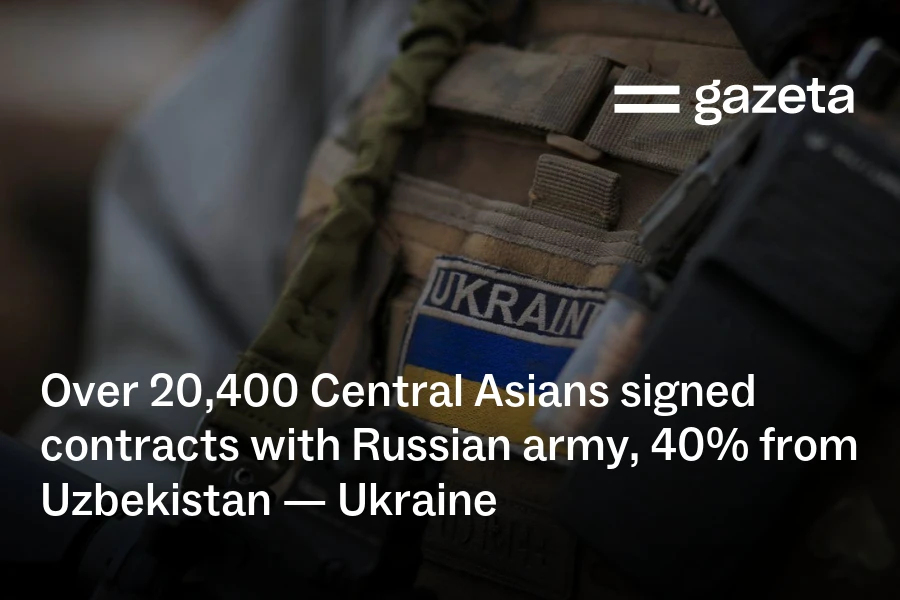
More than 20,400 citizens of Central Asian countries had signed contracts with the Russian Armed Forces to fight in Ukraine as of 1 October 2026, according to figures presented by Ukraine’s prisoner-of-war outreach project “I Want to Live” at a briefing for regional media on 20 October.
Uzbekistan contributed the largest share: 8,207 people, or 40% of the Central Asian total. Citizens of Tajikistan numbered 5,308 (26%), Kazakhstan 3,819 (19%), Kyrgyzstan 2,219 (11%) and Turkmenistan 884 (4%). Taken together, Central Asians represent 44% of all foreign nationals the project has identified as serving in the Russian army under contract.
A project representative cautioned at the briefing that the figures exclude ethnic Central Asians who already hold Russian citizenship, meaning the true total is likely higher.
Recruitment accelerating year on year
The pace of enlistment has risen steeply. In 2024, the project recorded 4,119 Central Asian contract signings, including 1,446 from Uzbekistan. That figure more than doubled to 8,497 in 2025, with Uzbeks accounting for 3,487. In the first nine months of 2026 alone, a further 6,043 people signed contracts — 2,602 of them Uzbek citizens — equivalent to 71% of the entire 2025 figure.
“Recruiting residents of neighbouring countries is particularly convenient due to linguistic, cultural and migration ties,” the project stated in its presentation.
Three recruitment methods identified
“I Want to Live” describes three principal methods used to draw foreign nationals into Russian service. The first is financial inducement: recruiters reportedly promise monthly salaries of $2,000–$3,000, Russian citizenship and additional benefits. The project acknowledges that many recruits knowingly accept these terms in pursuit of income.
The second method is deception. Advertisements offer high-paying civilian work in construction, security, warehousing or driving, sometimes noting that the role is “in the interests of the Ministry of Defence” without disclosing combat deployment. After signing, recruits undergo a brief period of military training before being sent to the front. The project says this approach is most prevalent among citizens of Sri Lanka, Cuba, Nepal and several African countries.
The third method is coercion, which the project identifies as particularly common in Central Asia. Police raids detain undocumented migrants or those with expired documents, who are then threatened with imprisonment or deportation and offered an alternative: sign a contract with the Russian Defence Ministry in exchange for money and citizenship.
Prisoners cite citizenship and fear of prosecution as top motives
As of 12 October 2026, hundreds of foreign nationals who fought for Russia were being held in Ukrainian captivity, drawn from 59 countries, with the project noting their numbers grow each year. The seven most represented nationalities among foreign prisoners of war were, in the order listed in the presentation, citizens of Uzbekistan, Tajikistan, Belarus, Colombia, Kazakhstan, Azerbaijan and Kyrgyzstan. No country-by-country breakdown of prisoner numbers was provided.
More than 90% of foreign prisoners completed a survey on their motivations. Among respondents from Central Asia, the desire to obtain Russian citizenship was the leading reason, cited in 32% of responses. Escaping prison or avoiding criminal prosecution accounted for 20% — the highest proportion of any regional group surveyed. The desire to earn money represented 10% of responses, and avoiding deportation from Russia 6%. Twelve percent of responses indicated that recruits had signed voluntarily in support of Russia’s military actions; a project representative said ethnic Russians who had lived in Central Asia before the war also gave this reason in personal interviews.
When asked about future plans, prisoners from Central Asia overwhelmingly said they wanted to return to Russia, accounting for 82% of answers. Returning to their home country was mentioned in only 11% of responses. The project representative said prisoners explained this by describing themselves as Russian citizens — even those who had received Russian passports only after signing their contracts — and by expressing fear of prosecution at home, noting that mercenary activity is a criminal offence across the region. The prisoners also said they expected financial compensation for their combat service.