


Listen to the article
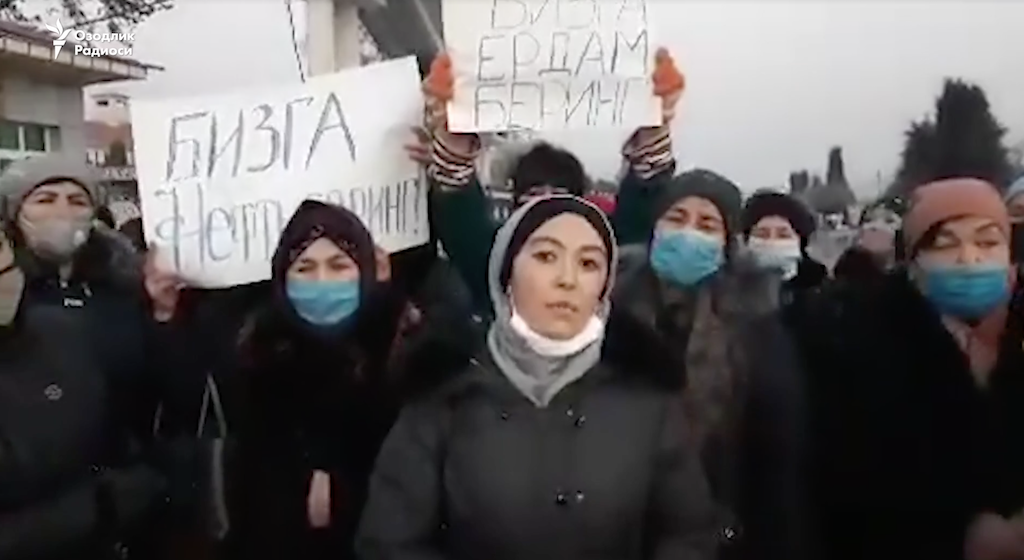
Workers at the Altyaryk oil refinery in Ferghana province have been on strike since January 10, staging street sit-ins and carrying placards reading “Help us,” “Give us work” and “Give us oil,” according to footage obtained and broadcast by RFE/RL’s Uzbek service, Radio Ozodlik.
The dispute centres on what employees describe as a production standstill lasting nine months and warnings from management that roughly 2,000 workers face dismissal from March. The Altyaryk plant is an asset of Ferghana Oil Refinery, known by its Uzbek acronym FNPZ, which is managed by Jizzakh Petroleum — a joint venture established in 2017 between state energy company Uzbekneftegaz and Russia’s Gazprom.
Mamura Sayfutdinova, a spokeswoman for FNPZ, flatly rejected the workers’ account. “This is incorrect information. We are taking steps to preserve jobs and wages for workers,” she told Eurasianet. The company has also pointed to a June announcement of a $300 million refurbishment of the plant aimed at producing Euro-5 standard petrol, with completion scheduled for 2023. In December, Jizzakh Petroleum posted a statement on its website saying modernisation work had begun, though by January 19 that text had been replaced with Lorem ipsum placeholder text.
A plant employee who spoke to Eurasianet on condition of anonymity, identifying himself only as Sherzod, contradicted the company’s position. He said the Altyaryk facility was at a standstill and that around 200 workers had been relocated to the company’s headquarters in the city of Fergana. “Factory workers were told that 2,000 people would be laid off from March this year. I have not signed dismissal papers yet. I told the management that I had no other profession and could not find another job. I believe that the cutbacks are illegal, we demand justice,” he said.
Sherzod said his monthly salary before the Jizzakh Petroleum takeover had been around 3 million soums — approximately $300 at current rates — but that wages had since been cut by as much as $150 a month, with other benefits also reduced.
Ownership questions shadow the transition
The transfer of the Ferghana refinery complex to Jizzakh Petroleum has drawn criticism beyond the factory floor. Alisher Ilkhamov, a research associate at the School of Oriental and African Studies in London, wrote in a Facebook post in August that the handover to the joint venture was conducted without a competitive tender. “All these super-profitable assets are being transferred to Russian companies without transparent and open tenders, apparently thanks to personal connections,” Ilkhamov wrote.
The refinery had previously been linked to Akbarali Abdullayev, the son of late President Islam Karimov’s sister-in-law. Abdullayev was charged with fraud and embezzlement in 2014 and was arrested in Ukraine in January 2017 at Uzbekistan’s request; he was still contesting extradition as of the time of reporting. Critics have argued that the Jizzakh Petroleum arrangement replaced one opaque ownership structure with another.
As of January 19, the strike was continuing, with no resolution announced by either workers or management.