



Listen to the article
A sale of one of Uzbekistan’s state-owned banks in 2027 remains possible but cannot yet be treated as a foregone conclusion, Fitch Ratings said on 27 October, raising the prospect of yet another delay to a privatisation programme that has already been pushed back once.
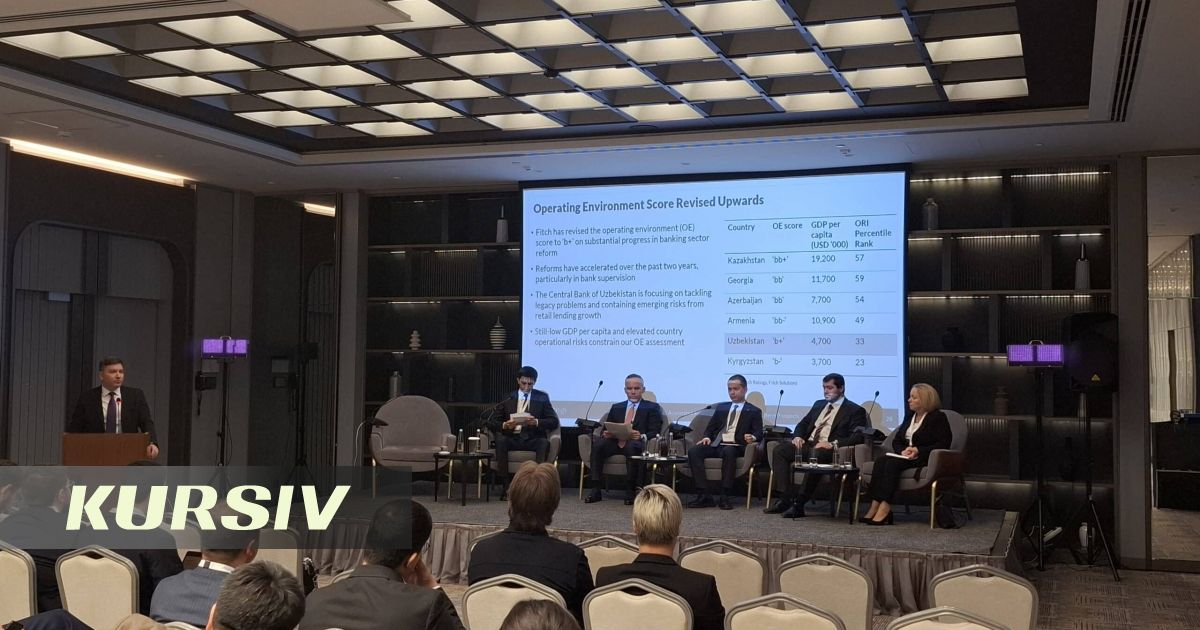
Pavel Kaptel, Fitch’s director for Uzbekistan’s banking sector, told the agency’s Fitch on Uzbekistan conference that pre-sale preparation could yet demand more time than the current schedule allows. “We certainly believe that a sale of one bank next year is possible, but we do not consider this a one-hundred-percent scenario at this point,” he said. “There is a scenario where preparation takes a little more time and the sale could be pushed somewhat further out.”
A Programme Already Revised Once
Uzbekistan’s authorities revised their privatisation timetable at the start of 2026. Under the updated Uzbekistan 2030 strategy, no state-bank sale was scheduled for 2026; the process was to begin in 2027. The broader ambition is to reduce the number of state-owned banks from nine to four by 2030, transferring five institutions to private investors.
Fitch’s focus has narrowed to two candidates: Uzpromstroibank, known by its Uzbek acronym SQB, and Asakabank. Together the two institutions hold roughly 17 percent of the banking system’s total assets — a share large enough that their successful sale would materially reshape the sector’s ownership structure and, in Fitch’s assessment, improve the overall operating environment for all banks.
Of the two, Kaptel identified SQB as the more advanced candidate, citing progress in transforming its business model. Asakabank is following a different path: a presidential decree dated 20 April 2026 envisages the European Bank for Reconstruction and Development acquiring a 15 percent stake in the bank as part of its transformation and preparation for privatisation. SQB, meanwhile, is being prepared with the involvement of the Uzbekistan National Investment Fund, which is managed by Franklin Templeton.
Kaptel said the involvement of such institutions was a positive signal. “From our point of view, the engagement of such influential, important players in the pre-sale preparation and business-model transformation undoubtedly improves the medium-term prospects for the sale of both banks,” he said.
Legacy Loans Remain the Key Obstacle
The most persistent structural hurdle is the stock of old problem loans accumulated by state banks over years of directed lending. Fitch acknowledged that authorities and the banks themselves have undertaken significant work to clean up asset quality in recent years — injecting additional capital and writing off portions of legacy bad debt.
The agency noted that the share of recognised problem loans at the banks undergoing transformation has risen somewhat in recent years, but cautioned against reading this as straightforward deterioration. The increase is partly a function of stricter loan-classification and provisioning rules being applied as the banks modernise their governance, Fitch said, rather than a sign that underlying credit quality is worsening.
Separately, Fitch’s director for Asia-Pacific sovereign ratings, Sagarika Chandra, noted at the same conference that risks associated with Uzbekistan’s large state sector — including its dominant state banks — are factored into the agency’s assessment of the country’s creditworthiness, and that sustained structural reform, high growth and improved public finances would be needed for Uzbekistan to reach an investment-grade sovereign rating.