



Listen to the article
Hundreds of thousands of people marched through French cities on Saturday in a wave of demonstrations that exposed a sharp dispute over the scale of public anger: the Interior Ministry recorded 410,000 participants nationwide, including 110,000 in Paris, while the CGT trade union — one of the principal organisers — counted 800,000 marchers across the country and 250,000 in the capital alone.
The protests, which spread across more than 100 cities, were driven by a convergence of grievances including the rising cost of living, cuts to social spending, corruption scandals and, according to the source reporting, demands related to school uniform policy. The breadth of the coalition behind the demonstrations reflects frustrations that have been building across several fronts simultaneously.
In Paris, the march proceeded without significant incident. The rally had been formally authorised by city authorities and drew members of the left-wing party La France Insoumise, including its presidential candidate Jean-Luc Mélenchon. The Interior Ministry described the atmosphere in the capital as broadly calm.
Lyon: Bans and Tear Gas
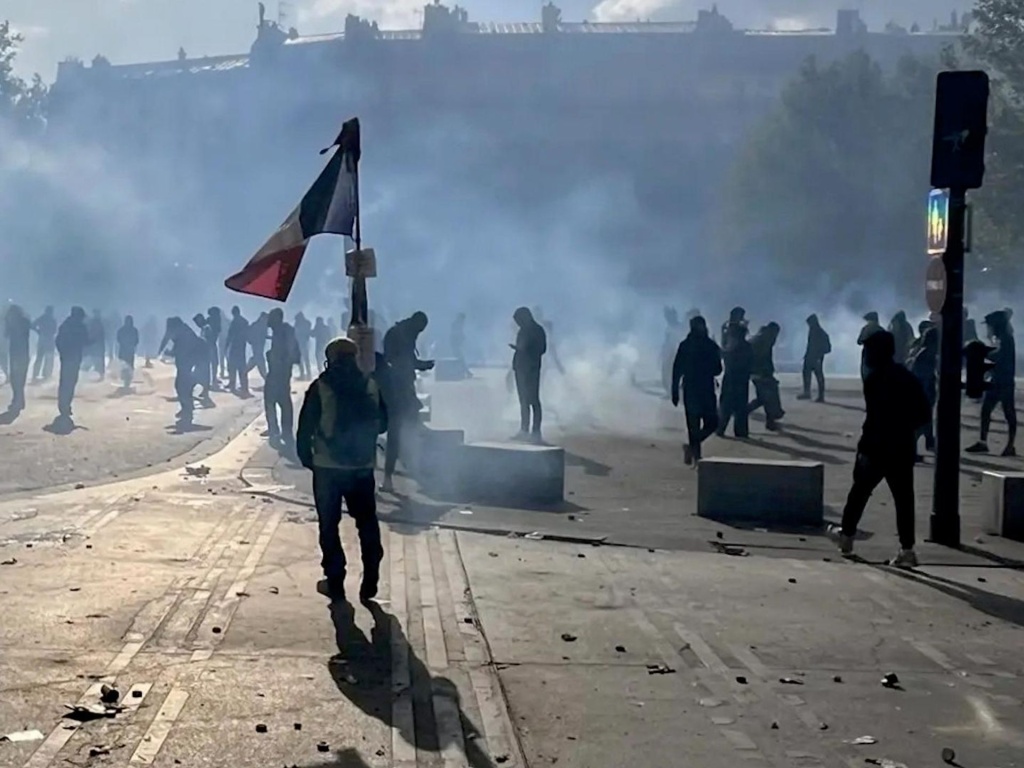
The picture was different in Lyon, where local authorities had pre-emptively banned demonstrations citing the risk of disorder and vandalism. Police moved against a group of approximately 150 activists who gathered despite the prohibition, deploying tear gas to disperse them. Lyon was not alone: several other cities also imposed bans on marches for similar reasons, reflecting official concern that organised protests could provide cover for more destructive elements.
The contested attendance figures are themselves a feature of French protest politics. Government tallies, compiled by the Interior Ministry, consistently run lower than those provided by unions and organisers, and the gap between the two sets of numbers — roughly double in this case — illustrates how the same event can be framed as either a significant but manageable expression of discontent or a mass popular uprising, depending on which count is accepted.
Saturday’s demonstrations are part of a broader pattern of street mobilisation that has swept several European countries in recent days, with protests in multiple nations accompanied by clashes with police, property damage and hundreds of arrests, according to the reporting. France’s marches appear, at least in Paris, to have remained within the bounds of the authorised route, though the situation in cities where bans were imposed proved more volatile.