



Listen to the article
Two men widely discussed as potential presidential candidates in Kyrgyzstan have failed to score the required marks on the country’s mandatory state language examination at their first sitting, according to reporting by Bishkek news outlet 24.kg — underlining a broader pattern in which fewer than one in five test-takers pass on their initial attempt.
Omurbek Suvanaliyev and Siymik Japiqayev both fell short of the required score when they first sat the Kyrgyztest examination, 24.kg reported. Japiqayev subsequently retook the test. A third prospective candidate, Iskhak Masaliyev, has also sat the exam, though his results had not been made public at the time of reporting.
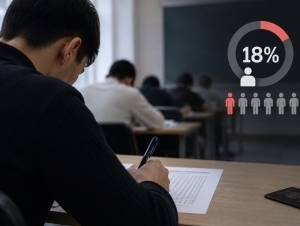
The failures are not outliers. To assess the test’s difficulty, 24.kg downloaded and reviewed 200 result files published on the Kyrgyztest website covering the period from January to October 2026. Of the 21,552 people who sat the exam for the first time during that period, only 3,859 — 17.9 percent — achieved a passing score. When repeat sittings are included, the share of all participants who eventually passed rises to roughly 41 percent.
Kyrgyztest, the state body that administers the examination, provided its own figures to 24.kg, recording 30,525 test sessions between January 1 and October 1. Of those, 13,278 resulted in a confirmed pass — 43.5 percent of all sessions, a figure the outlet noted was broadly consistent with its own analysis. The agency’s data did not, however, distinguish between first attempts and retakes.
The examination consists of five sections: lexis and grammar, listening comprehension, reading, writing, and speaking. Candidates have two hours and fifty minutes in total. The lexis and grammar section is the largest, requiring 90 tasks to be completed in 70 minutes. Writing and speaking each contain three tasks.
According to 24.kg’s breakdown, writing and speaking proved the hardest sections: before September, more than half of all candidates failed both. Reading and listening were comparatively more forgiving. The overall first-attempt pass rate has also worsened since September, when the lexis and grammar section was temporarily removed as a standalone component and its content folded into the other sections. Before that change, roughly one in five candidates passed all sections at the first sitting; after it, the ratio dropped to approximately one in nine.
Public figure Ilim Qaripbekov decided to take the test himself to gauge its difficulty firsthand. He concluded, according to 24.kg, that failing would require either a genuine lack of Kyrgyz language ability or a deliberate effort to answer incorrectly.
The stakes of the examination are rising. Under a phased schedule, civil servants and municipal employees must demonstrate at least a B1 level of Kyrgyz from 2025, rising to B2 from 2027. Staff at state enterprises, schools, research institutions and medical facilities face the same B1 threshold from 2026 and B2 from 2028. Ethnic minority citizens who are permanent residents and nationals of Kyrgyzstan are subject to a separate, lower schedule: A2 from 2026 and B1 from 2028. Proficiency is assessed on a scale running from A1 to C1.
The timing matters for the political calendar. Candidates for the presidency are required to demonstrate command of the state language, making Kyrgyztest results a formal hurdle rather than a symbolic one for anyone seeking to stand in the next presidential election.