



Listen to the article
Every country in Central Asia has deepened its authoritarian trajectory over the past year, according to Freedom House’s annual Nations in Transit 2024 report, which tracks democratic performance across 29 countries in Central Europe and Central Asia and documents a regional decline now stretching two decades.
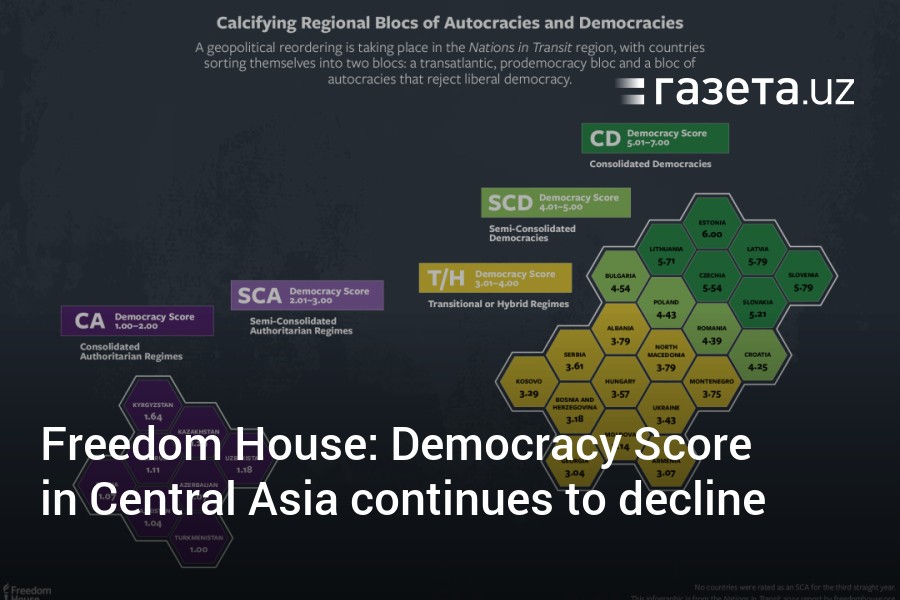
Uzbekistan received a Democracy Score of 1.18 out of a possible 7 points, down from 1.21 the previous year. Kazakhstan dropped to 1.29 from 1.32, and Kyrgyzstan fell to 1.64 from 1.68. Tajikistan scored 1.04, while Turkmenistan received the lowest mark in the entire survey at 1.00 — a perfect floor. All five countries sit in Freedom House’s lowest classification: Consolidated Authoritarian Regimes.
Across the full 29-country survey, 10 states recorded declines in their Democracy Score over the past year while only five registered improvements. Freedom House attributes the region’s failure to consolidate democratic governance to authoritarian and anti-democratic leaders who have reinforced their grip rather than loosened it.
Kazakhstan and Kyrgyzstan cross a threshold
The report singles out Kazakhstan and Kyrgyzstan for particular attention, noting that both countries, which had previously scored at the less repressive end of the authoritarian range, now fit the broader Central Asian trend of authoritarian consolidation. Together with Azerbaijan, Belarus and Russia — which scored 1.07 each — all eight states in the Consolidated Authoritarian Regimes category continued to, in Freedom House’s phrase, “lead the race to the bottom” over the past year. Belarus scored 1.11; Russia and Azerbaijan each received 1.07.
The organisation frames the broader regional picture against the backdrop of Russia’s full-scale invasion of Ukraine and the conflict in Nagorno-Karabakh, arguing that those events have “accelerated a geopolitical reordering in the region, with countries sorting themselves into two opposing blocs: those committed to a liberal, democratic order and those that violently reject it.”
Where the region’s higher scores sit
At the opposite end of the scale, Estonia led all 29 countries with a score of 6.00, followed by Latvia and Slovenia at 5.79 each. Among countries classified as Hybrid Regimes — a middle tier that includes Armenia, Georgia, Hungary, Moldova and Ukraine — Ukraine scored 3.43, Armenia 3.07 and Georgia 3.04. Ten countries, among them Bulgaria, Latvia, Lithuania and Poland, fell into the Semi-Consolidated Democracies category.
The Nations in Transit findings follow a separate Freedom House assessment published in March, in which Uzbekistan scored 12 out of 100 points on the organisation’s annual freedom rating. That report classified all Central Asian countries as “not free.”