


Listen to the article
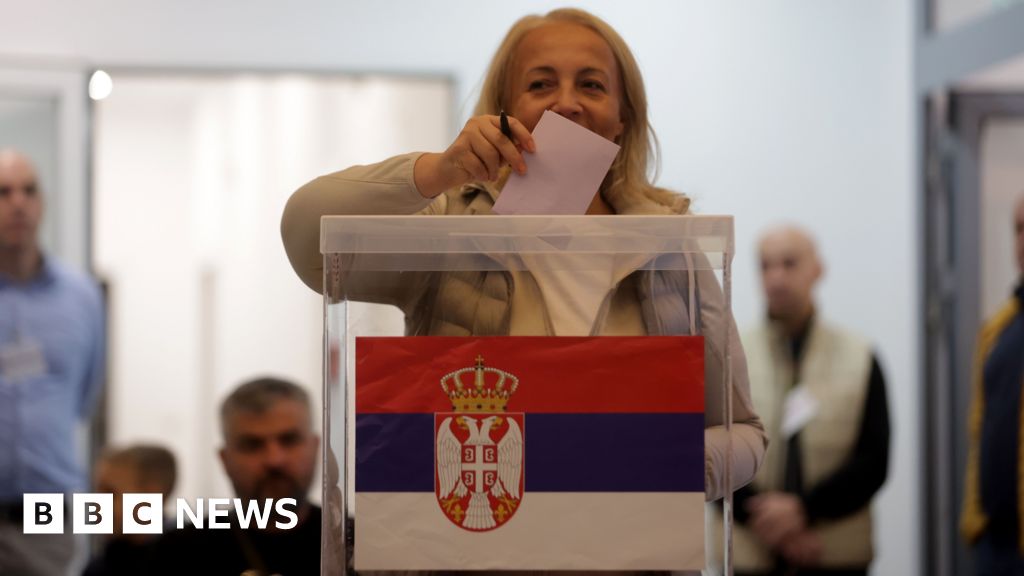
Serbian voters turned out in unexpectedly large numbers on Sunday as the country held a snap parliamentary election that pits President Aleksandar Vučić’s ruling Serbian Progressive Party against a student-led opposition movement born out of two years of anti-corruption protests.
Preliminary figures showed 46 percent of the electorate had voted by 14:00 local time — nearly a million more than the comparable figure recorded during the December 2023 election. Most commentators had suggested that a final turnout of 65 percent or above would favour the opposition Student List, making the early numbers a source of cautious optimism among its supporters.
Long queues formed at polling stations across Serbia, from larger cities to smaller towns, and at Serbian missions abroad including Ljubljana, Munich, Los Angeles, Chicago and Paris, where voters waited in heavy rain. In Belgrade, police closed streets around the Republic Electoral Commission, while nearby drivers lowered their windows to blast the students’ unofficial anthem — a folk song called “I Want Three Kisses,” chosen because Student List appears as number three on the ballot paper. Young people on the pavement began dancing.
A movement born from tragedy
The election was called after Vučić dissolved parliament following sustained protests triggered by the November 2024 collapse of a canopy at a train station, which killed 16 people and became a symbol of what demonstrators described as systemic corruption and state negligence. The protests, led largely by university students, eventually coalesced into a formal political vehicle: the Student List, whose 250 parliamentary candidates were chosen by student assemblies at university faculties rather than by a conventional party apparatus.
The list is headed by Ilija Srdanović, a professor at Novi Sad University, and includes doctors, actors, academics and sports personalities alongside student representatives. Its manifesto calls for removing officials who cracked down on protesters, ending the practice of placing party loyalists at the heads of public enterprises, and freeing the national broadcaster from political control.
Vučić and the SNS deny corruption and deny seeking to influence the media. Having served two terms as president and being constitutionally barred from a third, Vučić is now leading his party with the aim of returning to the prime ministership, a post he last held in 2017. He retains substantial support, with backers crediting him with significant economic growth over the past decade and improvements in infrastructure. His campaign pledges include higher pensions and public sector salaries and investment in state healthcare.
Fraud allegations and observer deployment
Amid fears of electoral manipulation, the Student List deployed at least two observers to each of Serbia’s 8,210 polling stations. Videos circulating on social media on Sunday showed a café in the southern city of Niš where ballot papers appeared to have been filled out in advance — a practice known as chain voting. When those inside realised they were being filmed, the papers were quickly concealed. There were also reports of attacks on election monitors and journalists at several polling stations.
The electorate stands at 6.45 million in a population of 6.53 million, a disparity that has raised concerns about the reliability of the electoral register. Serbs from Kosovo and dual Serbian citizens from neighbouring Bosnia also hold voting rights.
What a close result could mean
Žarko Korać, a former deputy prime minister and long-standing opponent of nationalist parties including the SNS, told the BBC the election represented “a unique experiment in European contemporary history.” He noted the inherent uncertainty of a governing coalition assembled from 250 candidates who do not know one another and whose political beliefs are largely unknown. “It’s anybody’s guess what happens after they win,” he said.
Korać also warned that a narrow or disputed result carried its own risks. “If Vučić declares victory this evening, probably late in the evening, I don’t think the students will accept that,” he said, adding that a close outcome with both sides claiming victory could produce weeks or months of political instability. He suggested that some current Vučić loyalists in senior positions might switch sides at the last moment if the students appeared to have won.
Katarina, a 29-year-old Serbian citizen who flew back from the Netherlands specifically to vote in person rather than cast a remote ballot, told the BBC outside a polling station in Belgrade’s Zvezdara district that she believed Student List had a genuine chance of winning, but expressed doubt about whether such a result would be respected. On the question of the candidates’ political inexperience, she said: “Just because they’re politically inexperienced, they are experts in their own fields, which we have not seen thus far.”
Voting was due to close at 20:00 local time, with first indications of results expected two hours later.