


Listen to the article
When the production team behind Rise of the Conqueror (Amir Timur) needed rain for a pivotal battle scene, they called the fire service of the Almaty region. Tens of tonnes of water were pumped onto the set each day for four consecutive days to simulate the conditions of the only engagement in Timur’s military career that ended in defeat. It was, by the director’s own account, the hardest sequence he had ever made.
The film had its world premiere on 2 April and has since been released across more than 120 countries, with theatrical screenings in 30 of them. Executive producer and co-screenwriter Behruz Hamzayev said distribution rights had been sold to that same number of territories, with the film’s potential audience estimated at over 250 million viewers.
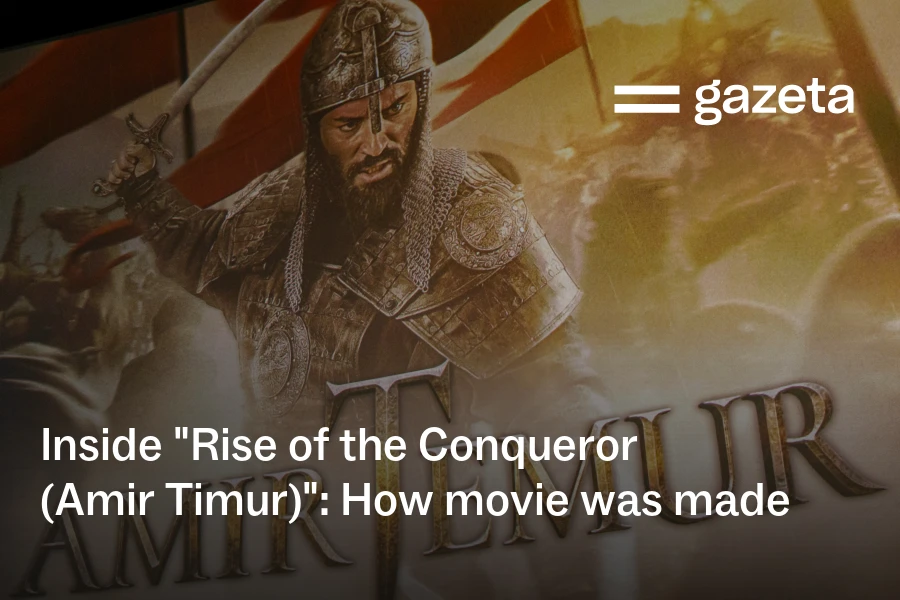
The production is a collaboration between international companies Mystery Box, 7SABER and BWG Production. It follows a young Amir Timur — the 14th-century ruler and founder of the Timurid dynasty, also known as Tamerlane — as he pursues power in the aftermath of a grave injury and profound personal loss, set against the political fragmentation that followed the collapse of the Mongol Empire along the Silk Road.
Telling the story from the inside
For Hamzayev, the project carried a weight beyond filmmaking. “For many people, it has been a source of deep pain to have their history narrated by outsiders,” he said. “We are proud to finally be telling the story of our ancestors ourselves, through our own perspective and in our own voice.”
Director Jacob Schwartz said the production crew worked closely with Uzbek historians and cultural consultants throughout, with the screenplay drawing on primary historical sources including the Institutes of Timur. He was candid about the limits of that effort. “I think we did our best to try to make the film as historically accurate as possible,” he said. “Whether it was historically accurate — that is for audiences to decide.”
One of the production’s defining commitments was to shoot entirely on location, forgoing studio sets and CGI altogether. Filming took place across Uzbekistan and Kazakhstan, with around 530 people working on set each day and the number rising to 800 during battle sequences.
The battle that moved to Kazakhstan
The most demanding of those sequences was the “Battle in the Mud,” which depicts Timur and his ally Emir Husayn facing the Moghulistan khan Ilyas-Khoja. Because an insufficient number of trained horses was available in Uzbekistan, the entire sequence was relocated to Kazakhstan. The Almaty region fire service was brought in to simulate rainfall, and filming lasted four days.
The leading role was taken by Danish actor Christian Mortensen, who also served as a producer. Mortensen and Schwartz have collaborated for two decades, and the film represented the fulfillment of a long-held ambition for both. “We have dreamed of telling different stories, whether it is George Washington in the United States, one of our revolutionary heroes, or your revolutionary hero, Amir Timur,” Mortensen said. “And the goal was always to humanize these people who seem larger than life. But what I found over the time of filming in Khiva, in Toprakala, in Almaty, I did not find the legend. I found the man.”
A cast drawn from across the world
The role of Emir Husayn was played by Mahesh Jadu, known internationally through the series The Witcher and Marco Polo. Asked whether historical drama demanded a different approach from fantasy, he pushed back on the distinction. “Sometimes when you’re playing a character that is from a real story, you have to find the magic in it, and then when you’re playing a character that is about fantasy and magic, you have to find the truth in it. So for me, it’s sometimes two sides of the same coin,” he said.
Joshua Jo, who portrayed the antagonist Ilyas-Khoja, drew on his background in voice acting to develop a distinct vocal quality for the character. The scene that left the deepest impression on him was a tense chess match with Mortensen. To ensure the sequence appeared convincing, both actors spent two weeks studying the game before filming began.
Jo also spoke about an early moment on set in Uzbekistan. The 65-year-old Uzbek actor Maruf Atadjanov cooked plov for the entire crew of thirty people. When Jo addressed him as “sir” the following morning, Atadjanov declined the formality. “There is no need for that,” he said. “Call me dada” — the word for father. Jo described it as the most generous gesture he had received from a senior colleague in his professional career.