



Listen to the article
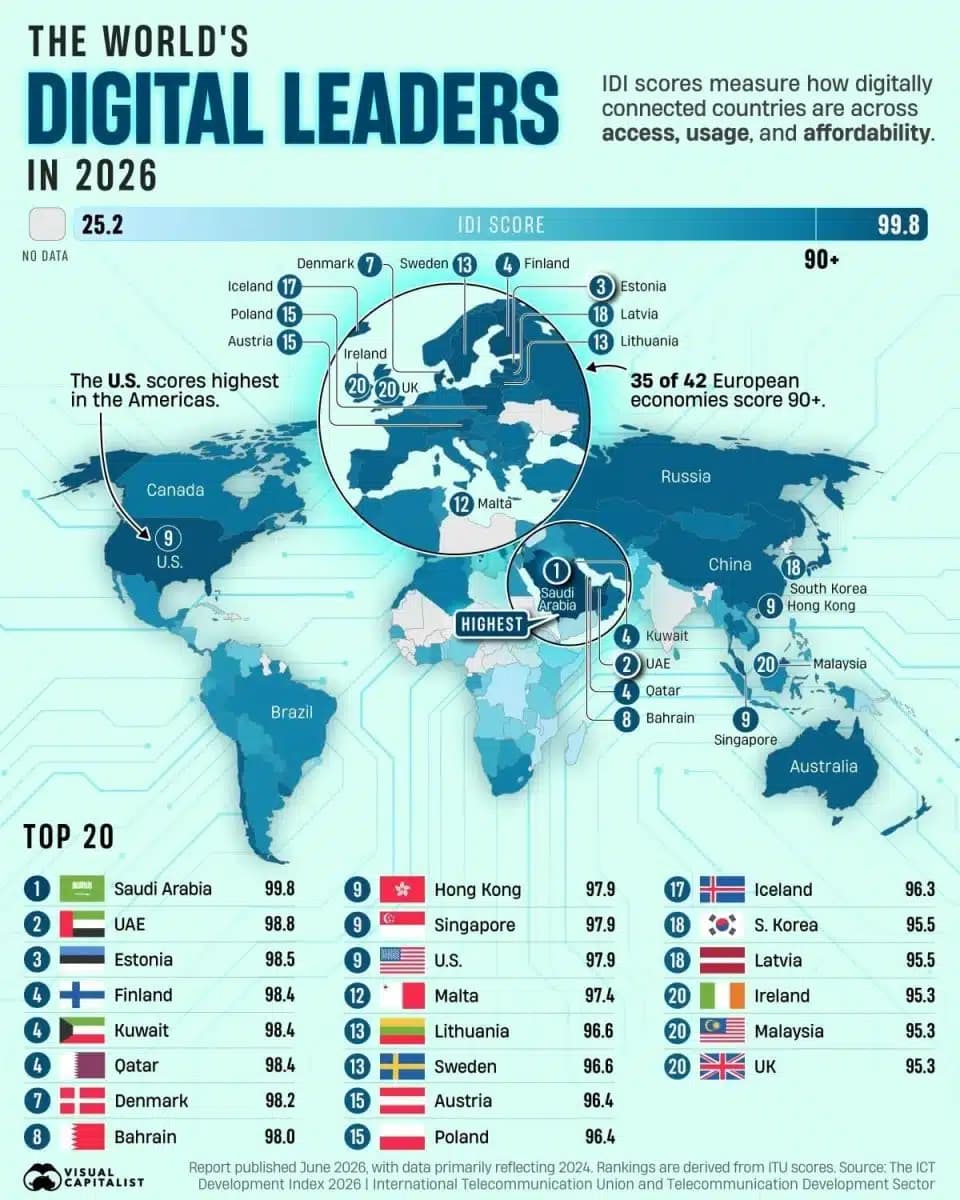
Saudi Arabia has topped the International Telecommunication Union’s 2026 ICT Development Index, scoring 99.8 out of 100, according to a Visual Capitalist analysis of the data covering 159 economies. The kingdom recorded a perfect 100 points for universal connectivity and 99.6 for meaningful connectivity.
The IDI measures how far countries have advanced toward what the ITU terms “universal and meaningful digital connectivity.” It is built from ten indicators encompassing internet access and use, network coverage, data consumption and the affordability of internet services for the general population.
Five of the ten highest-scoring economies are in the Middle East. The United Arab Emirates, Kuwait, Qatar and Bahrain all placed alongside Saudi Arabia in the upper tier, underlining the region’s rapid infrastructure investment in recent years. The Arab states region as a whole, however, shows sharp internal disparities: the regional average stands at 78 points, yet individual scores range from near-maximum down to 37, illustrating how access, adoption and pricing can diverge dramatically even between neighbouring countries.
Europe and Asia-Pacific
Among European economies, Estonia leads with 98.5 points, followed by Finland at 98.4 and Denmark at 98.2. In the Asia-Pacific region, Hong Kong and Singapore each scored 97.9, matching the United States, which ranks ninth overall. South Korea recorded 95.5 and Malaysia 95.3. The Asia-Pacific region also shows wide internal variation, with a gap of 62 points between its highest and lowest performers; urbanisation rates, telecoms infrastructure and household incomes are identified as the principal drivers of that spread.
Russia and China each registered 94.4 points. The index notes that cloud technology and artificial intelligence adoption are drawing new investment into Malaysia, Indonesia and Thailand, contributing to Asia’s broader expansion in data-centre construction and digital infrastructure.
Uzbekistan’s position
Uzbekistan scored 88.8 points, placing it above the global average of 79 but below the cluster of high-income economies that dominate the top tier. Fifty-nine of the 159 economies assessed fell in the 90–100 band, while 15 scored below 50.
The index underscores a persistent correlation between income levels and digital development. Low-income economies average 42 points on the IDI, whereas high-income economies average 93 — a gap of more than 50 points that the data suggest has not meaningfully narrowed.