


Listen to the article
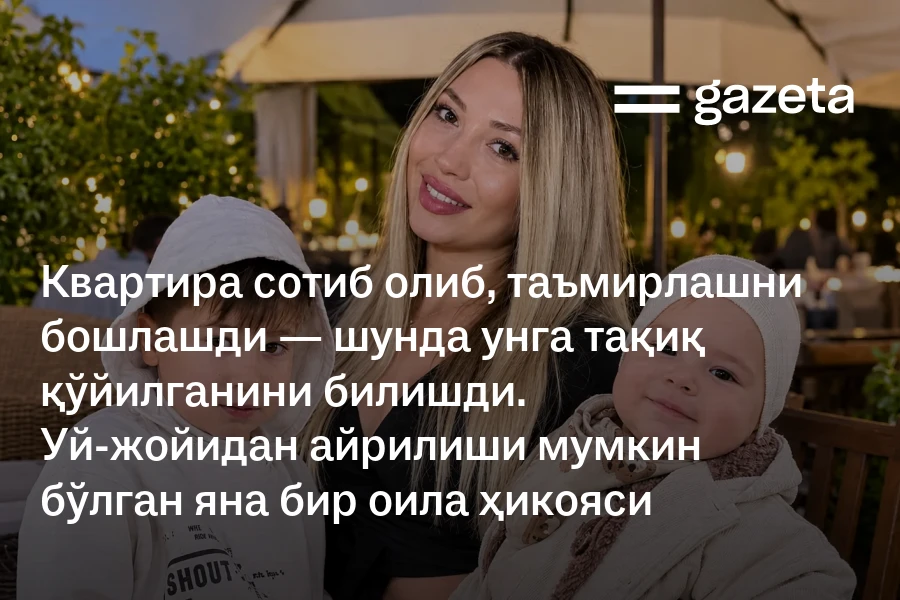
Adelina Baldina’s family sold their home, pooled every soum of the proceeds and bought a larger flat in Tashkent’s Mirzo Ulugbek district last October. Within a week of signing, they discovered the prosecutor’s office had placed a legal prohibition on the property. A court ruling issued on 23 October now threatens to hand back not the $85,000 they paid but the 71.3 million soums — roughly $5,870 at the October 2025 exchange rate — written into the notarised contract. The gap between those two figures is nearly fourteen-fold.
Baldina’s account, shared with Gazeta.uz, is the third in a series of cases the outlet has documented in which Tashkent buyers who completed all required legal steps have found themselves fighting overseas heirs in court over flats they believed were legitimately theirs.
How the purchase unravelled
The family of five — Baldina, her husband, two sons aged twelve and one-and-a-half, and her elderly pensioner mother — had been living in a three-room flat of about 60 square metres in the Darkhon-3 neighbourhood. By August 2025 the space had become too small, so they sold it and began searching for something larger while staying temporarily with relatives.
In October they found a listing on OLX for a 61.92-square-metre flat in the Ts-1 neighbourhood of Mirzo Ulugbek district. The seller, identified as Elmira M., showed documents registering the property in her name under a sale-and-purchase agreement dated 10 October 2025 — just days before Baldina’s own transaction. The asking price of $85,000 matched market rates for the location and condition. Baldina sent the documents to a trusted notary, who confirmed everything was in order. On 14 October 2025 the parties met at the notary’s office; a check at that moment showed no prohibitions or encumbrances on the flat. The contract was signed the same day, with title registered in Baldina’s name on 15 October.
As is common practice in Uzbekistan’s property market, the contract recorded the cadastral value — 71.3 million soums — rather than the actual price paid. The real sum of $85,000 was documented in a separate receipt and captured on video, which Gazeta.uz says it reviewed. Elmira’s own lawyer later confirmed in court that the full amount had indeed been paid.
Gazeta.uz notes that recording cadastral rather than market values in property contracts has been widespread for years, used to reduce notarial fees and potential tax liabilities. Uzbekistan began transitioning to market-based property valuation this year. Property market experts cited by the outlet warn that even recording the true price offers no guarantee a buyer can quickly recover the full sum from a seller if a dispute arises, and that legal costs alone can be substantial — leaving buyers exposed to losing both the property and their money.
A prohibition that arrived one day too late
The prohibition request had been filed with the prosecutor’s office on 13 October 2025 — one day before Baldina’s transaction. But it was only entered into the register on 16 October, the day after title had already passed to her. Had the entry been made promptly, the notary would have seen it and the deal would not have proceeded.
Investigating the flat’s history, Baldina learned that the previous owner — an elderly man — had died leaving two flats in the Ts-1 and Ts-2 neighbourhoods. A woman in Russia, claiming to be his daughter, formalised the inheritance through a representative acting under a power of attorney, then issued a further power of attorney to sell. Elmira purchased the flat on 10 October under that chain of authorisations. A separate claimant — a woman in Poland also identifying herself as the deceased man’s daughter — subsequently challenged the inheritance and all subsequent transactions, including Baldina’s purchase. The relationship between the two women and the true entitlement to the estate, Baldina says, is for the courts to determine.
The person who participated in formalising the inheritance was placed on a local and then an international wanted list. Investigative materials were transferred to the district interior affairs department.
Between November of last year and October of this year, two sets of civil proceedings were heard at the Mirzo Ulugbek inter-district civil court. The first round, comprising seven hearings, was initially dismissed because the claimant’s representative lacked the required certifications in the power of attorney. The documents were resubmitted with an apostille, and a second round of four hearings followed. On 23 October the court declared all sale-and-purchase contracts relating to the flat invalid and ordered the seller to return to Baldina the 71.3 million soums stated in the contract — not the $85,000 actually paid. The court did not take into account the receipt or the video recording, despite the seller’s own lawyer acknowledging the real payment. Baldina says she has engaged a lawyer and intends to appeal.
A pattern and a legal gap
The earlier cases documented by Gazeta.uz follow a similar arc. Furqat Nurmukhammadov, reported by Daryo in June, completed all legal formalities, renovated and moved in, only for a realtor acting for an overseas heir to reclaim the flat through the courts; he has lost at every level and only the Supreme Court remains. Anton Goryaev’s family, covered by Gazeta.uz in September, registered title, enrolled the family at the address and began renovations before a prohibition was imposed and a court voided their contract; they are still litigating.
Gazeta.uz observes a common thread beyond the appearance of foreign heirs after completed transactions: in each case, the buyers’ lawyers did not file a counter-claim in the first-instance court seeking recognition of their clients as good-faith purchasers — which the outlet describes as the only available mechanism for protecting a legitimately acquired home. As a result, buyers who followed every prescribed legal step are being stripped of title by court order and left at risk of homelessness, a consequence the outlet attributes to gaps in the law.
For Baldina’s family, the practical reality is already severe. They have spent nearly a year living with relatives and acquaintances. Renovation of the flat they bought is unfinished; they occasionally sleep there but it is not yet habitable. They sold their previous home and have no other property. “We hoped the court system and the state would protect us, because we acted in good faith at every stage,” Baldina told Gazeta.uz. “But right now we feel no protection at all.”