



Listen to the article
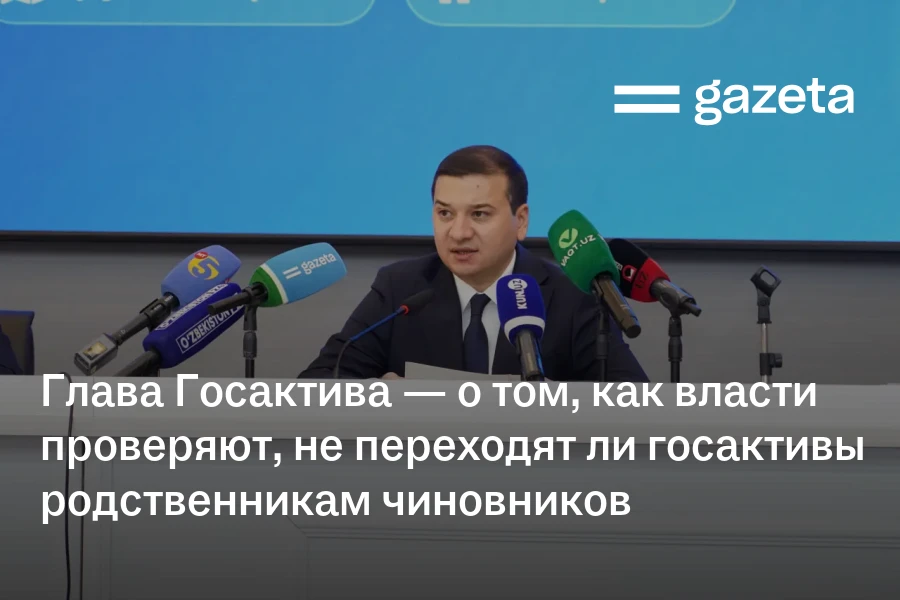
When Uzbekistan sells a major state enterprise, the agency responsible for government assets does not itself vet whether bidders are connected to senior officials or their relatives — that task is contracted out to international consultants, typically one of the Big Four accounting firms. Sohibjon Murodov, head of the Agency for the Management of State Assets (AUGA), disclosed the arrangement at a press conference on 8 October, responding to a journalist’s question about how the state prevents privatised property from passing to the families of powerful officials.
“To prevent conflicts of interest in the sale of large assets, we in most cases engage international consultants,” Murodov said. “The State Assets Agency acts only as the client. Verification and the establishment of connections with interested parties is carried out not by the agency itself but by an international consultant on a contractual basis.” He said those consultants are expected to determine whether tenders are genuinely competitive and whether any circumstances could lead to an unlawful sale because of a conflict of interest.
What the checks cover — and what they do not
For sales conducted through the electronic auction platform E-auksion, a degree of automated screening already exists. A presidential decree — Resolution PP-3149, signed on 27 July 2017 — bars employees of certain state bodies, and valuers who assessed the property being sold, from participating in electronic auctions of assets under enforcement proceedings. Murodov said the platform cross-checks participants automatically against state information databases. For individual asset sales, the system also verifies whether a bidder is employed by the organisation whose property is on the block, drawing on the labour-relations information system.
The 2017 decree, however, governs enforcement-related asset sales rather than full privatisation, which operates under separate legislation. A Law on the Privatisation of State Property, enacted in 2024, requires procedures to be conducted on principles of openness, equal competition and anti-corruption.
For larger transactions, AUGA has required bidders to disclose ultimate beneficial owners. When the agricultural insurer Uzagrosugurta was privatised in 2025, prospective buyers had to identify shareholders holding more than five percent and the ultimate owners of their companies. Candidates were also assessed on financial capacity, litigation history, anti-money-laundering compliance and international sanctions exposure. Deloitte served as financial adviser on that deal; PwC acted as independent valuer. For the sale of mobile operator MobiUz, the agency retained Rothschild & Co, KPMG and Deloitte to run the international tender, value the business and evaluate investor proposals.
A legal framework with visible gaps
Uzbekistan has had a Law on Conflicts of Interest in force since December 2024. It defines a conflict of interest as a situation in which a civil servant’s personal stake influences, or could influence, the proper discharge of official duties, and envisages detection through data on close relatives, ultimate beneficial owners, employment records and other state registries. Murodov noted that the constitution guarantees every person the right to property, meaning that a family connection to a state official does not in itself bar someone from buying assets — what matters is whether a conflict of interest exists and whether interested parties could sway the outcome of a tender.
Yet the internal conflict-of-interest controls that law imposes on state bodies are not the same mechanism as the due-diligence checks that external consultants perform on prospective investors. Murodov’s answers left several practical questions unresolved: precisely what information consultants receive to trace buyers’ links to officials, whether the checks extend to every participant in a major privatisation rather than only shortlisted bidders, and how many candidates have been disqualified as a result. The published terms of past transactions do not make the methodology clear.