



Listen to the article
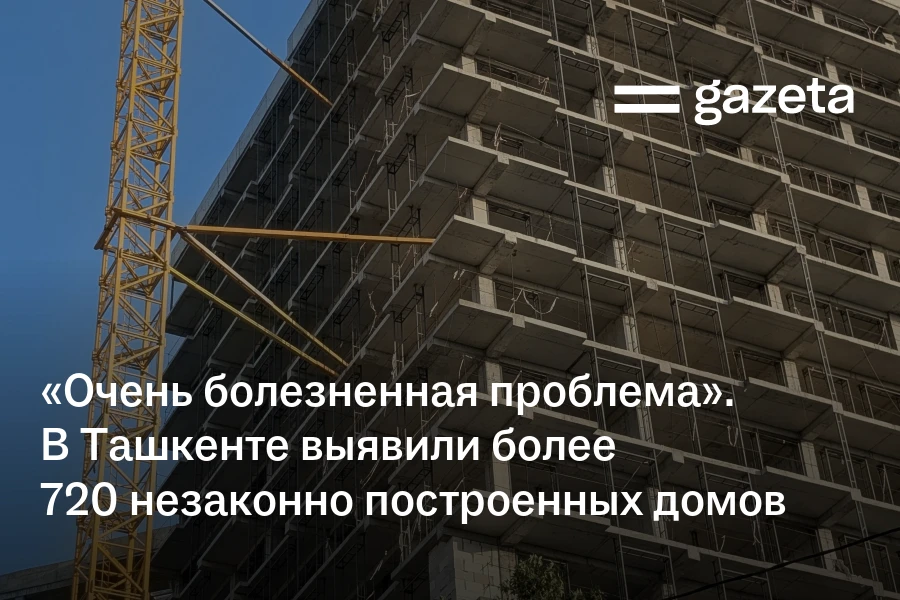
More than 720 multi-storey residential buildings in Tashkent were erected without the permits required from architectural authorities, Construction and Housing Minister Sherzod Khidoyatov told a parliamentary government hour session at the Legislative Chamber of the Oliy Majlis on 13 October. The figure, drawn from a nationwide inventory his ministry has completed, underscores the scale of a problem that accumulated over years before the capital’s general development plan was finally approved at the end of 2024.
“Many entrepreneurs built residential buildings on plots put up at auction before the general plan was approved,” Khidoyatov told deputies. “Today this has become a very painful problem. In Tashkent alone there are more than 720 such multi-storey buildings — problem structures erected without architectural permits.” The General Prosecutor’s Office is now handling those cases.
A City Built Ahead of Its Own Rules
The minister’s admission points to a structural failure in how Tashkent managed its construction boom: land parcels were auctioned and developed while the city still lacked an approved master plan to govern what could be built on them. The general plan, now digitised and publicly accessible, divides the city into conservation, renovation and reconstruction zones — a framework that did not exist when many of the flagged buildings went up.
Deputy Dilmurod Ismoilov raised the practical consequences for residents: shortages of children’s playgrounds, sports facilities and car-parking spaces around apartment blocks, with some districts now so densely built that no land remains for the infrastructure that should have accompanied the housing. He also noted cases in which developers failed to deliver the amenity spaces their own project documentation had promised.
Khidoyatov said the 720-plus buildings will not simply be regularised. Each will be assessed against urban planning norms for the number of playgrounds and parking spaces it requires, and commissioning — formal acceptance into operation — will only be possible once those conditions are met. Structural integrity is also at stake: the minister said every building will undergo instrumental examination to verify its load-bearing safety, a significant undertaking given Tashkent’s seismic exposure.
Tougher Laws and Digital Gatekeeping
Parliament moved to close the legal gap on 28 September, passing a law that sharply increases penalties for unauthorised multi-storey construction. A developer who repeats an offence after an administrative sanction faces three to five years in prison; if the violation results in a death or other grave consequences, the sentence rises to five to seven years. The law takes effect three months after official publication.
On the preventive side, the ministry has embedded artificial intelligence in its electronic project-review system. The system automatically rejects applications that do not include required parking, play areas, sports facilities and waste-container spaces. “If data are entered incorrectly or requirements are not met, the system automatically refuses to accept the application,” Khidoyatov said, adding that the system is already operational. He said the tightened controls and digitalisation of permit procedures have already stopped new cases of unauthorised construction.
A presidential decree has allocated 520 billion soums for the construction and repair of children’s playgrounds, pedestrian paths and related infrastructure — a recognition that the deficit of amenities is not confined to the unauthorised stock. The General Prosecutor’s Office launched a Telegram bot, @noqonuniy_qurilish_bot, in August to allow Tashkent residents to report suspected illegal construction directly.
Khidoyatov has previously urged prospective flat-buyers to verify that any building they are considering is registered in the Transparent Construction (Shaffof Qurilish) system, warning that registration is the clearest assurance of both legal status and seismic compliance. For the hundreds of thousands of people already living in the 720-plus unregistered towers, that advice comes too late — their buildings’ fate now rests with prosecutors, inspectors and a commissioning process whose timeline the minister did not specify.