


Listen to the article
Aleksandar Vučić, Serbia’s dominant political figure for more than a decade, conceded defeat late on Sunday to the student-led protest movement that had challenged his Serbian Progressive Party (SNS) in snap parliamentary elections, saying it was “clear” his party had lost even before final results were declared.
“We still do not have final results… it is clear that we have lost these elections,” Vučić said at SNS headquarters in Belgrade. The admission ended a political era in which he had served two terms as president and, before that, as prime minister — the post he had been seeking to reclaim by leading his party into Sunday’s vote.
Preliminary figures from Serbia’s election commission pointed to a record turnout, with 64.9 percent of voters having cast ballots by 18:00 local time, two hours before polls closed. Commentators had widely suggested that high participation would favour the opposition movement.
A movement born from tragedy
The elections were called after two years of sustained protests rooted in the November 2024 collapse of a canopy at a train station in Novi Sad, which killed 16 people. The disaster became a focal point for public anger over what demonstrators described as systemic corruption and state negligence. Vučić called the snap vote in response to that pressure.
The Student List, the electoral vehicle of the protest movement, fielded candidates drawn from across Serbian society — doctors, actors, academics and sports personalities — rather than career politicians. It campaigned on a platform that included removing officials who cracked down on protesters, ending the appointment of party loyalists to public enterprises, and freeing the state broadcaster from political influence.
The list’s lead candidate, Ilija Srdanović, told BBC Serbian: “This will be a free state.” He said the movement hoped to “free the country from tyranny.”
Celebrations in Belgrade and Novi Sad
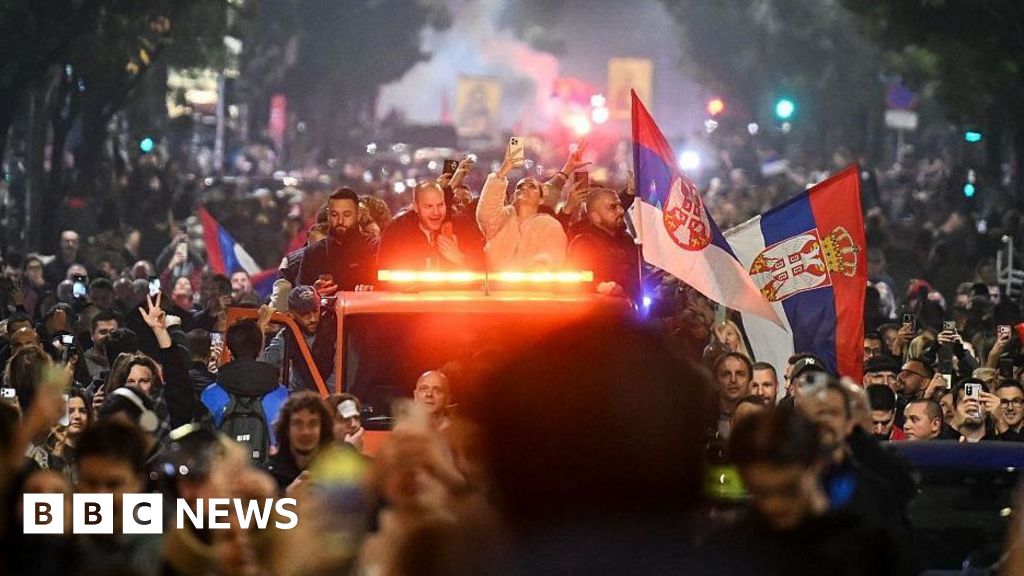
News of Vučić’s concession prompted immediate celebrations in Belgrade, with crowds dancing and chanting “victory,” cars honking and fireworks set off in the streets. “Serbia is free,” one student told the BBC. “It’s a miracle.” The centre of Novi Sad, the northern city where the protests began, was also crowded with people. “Everything is going to get better now,” said David Vasić, one of those gathered there, speaking to BBC Serbian.
Long queues had been reported at polling stations throughout the day, not only across Serbia but also at voting booths in Ljubljana, Munich, Paris, Los Angeles and Chicago, where sizeable Serbian communities turned out in numbers — some waiting in heavy rain in the French capital.
Vučić’s position and the SNS record
Having served the constitutional maximum of two presidential terms, Vučić had positioned himself to return to the prime ministership, a role he held from 2014 until 2017. The SNS and Vučić have consistently denied the corruption allegations that underpinned the protest movement’s campaign.
During the campaign Vučić pledged increases to pensions and public sector salaries and greater investment in state healthcare. He has backed Serbia’s European Union membership bid while declining to impose sanctions on Russia over its full-scale invasion of Ukraine.
The election was held under heightened security, with police sealing off streets around the Republic Electoral Commission building in Belgrade. Final official results had not been announced at the time of Vučić’s concession speech.