



Listen to the article
More than $760 million in outstanding Asian Development Bank loans is now directed at Karakalpakstan, the autonomous republic in Uzbekistan’s far west, representing a fifth of the ADB’s entire active lending portfolio in the country. The scale of that commitment was on display in mid-October when the bank organised a media tour for journalists to inspect projects under construction or recently completed across the region.
The ADB has worked with Uzbekistan since 1995, disbursing more than $15 billion over that period in loans, grants, guarantees and technical assistance. Karakalpakstan’s 20 percent share of the current portfolio is, by the bank’s own account, a deliberate choice. Kanokpan Lao Araya, director of the ADB’s Uzbekistan resident mission, told journalists at the opening event — held at Karakalpak State University named after Berdakh in Nukus — that the region’s exposure to climate change, its Soviet-era infrastructure deficit and its strategic position as a transit corridor into Central Asia all justify the concentration of resources.
“Karakalpakstan is an important gateway linking Uzbekistan with other regions. The area has suffered serious damage from climate change. Now is exactly the right time to fundamentally transform the region, invest in renewable energy and invest in young people,”
she said.
The republic is home to just over 2.16 million people — about 5.5 percent of Uzbekistan’s population — a figure projected to grow by 400,000 by 2050. Five ADB-financed projects are running exclusively within Karakalpakstan; a further seven national projects include a Karakalpakstan component.
Drinking water: closing a decades-old gap
The most immediate human impact visible on the tour was in drinking-water supply. A 2019 presidential decree authorised a $145 million ADB loan to bring centralised, treated water to residents and enterprises across six districts — Amudarya, Beruniy, Qorauzak, Qo’ng’irot, Nukus and Mo’ynoq — with a target of 326,000 permanent beneficiaries by 2026.
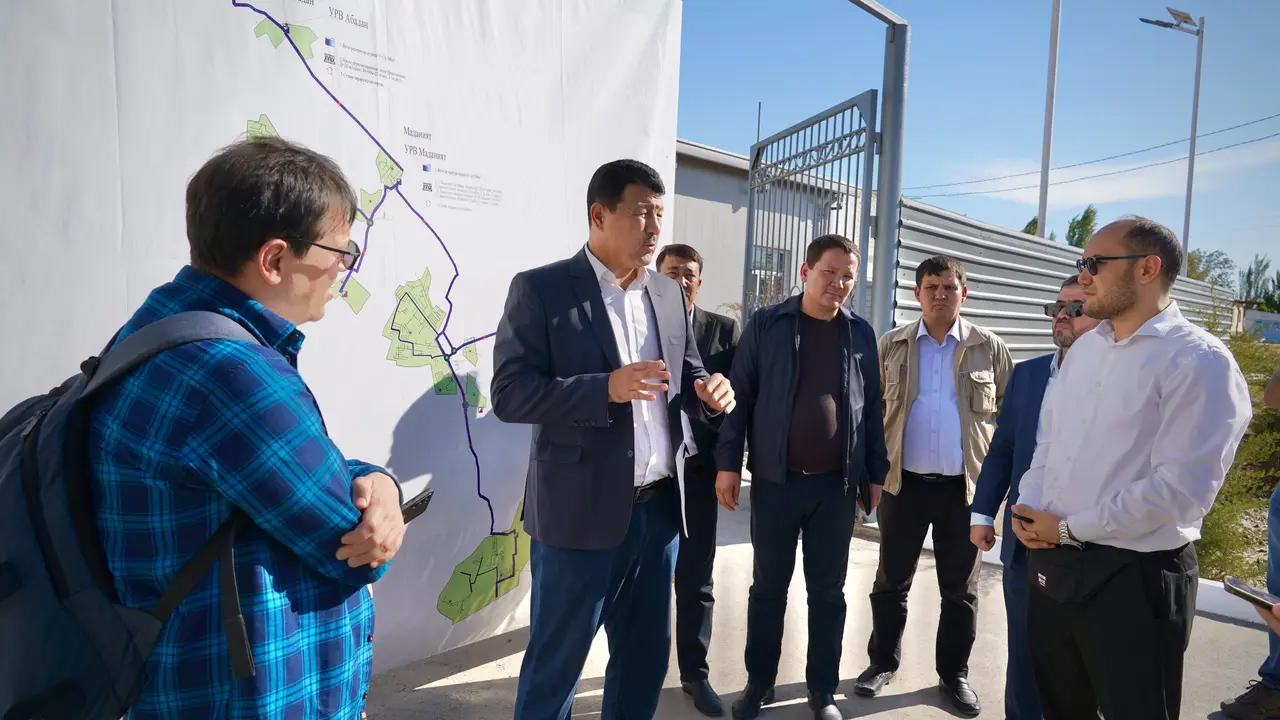
In Nukus district, a $11.4 million project has already delivered results: three water-distribution facilities — Madaniyat, Abadan and Kerder — were reconstructed and roughly 263 kilometres of new pipework laid. Coverage in the district rose from 68.4 percent to 89.7 percent, and 31,100 residents across 35 settlements received centralised drinking water for the first time. Residents described years of hauling water by cart or on foot over several kilometres from artesian wells; they now have household connections.
In Amudarya district, where 220,000 people live but only half had access to the central network, two larger projects are under way. A $13 million ADB-financed treatment plant — the Manghit Water Treatment Facility — has been completed. It draws turbid water from the Amu Darya river, passes it through settling tanks and filtration systems, and can process up to 40,000 cubic metres a day, enough to supply 200,000 people. A second, $29 million project to lay 260 kilometres of distribution pipes connecting the plant to households is 95 percent complete and expected to finish before the end of 2026. Once operational, the combined system will raise district coverage from 50 percent to 82 percent, with 70,000 people gaining piped water for the first time. An older facility currently serving 110,000 residents will be decommissioned and its users transferred to the new network.
Jamolidddin Sagatkaliyev, deputy director of the Karakalpak Water Supply joint-stock company, said centralised drinking-water coverage across Karakalpakstan as a whole currently stands at 75.1 percent.
ADB experts on the tour noted that the region inherited Soviet-era canal infrastructure built almost entirely around cotton irrigation. That network has deteriorated to the point where water losses are severe, and experts warned that water scarcity in Karakalpakstan is expected to worsen — making canal rehabilitation a priority alongside the drinking-water work.
Roads and renewable energy
The tour also covered a $48.7 million road project: the reconstruction of a 25-kilometre, four-lane section of highway running through Khojeli, Beruniy and Qorauzak districts. Work began in 2024 and is expected to conclude this year. The upgraded road, built to international standards with 27-centimetre concrete surfacing over an 18-centimetre base layer, raises the design speed from 60 km/h to 120 km/h. The stretch is part of the Andijan–Karakalpakstan corridor, which spans roughly 1,850 kilometres; 240 kilometres of that route have already been reconstructed. One local entrepreneur told journalists that journeys which once took 12 to 14 hours — at times barely 10 km/h on potholed roads — now take three to four hours, and that the route is used to export goods to Turkey, Belarus, Russia, Kazakhstan and Tajikistan. About 300 workers are employed on the current 25-kilometre section.
The final stop on the tour was the Nukus-2 wind power plant in Qorauzak district, being developed by Saudi Arabia’s ACWA Power. The facility comprises 26 turbines, each capable of generating 8 megawatts, making them — according to project chief executive Sardorbek Mahmudov — the tallest and largest wind turbines currently operating in Central Asia, with tower heights of 138 metres and blades reaching 170 metres above ground. A 44-kilometre transmission line connects the plant to the Beruniy substation of the national grid operator Uzbekistan National Electric Networks. Total installed capacity is 200 megawatts, supplemented by a 100-megawatt battery storage system currently being commissioned. The total project cost is $258.9 million, of which more than $51 million comes from ADB loans. Mahmudov said full operation would allow the plant to supply 300,000 households simultaneously.
The infrastructure gap in education was also raised during the tour, if not yet matched by a specific project announcement. Karakalpak State University named after Berdakh, which hosted the opening event, was designed for 5,000 students but currently enrols 28,000, running four shifts with classes continuing until 9 p.m. The university’s rector acknowledged the mismatch, and ADB analysts cited the need for new educational facilities and improved healthcare as priorities alongside physical infrastructure.