



Listen to the article
Estonia will close its road border crossings with Russia on December 1, a decision the government attributed to national security concerns following an attempted sabotage attack on an Estonian drone manufacturer that Tallinn blamed on Russian military intelligence. The restrictions will be reviewed after six months. Rail freight through Narva will continue under existing sanctions, though Estonian Prime Minister Kristen Michal said on November 24 that closing the railway crossing could be the next step.
The closure will directly affect an estimated 2,000 freight journeys a year by carriers from Kazakhstan, Kyrgyzstan, Uzbekistan, Azerbaijan, Armenia, and Georgia. Estonian authorities noted that roughly 80 percent of those journeys involve goods in transit through Estonia rather than cargo destined for the country itself. According to Ermo Perolainen, secretary general of the Estonian Association of International Road Carriers, fewer than ten trucks a day have recently passed through the Luhamaa and Koidula crossings, and of the approximately 500 Estonian companies that operated on Russian routes before 2022, fewer than 50 remain active in that market.
Latvia is moving toward a similar step. On November 23, Prime Minister Andris Kūlbergs instructed the ministries of foreign affairs and transport to prepare proposals for closing Latvia’s land border with Russia. Two days later, however, Kūlbergs criticised Estonia for acting without coordination and said a decision on next steps was planned for November 26. Guntis Pujāts, head of Latvia’s State Border Guard, warned that redirected traffic would lengthen queues and place additional pressure on Latvian border personnel.
Demand Falling, Costs Rising
The border decisions compound difficulties that Central Asian carriers were already experiencing. During the first nine months of 2026, requests for international road freight originating in Kazakhstan on the ATI.SU logistics platform fell by 34 percent, while average freight rates for deliveries into the country rose by 18 percent. Renata Zobova, director of ATI.SU’s Kazakhstan office, attributes the decline to tighter customs controls, border queues, stricter regulatory requirements, and Russia’s fuel crisis. She also points to Russia’s SPOT system, which requires importers to declare shipments in advance and, where applicable, make security deposits against tax liabilities.
In Kyrgyzstan, ATI.SU recorded a 29 percent decline in requests for road freight services to Russia in the third quarter of 2026, while requests in the opposite direction fell by 69 percent. Emirlan Beyilbayev, director of ATI.SU’s Kyrgyzstan office, cites changes in import regulations, security deposits, and expanded use of electronic tracking seals as the main drivers.
Lithuania’s recent experience offers a cautionary parallel. In the autumn of 2025, approximately 2,000 Lithuanian trucks were stranded in Belarus after Minsk blocked their departure in retaliation for Lithuanian border restrictions. According to Povilas Drižas, secretary general of Lithuania’s International Transport and Logistics Alliance, companies lost customers in Central Asia and China while their vehicles were immobilised, with storage costs averaging around $6,500 per detained truck. Polish and Latvian carriers moved in to fill the gap.
Rail Corridor Also Under Pressure
Rail freight along the northern corridor has faced separate disruptions. In October, Russian Railways twice restricted freight deliveries to and through Belarus. From October 28 to November 3, the restrictions applied to most freight from all five Central Asian countries, Azerbaijan, Armenia, and Georgia passing through two key railway border crossings, though they did not apply to freight originating in Russia or China.
Baltic ports, having lost substantial Russian and Belarusian transit volumes since 2022, have been seeking to attract Central Asian freight. The shared 1,520-millimetre railway gauge allows Kazakh grain and coal to reach Riga, Ventspils, Liepāja, and Estonia’s Muuga port without changing wheelsets. Arthur Raichmann, commercial director of Estonian Railways, said inbound rail freight volumes have fallen from more than 10 million metric tons annually before the war in Ukraine to approximately 200,000 tons in 2026. Most recent requests to transport Kazakh grain through Estonian ports have not been approved, with limited capacity on Russia’s railway network cited as the reason.
Transit shipments of Kazakh coal through Russia increased by 20 percent between January and July 2026, reaching 7.8 million metric tons, according to commodity intelligence agency Argus. Of that volume, 4.7 million tons passed through Russia’s Baltic port of Ust-Luga and 2.6 million tons through the Black Sea terminal at Taman. Following the suspension of loading operations at Taman in early August, pressure on Baltic routes intensified. For October and November, Russian Railways did not approve a single request for the transit of Kazakh coal to Baltic ports.
The Middle Corridor Grows but Remains Constrained
Uzbekistan has been gradually redirecting European freight across the Caspian Sea. The Middle Corridor’s share of Uzbekistan’s freight traffic with EU countries rose from 12 percent in 2021 to 28 percent in 2025. During the first ten months of 2026, container shipments along the route reached 57,300 twenty-foot equivalent units, up 64 percent year on year. Kazakhstan aims to increase annual volumes to 300,000 TEUs by 2029.
Capacity constraints, however, remain significant. An OECD study found that Kazakhstan’s national railway operator, Kazakhstan Temir Zholy, raised freight tariffs ten times between January 2023 and May 2025, with charges for access to the main network rising by 130 percent and locomotive traction costs by 70 percent. Businesses surveyed reported congestion at railway hubs, repeated truck inspections, informal payments, and difficulty planning long-term transport costs.
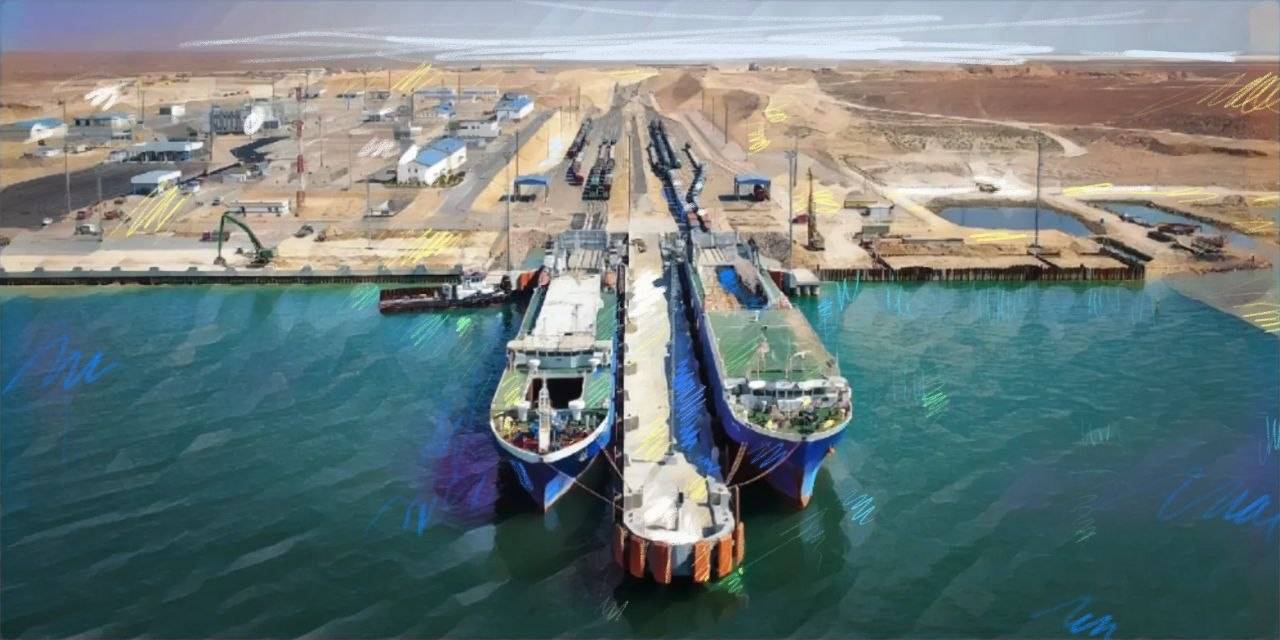
Falling Caspian Sea levels add a physical constraint. Alakbar Azizli, a representative of the Azerbaijan Caspian Shipping Company, told an OSCE meeting in Vienna in November that declining water levels mean one of the company’s ferries can operate at only 80 percent of its cargo-carrying capacity when transporting freight from Kazakhstan. Yerzhan Medeuov of the Aktau International Sea Commercial Port called for port infrastructure to be adapted to climate change. Kazakhstan’s Ministry of Transport representative Gulshat Daueshova announced plans to increase terminal capacity by more than 30 percent by 2028.
The World Bank estimates that at least $25 billion will be needed to modernise the Middle Corridor’s transport infrastructure through 2040, with a further $30.5 billion required for supporting facilities. In February 2026, the World Bank approved an $846 million guarantee for a railway project in Kazakhstan, with an additional $564 million in guarantees expected from the Asian Infrastructure Investment Bank.
For bulk commodities such as coal and grain, where transportation costs largely determine competitiveness in European markets, alternative corridors do not yet eliminate dependence on Russian infrastructure. Delays also persist within Central Asia itself: in November, approximately 990 trucks were backed up at the Konysbayev crossing on the Kazakhstan-Uzbekistan border, with drivers reporting waits of several days.