


Listen to the article
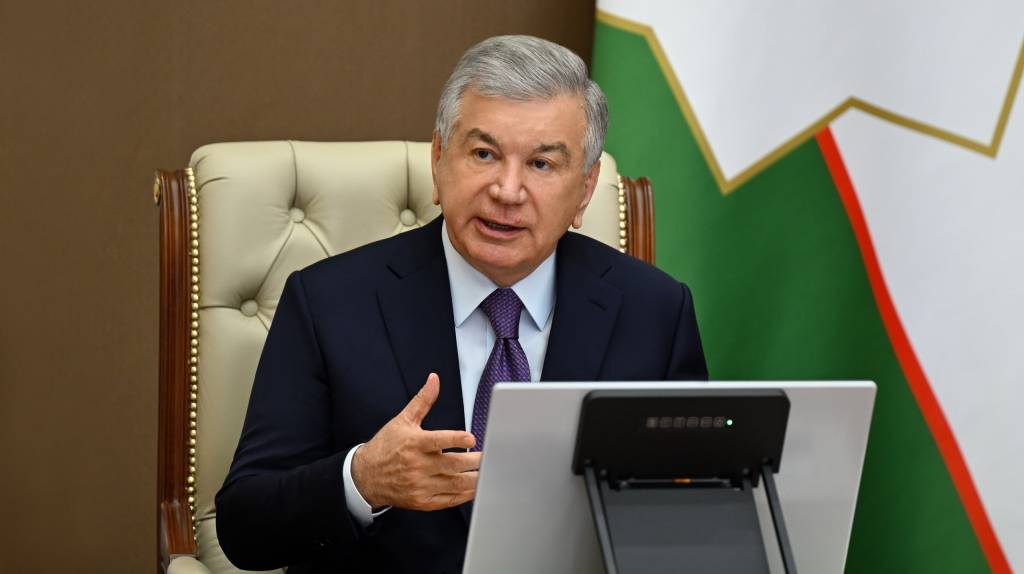
President Shavkat Mirziyoyev has reviewed a comprehensive programme to restructure Uzbekistan’s livestock feed base, with proposals to raise annual feed production from 48 million tonnes today to 64.5 million tonnes by 2027 and 90 million tonnes by 2030, according to a presentation examined at a government briefing on Tuesday.
The case for urgency rests on a widening gap between supply and need. Uzbekistan currently keeps 12.5 million head of cattle, 23 million sheep and goats, and 125 million poultry. Each head of cattle requires 6.5 tonnes of feed per year; in practice, the figure does not exceed four tonnes. Feed costs already account for 30 percent of meat production expenses, and demand for meat and dairy is rising as the population grows, incomes increase and tourism expands.
Land and yields
At least 20 percent of the roughly 480,000 hectares allocated to livestock farming is being used ineffectively, the presentation found. Fodder crop yields are to be pushed from 350 centners per hectare to 500 centners through repeat cropping, high-yield varieties and modern agrotechnology. An additional 200,000 hectares of land is to be brought back into productive use by 2030, with 50,000 hectares targeted in the coming year alone.
Pasture productivity will receive separate attention. In eight districts of Qashqadaryo region, drought- and salinity-resistant fodder crops are to be introduced in cooperation with foreign specialists. Across the country, one million hectares of pasture are to be seeded by drone by 2030. Satellite monitoring will be used to verify that land designated for livestock is actually used for that purpose, and a digital registry of fodder crop areas and varieties will be established by region.
Feed centres and the household sector
A vertically integrated supply chain is proposed, running from production through processing, storage, stockpiling and delivery. More than 100 feed centres and branches are to be established across the regions, tasked with bulk purchasing, processing, maintaining adequate reserves and ensuring continuous market supply.
The system is described as particularly important for household farms, which account for 87 percent of the country’s cattle herd. A pilot scheme in Qashqadaryo from 2027 would subsidise 10 percent of feed purchase costs for household livestock keepers.
Financial incentives
The presentation outlined several new support mechanisms for entrepreneurs. Those who develop more than 500 hectares for fodder crops and install modern irrigation would be eligible for reservoirs of up to 100,000 cubic metres, funded from local budgets. Subsidies for pivot irrigation technology would rise from 2.5 million soums per hectare to 4 million soums. Entrepreneurs irrigating at least 10 hectares using renewable energy sources could have up to 50 percent of equipment costs covered.
In Karakalpakstan and the regions of Navoiy, Bukhara, Qashqadaryo and Khorazm, entrepreneurs developing pastureland would be permitted to build livestock complexes on part of those areas. Concessional loans for establishing feed centres and growing fodder crops, additional benefits for purchasing modern agricultural machinery, and partial reimbursement of costs for bringing in foreign specialists and training local staff are also envisaged.
Seeds and breeding
Ninety-five percent of fodder seed demand is currently met through imports. The presentation proposed establishing research and seed centres in Qashqadaryo in partnership with Egyptian scientists, with the goal of developing locally adapted, high-yield, drought- and salinity-tolerant varieties and progressively reducing seed imports.
On livestock genetics, the programme calls for wider use of artificial insemination and high-genetic-value embryo transfer, development of breeding services at the regional level, and cooperative arrangements between large farms and household producers.
If the measures are implemented as proposed, the presentation projected that cattle slaughter weights would rise from the current range of 250–350 kilograms to 450–550 kilograms, and that an additional 400,000 tonnes of meat per year could be produced.
Mirziyoyev told officials that sustainable growth in the livestock sector requires, above all, a solid feed base, rational use of land and water, and improved production efficiency grounded in science and modern technology. Responsible ministries were instructed to refine the proposals, define precise financing mechanisms, develop targeted regional projects and ensure price stability for meat and dairy products on the domestic market.