



Listen to the article
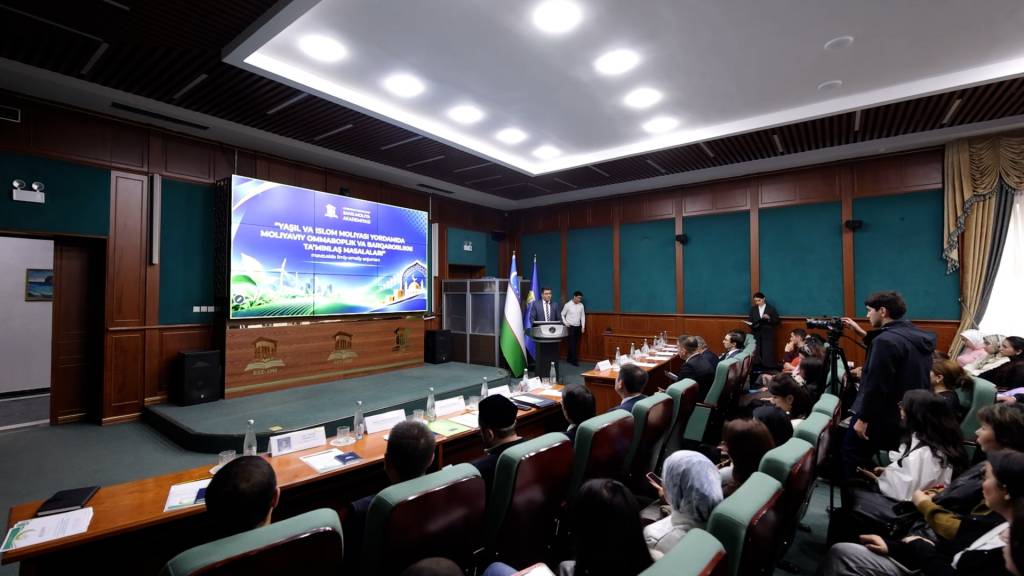
Academics, government officials and financial institution representatives gathered at Uzbekistan’s Banking and Finance Academy for a national scientific-practical conference focused on two emerging priorities: the development of Islamic finance and the transition to a green economy.
Vice-Rector Mashkhurbek Jalalov told participants that, according to Islamic Financial Services Board data for 2025, global Islamic finance assets have reached $4.4 trillion, representing growth of more than 13 per cent. He argued that expanding Islamic banking inside Uzbekistan was essential to bringing a broader share of the population into formal financial services. “Today we studied foreign experience and analysed it together with finance scholars,” Jalalov said, adding that practical recommendations on all issues raised would be produced by the close of the conference.
Speakers devoted particular attention to the institutional architecture required for Islamic finance to function within Uzbekistan’s existing regulatory framework. Discussions covered a two-tier Sharia governance model, the role of the Islamic Finance Council operating under the Central Bank, and the mechanisms needed to ensure compliance with Sharia principles across financial activities. Participants also examined prospects for applying those principles in digital environments and integrating them with emerging financial technologies.
Green finance formed the second major strand of the conference. Sessions examined how carbon trading mechanisms could be used to channel funding into environmentally oriented projects, how to assess the investment attractiveness of innovative initiatives, and how ecological solutions might be introduced more effectively in the oil and gas sector.
The conference also addressed financial inclusion more broadly. Delegates discussed ways to increase retail investor participation in the securities market, strengthen the role of insurance companies as institutional investors, and improve corporate governance in joint-stock companies. Digital transformation’s effect on investment attractiveness, the use of modern technology to raise industrial competitiveness, and the digitalisation of the tourism sector were also on the agenda.
Social dimensions of finance were not overlooked. The potential of social insurance systems to reduce poverty and measures to encourage entrepreneurs to participate in public procurement were both raised during the sessions.
Organisers described the event’s significance as lying in its combination of academic analysis with the practical needs of the sector, creating a platform for specialists to exchange experience across the boundary between theory and applied finance.